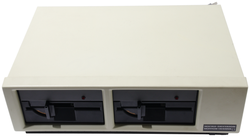
Morrow Designs
~ the obituary ~
Morrow Designs filed for bankruptcy on 11 March 1986, ten years after George Morrow started selling computer parts out of Berkeley under the name Thinker Toys. CBS made him drop that one on the grounds that it sat too close to Tinker Toys, so the business restarted under his own surname. He had left high school without finishing and gone back at 28 for a physics degree at Stanford, then drifted into the Berkeley computer lab while chasing a mathematics doctorate he never completed.
Everything I have on this company is documents. A bankruptcy date and a June 1982 InfoWorld story announcing the machine, with prices in it that were news at the time. There is also a Computer Chronicles episode from October 1985 with Morrow himself on camera, which is the closest anyone gets now. The company was gone before I turned three.
What he sold first was S-100 bus hardware for machines like the Altair, beginning with an Intel 8080 board that hobbyists disliked because it used an octal keypad instead of the switches they were used to. The floppy package was the hit. An 8 inch external drive with a controller card, plus CP/M in the box, which turned a machine you had soldered into something that could keep records. Two of the engineers he worked alongside in that period left over disagreements and went off to found North Star Computers.
The Micro Decision arrived in late 1982 and was the whole company after that. A single-drive 200 kilobyte Z80 system with a terminal sold for under two thousand dollars at a time when a comparable business machine cost roughly twice that, and the Whole Earth Software Catalog summed the line up as respectable machines with "no sex appeal". They were built to take the market for the IBM Displaywriter and they were priced to take it from underneath.
~ the case file ~
| Born | 1976, as Thinker Toys, renamed after CBS objected to the resemblance to Tinker Toys |
|---|---|
| Peak | the Micro Decision line, a complete CP/M desktop under $2,000 in 1982 |
| Killed | 11 March 1986 |
| Lifespan | 10 years |
| Made by | George Morrow, of the Homebrew Computer Club |
| Killed by | MS-DOS, and a license that armed Zenith Data Systems |
~ the micro decision ~
The hardware was plain on purpose. A Z80A on a single board, with one or two three-quarter-height floppy drives holding about 200 kilobytes unformatted each. The floppy controller was built around the NEC uPD765 that the IBM PC used, rather than the Western Digital part most CP/M builders reached for. Console duty went to a Lear Siegler ADM-20 terminal, later a Liberty 50.
Some of the cost-cutting showed. The baud rate DIP switches sat inside the case, so changing the printer speed meant taking the cover off. A design flaw in the serial circuitry meant the ports could not actually run at the 19,200 the UART advertised and capped at 9,600. Every ROM revision but the last carried a bug that made the fourth floppy drive unreachable. The final machine in the line, the MD-11, came with 128 KB of memory and CP/M 3.0, and would take a 10 MB hard disk.
~ the deal that armed zenith ~
In 1984 Morrow shipped its first IBM compatible, the Pivot, a lunchbox portable where neither the keyboard nor the screen folded away from the case. An outside manufacturer built it, and Morrow licensed the same design to Zenith Data Systems, which sold it as the Z-171.
Zenith had the bigger name and the lower price, and then it won an extremely profitable contract to supply computers to the United States government. The president of Morrow Designs had by then left to work at Zenith. The machine Morrow designed went on to earn a fortune for the company that licensed it, while the company that designed it ran out of money inside two years.
~ after the bankruptcy ~
Morrow was already a familiar face by then. He co-hosted Computer Chronicles on public television, appearing in more than forty episodes between 1985 and 1995, explaining computers to an audience that mostly did not own one yet.
He spent the rest of his life on 78 rpm records. He collected something like 70,000 of them, mostly jazz and dance music from the 1920s and 1930s, and built himself a computer system to transcribe and clean up the audio, reissuing the results on his own Old Masters label. He died at home in San Mateo on 7 May 2003, of aplastic anemia, aged 69.
~ leave a rose ~
an anonymous tribute. one rose per visitor per day.
@}-->-- ... roses left here
~ leave a wreath ~
a rose fades by morning. a wreath stays on this grave for good, with your name on it.
from $1, paid once through stripe. it keeps the graveyard running: the hosting and the nightly digging. adopt it and the headstone reads "maintained in memory by" you. the groundskeeper plants new wreaths at the next tending, usually within a day.
» one email a week: new graves and the anniversaries of the dead. subscribe
other gadgets: Logitech Harmony, Fitbit Sense, Project Ara, ASUS Eee PC
also died in the 1980s: Trilogy Systems, British Leyland, Confravision
~ leave a note ~
visitors before you have left these graveside notes. anonymous welcome.