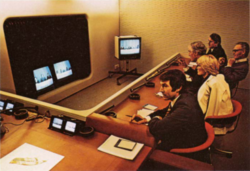
Confravision
~ the last words ~
A video call used to be a reservation. You rang the Post Office or sent a telex and asked for a slot in a studio. On the day itself you traveled to a building in the middle of your own city and sat down in a room with four colleagues and a camera. The people you were talking to did the same thing in Glasgow. Nobody in either room owned any of the equipment or knew how any of it worked.
Confravision opened in 1971, run by Post Office Telecommunications, which is what the British state telephone operator was called before BT existed as a name. It came out of microwave link experiments between the Post Office headquarters on Gresham Street and the research station at Dollis Hill, and there had been a public demonstration of the experimental version as early as 1967.
By 1972 the service joined five cities, with two studios in London and one each in Birmingham, Bristol, Manchester and Glasgow. Every room seated five people, each with a microphone in front of them, and up to three rooms could be connected at a time. The interiors were designed by Kenneth Grange, which reads like trivia until you notice what it means: somebody was paid to think about how it feels to be photographed while working.
There is no version of this that reaches Turkey, and that is not a distribution failure, it is what the product was. Confravision was six rooms, and the map of who could use it was the map of where the Post Office had built one. It could not be exported or installed by a customer, because the thing being sold was real estate and microwave towers. By the time a video call was something i could make it was a webcam sitting on a monitor and it cost nothing, which is a different object wearing the same name.
~ the record ~
| Born | 1971, post office telecommunications |
|---|---|
| Peak | the mid 1970s, six studios plus two mobile ones |
| Killed | some time after 1986, with no notice anybody kept |
| Lifespan | fifteen years on the record, probably longer |
| Made by | post office telecommunications, later bt |
| Killed by | video compression, which moved the studio into the customer's own building |
~ six rooms ~
The addresses are worth writing down, because the addresses are the service. Euston Tower and Gresham Street in London, Telephone House in Birmingham, Clifton Heights in Bristol, India House in Glasgow, Bridgewater House in Manchester. Two mobile studios came later, which is the closest the system ever got to going to a customer rather than the other way around.
Billing ran by the half hour and by distance. A two-way call over up to two hundred kilometers cost seventy-five pounds for thirty minutes, which was serious money at the time, and the arithmetic that justified it was the train fare plus the working day nobody lost. Pictures were monochrome and traveled over microwave links. Where a route had no separate audio path the sound was carried digitally inside the video signal itself, using a Post Office technique called sound-in-syncs.
Experimental links to Sweden and the Netherlands opened in 1975. There were also tests across the Atlantic against AT&T's Picturephone, running at 1.544 Mbit/s over a T-carrier circuit on the TAT-6 submarine cable, which is a sentence describing an enormous quantity of infrastructure spent on letting five people see five other people.
~ where the record stops ~
An engineering journal has the system in use in 1982. BT's own internal directory still lists a Confravision department in 1986. After that there is nothing at all, no closure notice and no final booking, which is normal for a line item inside a nationalized telephone monopoly that then became a privatized one. Somebody stopped taking reservations and nobody wrote it down.
What ended it was not a competitor, it was compression. Once a codec could get a moving picture down to a couple of megabits, the studio no longer had to be a building the Post Office owned. It became a cabinet a company could rent and wheel into its own meeting room, which is the business PictureTel and the rest of that generation were built on. Confravision's successor was not another service. It was the same idea moved indoors, and then moved again onto whatever screen happened to be in front of you.
~ leave a rose ~
an anonymous tribute. one rose per visitor per day.
@}-->-- ... roses left here
~ leave a wreath ~
a rose fades by morning. a wreath stays on this grave for good, with your name on it.
from $1, paid once through stripe. it keeps the graveyard running: the hosting and the nightly digging. adopt it and the headstone reads "maintained in memory by" you. the groundskeeper plants new wreaths at the next tending, usually within a day.
» one email a week: new graves and the anniversaries of the dead. subscribe
other connectivity: Teledesic, Quam, Avea, Thrunet
also died in the 1980s: Informatics General, Coleco Industries, British Leyland
~ leave a note ~
visitors before you have left these graveside notes. anonymous welcome.