Planet Stories
~ the obituary ~
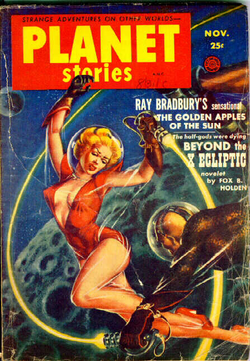
Fiction House had been publishing adventure pulps since 1921 and ran a comics line on the side, and at the end of 1939 it decided to add a science fiction title through a subsidiary named, with no apparent sense of irony, Love Romances Publishing. The first Planet Stories was cover-dated Winter 1939: pulp size, 128 pages, twenty cents, with the line "Strange Adventures on Other Worlds" running across the top. It stayed pulp size for all seventy-one issues, and that format is precisely what finished it off in 1955.
The editorial policy was narrow on purpose. Planetary romance, which meant swords and ray guns on Mars or Venus, told at speed. The titles are the clearest statement of intent anyone could ask for: "Beneath the Red World's Crust," "Black Priestess of Varda," "Valkyrie from the Void," "The Beast-Jewel of Mars." Allen Anderson painted most of the early covers and Frank Kelly Freas did many of the later ones, and Alexander Leydenfrost did interiors that one historian called almost Rembrandtian in their handling of light. That verdict lands oddly on a magazine whose cover women wore transparent spacesuits while the men got functional ones. Harry Harrison's name for that arrangement was sexual dimorphism in space.
It paid one to two cents a word, substantially under what the respectable magazines paid, and it got what that buys: a stable of writers who were either very young or working at the top of a form nobody was giving prizes for. Malcolm Reiss edited the first eleven issues himself and then stayed on as managing editor for the other sixty, whoever's name was on the masthead, so the thing kept one continuous sensibility from 1939 to 1955. Jack O'Sullivan had the chair at the end.
~ the case file ~
| Born | cover-dated Winter 1939, 128 pages for twenty cents |
|---|---|
| Peak | the Eric John Stark novellas, all three of them cover stories, 1949 to 1951 |
| Killed | Summer 1955, volume 6 number 11, the 71st issue |
| Lifespan | 15 years, 71 issues, 17 of them carrying a Leigh Brackett story |
| Made by | Fiction House, through its Love Romances subsidiary |
| Killed by | distributors who would no longer carry a pulp-format magazine |
~ the vizigraph ~
The letters column was called the Vizigraph and it was the loudest part of the magazine. Readers voted on which letters they liked best. Working writers wrote in alongside the fans, which meant professionals and teenagers argued at the same length in the same column, and the editors answered in the same register rather than from above. Damon Knight's letters there are still described as legendary. Robert Silverberg used his space in the Summer 1950 issue to say that Ray Bradbury certainly gets some original ideas, if not good ones.
The best-documented brawler is Isaac Asimov, who spent three years feuding with the magazine for printing his name as Isaac Asenion. "I will punch the next guy who calls me Asenion right in the kisser," he wrote, and later, "My name is Asimov, and not Asenion, curse you all!" He also asked readers to stop wasting votes on his letters, disqualifying himself as a professional, and called it one of the best letter columns in science fiction. Across a great many comment sections since, I have never seen a house let itself be the joke that willingly. The mechanism that made it work is just the slowness: a reply took a quarter of a year to reach print.
~ brackett's seventeen ~
Leigh Brackett published seventeen stories in Planet Stories, starting Winter 1940, and became the thing the magazine was actually for. All three Eric John Stark novellas ran there and all three took the cover: "Queen of the Martian Catacombs" in Summer 1949, "Enchantress of Venus" that fall, "Black Amazon of Mars" in March 1951. Two of them were later expanded into an Ace Double. Her description of her own heroines was that they ran to the bitchy side, warm-blooded and hot-tempered but gutty and intelligent, and she meant all of that as praise.
During the war years this was the magazine where a reader was most likely to run into a woman who could fight rather than one being fought over, which sits oddly against those covers and is true anyway. In Summer 1946 she and Bradbury wrote "Lorelei of the Red Mist" together off an idea of hers. One reader wrote in to say he had needed a pint of Listerine to wash the taste out of his mouth. Philip K. Dick's first published story, "Beyond Lies the Wub," ran in the issue of July 1952. Asimov's single appearance was a story Reiss retitled "Black Friar of the Flame," widely considered the worst thing he ever wrote.
~ the second death ~
The last issue is cover-dated Summer 1955, volume 6 number 11, ninety-six pages, and the spine says 6/12 because somebody misread the masthead. Nothing dramatic happened to it. Distributors had stopped wanting pulp-format magazines, readers were moving to digests and paperbacks, and by the end of 1955 almost every surviving pulp had either folded or shrunk to digest size. Fiction House went with it. The American News Company, usually blamed for this, did not collapse until June 1957, two years too late to have done it.
The name came back once. Paizo Publishing launched a Planet Stories book imprint in August 2007, reprinting exactly the kind of planetary romance the pulp had run, with Erik Mona behind it. On 10 February 2012 Mona announced that Robert Silverberg's The Chalice of Death would be the last volume for the foreseeable future and closed new subscriptions, calling it a hiatus rather than a cancellation. Paizo's own help pages now describe the line as not currently active, and the address paizo.com/planetstories redirects into the company archive.
So there are two graves here, fifty-seven years apart, and the second one was dug by people who were deliberately trying to keep the first one open.
~ leave a rose ~
an anonymous tribute. one rose per visitor per day.
@}-->-- ... roses left here
~ leave a wreath ~
a rose fades by morning. a wreath stays on this grave for good, with your name on it.
paid once through stripe. payments are handled by OÜ Lakeview, the small company that keeps rip.so running. the money pays for the hosting and the nightly digging. adopt it and the headstone reads "maintained in memory by" you. the groundskeeper plants new wreaths at the next tending, usually within a day.
» one email a week: new graves and the anniversaries of the dead. subscribe
other phenomena: Stick Figure Death Theatre, XTube, Mindpixel, YouTube Video Annotations
also died in the pre-1980s: Fawcett Comics, Sabamobil, Woman's Home Companion
~ leave a note ~
visitors before you have left these graveside notes. anonymous welcome.