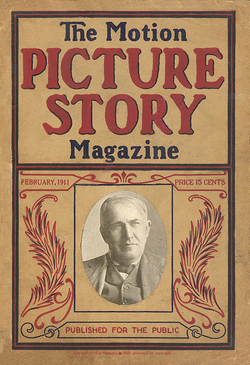
Motion Picture Magazine
~ the eulogy ~
The first issue is dated February 1911 and cost fifteen cents. Its masthead reads The Motion Picture Story Magazine, published for the public monthly by The Motion Picture Story Publishing Company, 26 Court Street, Brooklyn. The president listed there is J. Stuart Blackton, who was also the artistic head of Vitagraph, and the secretary-treasurer is Eugene V. Brewster, who did the actual editing. Thomas Edison is on the cover. The opening editorial explains that the stories come through the courtesy of the leading manufacturers of moving pictures.
That courtesy had a shape. In its early years the magazine carried films only from members of the Motion Picture Patents Company, the licensing cartel that Edison ran and Blackton's studio belonged to. So the first American fan magazine began as a trade body's promotional vehicle, printing prose versions of the pictures its own owners were releasing that month, and the masthead went on carrying the standing line Founded by J. Stuart Blackton, trademark registered, for decades after he had gone. The name was shortened to Motion Picture Magazine with the March 1914 issue.
It outlived the cartel that created it and the studio system that followed, and stopped in 1977. Nobody wrote down which month. The December 1976 issue had already given itself over to nostalgia, reprinting its own old pieces on Brando and Garbo, which is what a magazine prints once it has no present tense left. Two sibling titles in the same company, TV Radio Mirror and Pageant, died in the same year.
~ the dossier ~
| Born | February 1911 in Brooklyn, as The Motion Picture Story Magazine |
|---|---|
| Peak | 400,000 copies a month, a figure it printed in its own Answer Man column in December 1919 |
| Killed | 1977 |
| Lifespan | 66 years |
| Made by | J. Stuart Blackton of Vitagraph and Eugene V. Brewster |
| Killed by | television, the scandal sheets, and People magazine arriving in 1974 |
~ what a fan magazine was for ~
The job this thing did no longer exists. In 1911 a person who had watched someone move across a screen had no other channel to that person: no television interview, no account to follow. Fifteen cents a month bought the only writing about them in the world. My own first years online ran the other way, with more published about any famous person than a reader could get through and no label on the parts that had been placed. The magazine's circulation grew faster than the industry it was covering, from 205,000 in April 1913 to 270,000 a year later.
~ the answer man was a woman ~
The magazine invented the reader question column, under the heading The Answer Man, and a contemporary account from 1914 noted the joke in it: the Answer Man was a woman, described as a veritable encyclopedia of picturedom. Photoplay started something similar that was never a match. The column also leaked the circulation. In the December 1919 issue the column replied to a reader with a shrug that doubles as the best surviving figure for the magazine's peak: guess there are a few reading this magazine, circulation last month, 400,000.
The star interview starts here too. In December 1911 half a page went to Florence A. Lawrence of the Lubin Company, which appears to be the first such thing printed in an American fan magazine. Later came the reader ballots and the Hall of Fame nominations, mailed to an address on Duffield Street in Brooklyn. In October 1944 the cover was a photograph of Lena Horne, the first time any fan magazine put a Black performer on its front. The executive editor who approved it, Laurence Reid, was told it was a high-risk decision. Sales went up.
~ the fame and fortune contest ~
In November 1918 the magazine announced a competition open to any young woman in the world, promising that the winner would be made into an internationally famous motion picture player. The jury at various points included Mary Pickford and Cecil B. DeMille. It ran across Brewster's titles for years and it did find people. Clara Bow entered in the autumn of 1921, and the jury's verdict on her was printed in the January 1922 Motion Picture Classic: she had a genuine spark of divine fire and she screened perfectly.
It also supplied Brewster with weekend guests at his Long Island estate. He gave the 1920 winner, Corliss Palmer, twenty-three articles in his own magazine between 1921 and 1923, and married her in October 1926 when he was fifty-seven and she was twenty-seven. In 1931 his former wife sued him for alienation of affection and the money went. A photograph from that March shows the two of them playing backgammon in a small rented house in Hollywood. Palmer spent her last years in psychiatric institutions and died in 1952. Brewster died on New Year's Day 1939.
~ the name without the magazine ~
Someone registered motionpicturemagazine.com on 2 March 2022, forty-five years after the title stopped. It answers today as a site called Motion Picture Magazine, publishing celebrity gossip under bylines with no photographs behind them, and its own disclosure page states that generative tools draft and edit the text and that many of the images, article covers included, are produced rather than photographed. The parent company named in its code is Loaded Technologies Inc. Nothing on the site mentions Blackton, Brewster, Brooklyn or 1911. It is not a revival and does not claim to be one. It is a name with nothing attached, doing automatically what the original did with a staff.
~ leave a rose ~
an anonymous tribute. one rose per visitor per day.
@}-->-- ... roses left here
~ leave a wreath ~
a rose fades by morning. a wreath stays on this grave for good, with your name on it.
paid once through stripe. payments are handled by OÜ Lakeview, the small company that keeps rip.so running. the money pays for the hosting and the nightly digging. adopt it and the headstone reads "maintained in memory by" you. the groundskeeper plants new wreaths at the next tending, usually within a day.
» one email a week: new graves and the anniversaries of the dead. subscribe
other phenomena: GivesMeHope, Shutdownify, Will It Blend?, Encyclopædia Britannica (print)
also died in the pre-1980s: Atlas/Seaboard Comics, Stereo-Pak, Processor Technology
~ leave a note ~
visitors before you have left these graveside notes. anonymous welcome.