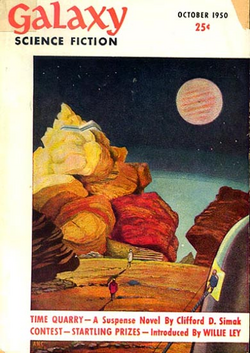
Galaxy Science Fiction
~ the obit ~
On the back cover of the first issue, October 1950, Galaxy printed two paragraphs side by side. The first was a parody of how a space adventure usually opened: "He cut out his super-hyper-drive for the landing ... and at that point, a tall, lean spaceman stepped out of the tail assembly, proton gun-blaster in a space-tanned hand." The second was the same sentence as a plain western: "He spurred hard for a low overhang of rimrock ... and at that point a tall, lean wrangler stepped out from behind a high boulder, six-shooter in a sun-tanned hand." The heading over it was "You'll Never See It In Galaxy!", and it was a statement of editorial policy disguised as a joke.
The magazine was funded by World Editions, a French-Italian company looking for a way into the American market, and it hired H. L. Gold to edit. Gold wanted stories about what technology does to people rather than stories about the technology, and within two years he had the leading science fiction magazine in the country. In 1952 Robert Guinn, who printed it, bought it.
Ray Bradbury's "The Fireman" ran in Galaxy before it grew into Fahrenheit 451. Alfred Bester's The Demolished Man was serialized there too. NBC built a radio series on the back of the magazine: X Minus One started on 24 April 1955 and ran 125 episodes, and from February 1956 its scripts were adapted exclusively from Galaxy stories, with the magazine running advertisements for the show from the April 1956 issue onward.
The last issue reached American newsstands in 1980 and I showed up in Turkey in 1984, so all of this came to me secondhand: Fahrenheit 451 in Turkish translation, the rest as paperback collections whose introductions explained where each story had first run. The stories traveled fine. The thing that carried them, a digest you bought every month with eight unfamiliar names on the contents page, did not travel at all.
~ the rap sheet ~
| Born | October 1950, from a French-Italian publisher chasing the American market |
|---|---|
| Peak | 81,035 copies when James Baen left in 1977, the highest figure in its own records |
| Killed | July 1980 |
| Lifespan | 29 years and 9 months, plus eight issues in 1994 and 1995 |
| Made by | World Editions, then its printer Robert Guinn |
| Killed by | Postage it could not pay |
~ what gold wanted ~
Frederik Pohl, who worked for Gold and then replaced him, put the influence in one line: "after Galaxy it was impossible to go on being naive." The historian David Kyle went further and called Gold the most influential editor of the whole post-war scene. Part of it was money spent in the right place: Gold insisted on production processes expensive enough to allow interior artwork integrated with the type, which cheap letterpress printing could not do.
Pohl had been doing most of the production work for years before he was given the title at the end of 1961, and under him the magazine held steady, with circulation between 73,000 and 78,000 through the middle sixties. He never won a Hugo for Galaxy. He won three of them for its smaller sister magazine, If, which is the kind of outcome that follows an editor around.
~ one cent a word ~
In 1969 Guinn sold to Universal Publishing and Distribution Corporation. Pohl was in Rio de Janeiro at a science fiction symposium when it went through, heard about it on his return, and resigned within days after learning the new publisher expected the editor at a desk from nine to five. The company invented a post called "editor emeritus" to keep his name off a competitor's masthead. Circulation went from 75,300 for the year ended October 1968 to 51,479 one year later.
James Baen arrived with the June 1974 issue and reversed it, lifting circulation from 47,789 to 81,035 and making the magazine profitable for a parent company that was going under anyway. If was merged into Galaxy at the end of 1974 because paper had become too expensive to run both. Baen left for Ace Books in late 1977, John J. Pierce lasted under a year, Hank Stine managed two issues, and the rate for fiction was down to one cent a word. John Varley reported that he was still owed money for stories five years after they had been printed.
~ the mailing list ~
The title ended up with a new company, Galaxy Magazine, Inc., owned by Vincent McCaffrey, who ran a secondhand bookstore called Avenue Victor Hugo in Boston. UPD held onto ten percent so it could keep collecting against its debts. Two issues Stine had already assembled were never published. One more did come out, dated July 1980, in a large format, edited by Floyd Kemske. An October 1980 issue was put together and never distributed.
McCaffrey could not cover the postage to circulate what he had printed, so some subscribers never received the final issue of the magazine they had paid for, and would have had to work out for themselves that there was not going to be another one. In January 1994 the name came back as a semi-professional magazine edited by E. J. Gold, son of the founding editor, which managed eight issues on a proper bimonthly schedule and stopped with March-April 1995.
~ leave a rose ~
an anonymous tribute. one rose per visitor per day.
@}-->-- ... roses left here
~ leave a wreath ~
a rose fades by morning. a wreath stays on this grave for good, with your name on it.
paid once through stripe. payments are handled by OÜ Lakeview, the small company that keeps rip.so running. the money pays for the hosting and the nightly digging. adopt it and the headstone reads "maintained in memory by" you. the groundskeeper plants new wreaths at the next tending, usually within a day.
» one email a week: new graves and the anniversaries of the dead. subscribe
other phenomena: 3D Maze, COVIDSafe, JenniCam, Piratbyrån
also died in the 1980s: IVC videotape, Misty, ANALOG Computing
~ leave a note ~
visitors before you have left these graveside notes. anonymous welcome.