Kaizō
~ the obituary ~
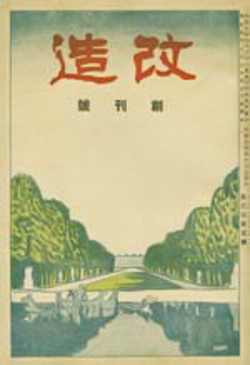
Yamamoto Sanehiko set his publishing house up in January 1919 and had the first issue of its magazine on sale by April. The name means something close to reconstruct, and the cover of that first number is a colored print of a tree lined avenue running down to a bridge, the title in red, the words for inaugural issue underneath. Sales grew on labor disputes and social questions, and by the close of the Taisho years Kaizō was spoken of in the same breath as Chuo Koron, the older magazine it had grown up against.
Its fiction list is why the name still turns up in Japanese literary history. Shiga Naoya's A Dark Night's Passing ran in it across sixteen years. Tanizaki's Quicksand was serialized there, and so were Yokomitsu Riichi's Shanghai and Akutagawa's Kappa. The argument between Tanizaki and Akutagawa over whether the plot of a novel is an artistic value at all was conducted in its pages, in public, issue by issue.
A prize competition announced in the August 1927 number was run ten times up to 1939. In August 1929 the first prize for criticism went to Miyamoto Kenji for an essay on defeat in literature, and the following month Kobayashi Hideo took second place with Designs of Various Kinds, which Japanese criticism has been arguing with ever since. The publishing house was just as busy: a complete works of modern Japanese literature sold at one yen a volume from 1926 set off the one yen book boom that reshaped Japanese publishing, and a paperback imprint followed in 1929.
A general interest monthly in prewar Japan was a political object whether it wanted to be or not, because the Home Ministry read it too. An issue was banned from sale in 1926 over a play it carried. The September 1927 issue was banned outright over a passage in a Nakazato Kaizan novel, judged a desecration of dignity, then allowed back on sale with the offending twenty pages physically cut out and a slip pasted in explaining that this was the revised edition.
~ the case file ~
| Born | April 1919, three months after Kaizosha was founded |
|---|---|
| Peak | level with Chuo Koron by the end of the Taisho era, fifth favorite monthly in Japan in a 1947 reader survey |
| Killed | the February 1955 issue, eleven years after the state closed it once already |
| Lifespan | 25 years, then 9 more after the war |
| Made by | Kaizosha, Tokyo, founded by Yamamoto Sanehiko |
| Killed by | a labor dispute that started with dismissals at the end of 1954 |
~ Einstein at Kobe ~
In 1921 the company brought Bertrand Russell to Japan to lecture, and over the following year it did the same for Margaret Sanger and for Albert Einstein. Einstein landed at Kobe seven days after the Swedish academy announced that he had won the Nobel Prize. The physicist Ishihara Jun traveled with him as interpreter and wrote up the Keio University lecture for the January issue of the following year, and the house went on to publish Japanese translations of his papers.
Among those who heard him speak on that tour was a middle school student in Kyoto called Yukawa Hideki, who decided on physics and took the Nobel Prize himself in 1949. A magazine that can move a physicist across the world, and redirect a schoolboy sitting in the hall while he does it, is not doing the job the word magazine now describes.
~ the photograph from the inn ~
In the August and September 1942 issues Kaizō published an essay by Hosokawa Karoku on the direction of world history. On 14 September the head of the Army press bureau attacked it in a book trade paper under the title War and Reading, calling it communist propaganda. Hosokawa was arrested by the Metropolitan Police the same day under the Peace Preservation Law, and the two issues were banned retroactively.
The rest followed from a photograph. In July 1942 Hosokawa had hosted a one night gathering at an inn at Tomari in Toyama, with editors from Kaizō and from Chuo Koron, and somebody took a group picture. A copy surfaced during a police search in May 1943 and the Kanagawa special higher police decided it showed a meeting to rebuild the Communist Party. Around sixty people were arrested over the next two years, ninety if you count the unconfirmed, drawn from both magazines and from the newspapers. Four of them died in custody. Japan knows this as the Yokohama Incident, and the courts were still awarding compensation to the families in 2010.
The magazine did not survive the arrests in any meaningful sense. Its editor in chief and the editor responsible for the essay left the company, the editorial staff was replaced and what came out afterward followed the official line. On 10 July 1944 the Information Bureau instructed Kaizosha and Chuo Koron-sha to close themselves down voluntarily, and both were wound up before July was out. The June 1944 issue was the last one. Bungei, the literary magazine the house had started in 1933, was sold off to Kawade Shobo, where it is still published today.
~ January 1955 ~
The revival issue, dated January 1946, went on sale in the last week of December 1945, carrying pieces on building a peaceful state and on the theory behind a democratic constitution. It worked for a while. A national reading survey in 1947 put Kaizō fifth among the monthlies people actually read, and the ranking fell away through every survey after that, to nineteenth by 1953. Yamamoto was purged from public office in 1947, got the ban lifted in 1951, returned as president and died the next year.
Dismissals started at the end of 1954 and turned into a full labor dispute. On 22 January 1955 the company fired the entire editorial department, and on the same day a group of writers including Aono Suekichi and Niwa Fumio formed a league refusing to write for it. A society to protect Kaizō was set up on 18 February and got nowhere. The February issue was the last, and the house went under. The name is still on shop fronts in Japan, on a chain of bookshops in Ginza and in railway stations, which sell books and publish nothing.
~ leave a rose ~
an anonymous tribute. one rose per visitor per day.
@}-->-- ... roses left here
~ leave a wreath ~
a rose fades by morning. a wreath stays on this grave for good, with your name on it.
paid once through stripe. payments are handled by OÜ Lakeview, the small company that keeps rip.so running. the money pays for the hosting and the nightly digging. adopt it and the headstone reads "maintained in memory by" you. the groundskeeper plants new wreaths at the next tending, usually within a day.
» one email a week: new graves and the anniversaries of the dead. subscribe
other news: Infonet, E24.se, Ahoy!, The Colorado Independent
also died in the pre-1980s: Fawcett Comics, Planet Stories, Simulmatics Corporation
~ leave a note ~
visitors before you have left these graveside notes. anonymous welcome.