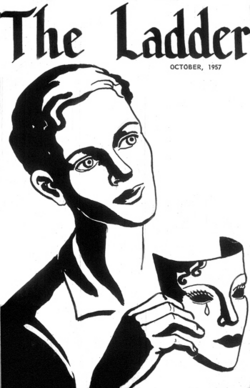
The Ladder
~ the eulogy ~
The Ladder died twelve years before I turned up, and its readership was never going to include me. What carries across anyway is the mechanics of the thing. Phyllis Lyon and Del Martin had founded the Daughters of Bilitis in San Francisco in 1955 and could not place an advertisement for a meeting in the local paper, so in October 1956 they typed a newsletter, ran it off on a mimeograph, stapled it by hand and mailed 175 copies to every woman the members could think of who might want one. The list they worked from included women with professional listings in the San Francisco phone book. The title came off the cover art, line drawings of figures walking toward a ladder that went up into clouds, and nobody recorded who drew it.
It went out in a brown paper covering, and it kept going out that way for the entire sixteen years. Early issues ran about twenty pages. By October 1957 there were 400 subscribers, a number the magazine published itself in a first-anniversary piece by Del Martin called "Growing Pains Don't Hurt." An annual article ran reassuring readers that their names were safe, which tells you what the subscription actually was. Putting your address on that list was the risk, and the magazine's only real asset was the promise that the address went nowhere else.
Readers wrote in. In May 1957 one letter came from Lorraine Hansberry, signed L.H.N., enclosing two dollars for back issues and saying she was glad as heck that they existed. Lyon printed it in full across two of that issue's thirty pages. Marion Zimmer Bradley published "Some Remarks on Marriage" in July 1957. Forrest J Ackerman wrote two pieces under the name LauraJean Ermayne and was declared an honorary lesbian for it.
~ the dossier ~
| Born | October 1956, volume 1 number 1, 175 mimeographed copies |
|---|---|
| Peak | a 3,800-name mailing list, of which exactly two copies existed |
| Killed | the double issue of August and September 1972, volume 16 number 11-12 |
| Lifespan | 16 years, 16 volumes |
| Made by | the Daughters of Bilitis, San Francisco |
| Killed by | the donor's checks stopping when the magazine left the organization |
~ ann ferguson is dead ~
Lyon edited the first few months under the pen name Ann Ferguson, then killed the pseudonym off on purpose. The January 1957 issue carries an item on page 7 titled "Ann Ferguson is Dead!", retiring the name so that readers would have one fewer example of hiding in front of them. The next issue ran a piece called "Where Did We Get Your Name?", because the first one had made people nervous about how their addresses had been obtained in the first place.
~ who was allowed on the cover ~
Barbara Gittings took over in 1963 and added the subtitle "A Lesbian Review" to the front. She had heard Frank Kameny argue at a convention that looking for the cause of homosexuality was wasted effort, and the magazine's register changed accordingly: White House pickets reported in its pages, readers urged to turn up. The line drawings gave way to photographs of actual lesbians. The first, in May 1964, was an unnamed model. The first woman who let her name be printed had sent in her picture with a letter about how isolated she was. Kay Lahusen, Gittings' partner, shot every cover portrait except the first two.
In January 1966 Lahusen photographed Lilli Vincenz, who was the first cover model shown neither in sunglasses nor turned to profile. That June the cover was Ernestine Eckstein, one of only two women of color ever to appear on the front, and the interview inside is the only substantial published piece anyone has found on her. Meanwhile the organization's mission statement was still printed inside the cover of every issue, committing the Daughters of Bilitis to a mode of behavior and dress acceptable to society, which is what the letters column had been fighting about since 1956. Gittings was pushed out that same year. One account says she dropped "For Adults Only" from the cover without asking; another says her issues were simply too often late.
~ reno, 1970 ~
Barbara Grier edited from 1968 under the name Gene Damon, working from Kansas City. She took the page count to forty-eight and removed the word "lesbian" from the cover to widen the readership. Covers started using Romaine Brooks and Georgia O'Keeffe, and Jane Rule and Rita Mae Brown appeared inside. Her review column, Lesbiana, covered any book with lesbian content whatever its quality, which over four years assembled something that had not existed before: a usable list of what there was to read.
The national organization dissolved in 1970 over the split between the assimilationist line and the feminist one. Rita LaPorte, then president, took the mailing list to Reno. There were two copies of it, one at the office and one at the printer, and the one that mattered left. Grier knew. Martin, Lyon, Gittings and Sandoz called it theft. Grier's position was that a dying organization's magazine could not have been kept alive any other way, and because the list had crossed a state line the matter would have been a federal case that nobody had the money to bring. The anonymous donor known only as "Pennsylvania," who had given about a hundred thousand dollars from 1963 onward in three-thousand-dollar checks made out to individual members, had been the organization's donor. Those checks stopped. The magazine lasted two more years on those 3,800 names.
~ the imprint that outlived it ~
The last one is a double issue, volume 16 numbers 11 and 12, cover-dated August and September 1972. Grier founded Naiad Press the following year and built its first customer base out of the same mailing list, which is how a lesbian publishing house that lasted three decades started with a stolen address book. Arno Press reprinted the magazine in nine hardback volumes in 1975 with a short foreword by Grier. The free scans at Berkeley start at October 1960, so the first four years exist only on paper and in a subscription database, and the cover price does not appear in anything readable online.
~ leave a rose ~
an anonymous tribute. one rose per visitor per day.
@}-->-- ... roses left here
~ leave a wreath ~
a rose fades by morning. a wreath stays on this grave for good, with your name on it.
paid once through stripe. payments are handled by OÜ Lakeview, the small company that keeps rip.so running. the money pays for the hosting and the nightly digging. adopt it and the headstone reads "maintained in memory by" you. the groundskeeper plants new wreaths at the next tending, usually within a day.
» one email a week: new graves and the anniversaries of the dead. subscribe
other news: Mega Power, Asian Correspondent, The Overtake, Ellenpont.hu
also died in the pre-1980s: VideoBrain Family Computer, Ramparts, Victor Talking Machine Company
~ leave a note ~
visitors before you have left these graveside notes. anonymous welcome.