Barazoku
~ the eulogy ~
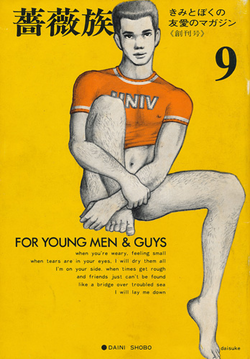
Ito Bungaku ran a small Tokyo publishing house called Daini Shobo and was not gay. He had put out books on homosexuality in the 1960s, and what came back through the post was mail from readers who had no one at all to tell. In July 1971 he turned that into a magazine. The inaugural issue was cover-dated September, went out on 30 July at two hundred and eighty yen, carried magazine code 7581 so bookstores across Japan could stock it like anything else, and sold most of its print run of ten thousand.
Japan had gay publications before it. Adonis began in September 1952 and ran to sixty-three issues, and there were at least five more after that, including one simply called Bara. All of them were membership magazines, mailed to people who had already found their way onto a list. Barazoku's claim is narrower and larger than "first": it was the first one a stranger could buy over a counter without declaring anything to anybody. Ito wanted the title to be the single word Bara, rose, and could not have it because the trademark was taken, so he added the suffix that Japanese used for motorcycle gangs and got Barazoku, the rose tribe. He coined yurizoku, the lily tribe, for women in the same breath, and both words outlived the magazine by a wide margin.
It went bimonthly for eighteen issues, then monthly from issue 19 in August 1974, and the format settled into nude photography and erotic fiction wrapped around the part the readers actually came for. The buntsuran, the correspondence column, was where men in towns with no bar and no bookstore section wrote to each other. Ito bound blank manuscript paper into the magazine so submitting something took no effort at all. There was a corner inside the column set aside for women. He held reader meetings in his own house, opened a cafe called Matsuri in 1976, and ran a telephone counseling line. Naito Rune drew the covers from February 1984 until September 1998.
This one I helped kill, in the aggregate. While Barazoku's correspondence column was being hollowed out, I was fifteen years old in Turkey and the fastest modem in the house managed 33.6k. The whole appeal of being online was finding people without anybody having to mail anything to your house. That worked. It worked so completely that it emptied out every publication whose real product had been a list of addresses, in Japan and everywhere else, and none of us doing the finding were thinking about the magazines.
~ the dossier ~
| Born | cover-dated September 1971, published 30 July 1971 at 280 yen |
|---|---|
| Peak | monthly from issue 19 in August 1974, in bookstores nationwide on magazine code 7581 |
| Killed | 21 April 2023 |
| Lifespan | 52 years, 444 issues, three revivals |
| Made by | Daini Shobo, under editor Ito Bungaku |
| Killed by | the internet doing the correspondence column's work for free |
~ the condom advertisement ~
The last issue of the original run was dated November 2004 and published that September, issue 382, which closed thirty-three years. The correspondence column had been hollowed out by the internet while newer and more narrowly targeted gay magazines took the newsstand. Underneath both of those, Daini Shobo was deep enough in debt that the printers would not run anything further.
That issue carried an advertisement from Okamoto, the condom manufacturer. No mainstream Japanese company had ever bought space in a gay magazine before, and Ito had spent decades asking. It arrived in the issue that could not afford a proper goodbye. There was no farewell notice printed, because the print bill for one was the thing in question.
~ three restarts ~
April 2005: a publisher called Media Soft restarted it with Ito still editing and a new brief, aimed at the general public rather than at gay readers, with a Miwa Akihiro interview in the relaunch number. It managed eight issues and stopped with the January 2006 issue, out that November, after a fight about whether it was a gay magazine or a subculture magazine. July 2006: a company called Navigator put out exactly one issue, then vanished with the material prepared for the second. Ito lost his house to the debts from that one.
April 2007: he restarted it himself, quarterly, funded personally, each issue digging through one year of the old Showa-era run. By issue 398 in autumn 2008 he was seventy-six and the economics were plain, so he printed his retirement notice in it. The print run was four hundred copies and fewer than a hundred of them sold. Issue 399 came out in January 2009, one short of the round number his deputy had proposed as a finish line, and then nothing happened for two years.
~ issue 444 ~
The succession was settled in May 2011 and Ryu Susumu took over as second editor in July. He put issue 400 out on 21 July 2011, which he said matched the first issue's release date forty years earlier, redesigned the thing from 401 onward, and repositioned it as an opinion magazine about sexuality rather than a gay men's monthly. It sold at Comiket. The quarterly cadence held for another decade: issue 442 on 21 July 2022, issue 443 on 21 October 2022, and then issue 444 on 21 April 2023, sixteen pages in full color at seven hundred yen, with three farewell letters and a final editor's note in it.
Two years later he wrote one more post on the magazine's note account, in April 2025, confirming in one sentence that publication had stopped as of April 2023. His stated reason for not continuing was that the thing the magazine had been founded to fight, a society where disclosing yourself got you thrown out of it, was in his view no longer the emergency it had been in 1971. The Japanese Wikipedia article has not caught up and still describes the magazine in the present tense.
Ito Bungaku turned ninety-four this March and Japanese Wikipedia still lists him among the living. The digital archive of the back catalog is a separate casualty: scans went up in August 2020, a fuller distribution opened in July 2024 under the Daini Shobo name, and in February 2025 Kindle pulled it for being too adult. A FANZA replacement was discussed and never happened.
~ leave a rose ~
an anonymous tribute. one rose per visitor per day.
@}-->-- ... roses left here
~ leave a wreath ~
a rose fades by morning. a wreath stays on this grave for good, with your name on it.
paid once through stripe. payments are handled by OÜ Lakeview, the small company that keeps rip.so running. the money pays for the hosting and the nightly digging. adopt it and the headstone reads "maintained in memory by" you. the groundskeeper plants new wreaths at the next tending, usually within a day.
» one email a week: new graves and the anniversaries of the dead. subscribe
other community: 99.se, Daum Agora, DMMコミュニティ (DMM Community), ZUG.com
also died in the 2020s: Warface: Clutch, Knockout City, Tfile
~ leave a note ~
visitors before you have left these graveside notes. anonymous welcome.