Harper's Weekly
~ the last words ~
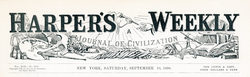
Harper & Brothers was a book house, started in 1825 by four brothers in New York. In January 1857 Fletcher Harper took the format that The Illustrated London News had proved in Britain and launched an American version. The first issue is dated 3 January 1857, and the engraved masthead carried the subtitle the magazine kept for its whole life: A Journal of Civilization.
Circulation was 200,000 by 1860. What people were buying was the pictures, and the Weekly paid for the best draftsmen in the country to make them. Winslow Homer and Granville Perkins both worked its pages, and the 10 November 1860 cover ran a portrait of the president-elect that Homer drew from a Mathew Brady photograph.
Then the war, the thing it is still remembered for. Harper's sent special artists to the front, Homer among them, along with Theodore R. Davis and the brothers Alfred and William Waud. Their sketches came back by mail and were cut into wood blocks in New York within days. Those engravings were the only images of the war that most readers would ever see, and they are still what the war looks like in American textbooks.
After Appomattox the Weekly dropped any pretense of neutrality. It backed Ulysses Grant in 1868 and again in 1872, and argued the Radical Republican line on Reconstruction. Then in 1884 it broke with its own party: editor George William Curtis and his star cartoonist both refused to support James Blaine and threw the magazine behind Grover Cleveland, the first Democrat elected president since 1856.
It kept a sideline in fiction the whole time. On 14 January 1893 it became the first American magazine to print a Sherlock Holmes story, which was The Adventure of the Cardboard Box.
~ the record ~
| Born | 3 January 1857, New York, as a journal of civilization |
|---|---|
| Peak | 200,000 copies by 1860 |
| Killed | 13 May 1916 |
| Lifespan | 59 years, 4 months |
| Made by | Fletcher Harper, at Harper & Brothers |
| Killed by | absorption into The Independent |
~ the man with the pen ~
Thomas Nast was recruited in 1862 and is usually called the father of American political cartooning, which undersells the job considerably. The elephant belongs to the Republican Party because he drew it that way, and the Santa Claus everyone else copies is the one he settled into shape in these pages. Through the 1870s he ran an unrelenting campaign in the Weekly against William Tweed and the Tammany machine, and Tweed's people offered him $500,000 to go away and draw in Europe instead. He stayed.
Rutherford Hayes later said Nast had been the most powerful single-handed aid he had in the 1876 election. After that the cartoons thinned out, because Nast and Curtis disagreed about how far a cartoon should carry the magazine's politics. His last contribution was a Christmas illustration in December 1886. The journalist Henry Watterson wrote that in quitting Harper's Weekly, Nast lost his forum, and in losing him, Harper's Weekly lost its political importance. His biographer Fiona Deans Halloran accepts the first half and doubts the second.
~ winding down to 1916 ~
The twentieth-century Weekly printed more argument and fewer woodcuts. Theodore Roosevelt wrote for it. Editor George Harvey proposed Woodrow Wilson for the presidency at a dinner in 1906 and then put Wilson's name on the magazine's own pages, issue after issue, years before anybody else took the idea seriously. Roderic Penfield ran the newsroom from 1912 to 1914. The final issue is dated 13 May 1916, after fifty-nine years, and The Independent absorbed the title, then merged into The Outlook in 1928.
The name came back once, when Harper's Magazine used it in the mid-1970s for a biweekly built largely out of reader contributions, and that one died too. The original survives in better shape than almost any American magazine of its age, and it survives commercially: harpweek.com sells it back as subscription databases cut by subject and by election year, 1857 through 1912, while harpersweekly.com is parked and carries an asking price. The journal of civilization is a login screen and a rate card now.
~ leave a rose ~
an anonymous tribute. one rose per visitor per day.
@}-->-- ... roses left here
~ leave a wreath ~
a rose fades by morning. a wreath stays on this grave for good, with your name on it.
paid once through stripe. payments are handled by OÜ Lakeview, the small company that keeps rip.so running. the money pays for the hosting and the nightly digging. adopt it and the headstone reads "maintained in memory by" you. the groundskeeper plants new wreaths at the next tending, usually within a day.
» one email a week: new graves and the anniversaries of the dead. subscribe
other news: Relevo, TechLife, TheFeature, Dengeki hp
also died in the pre-1980s: Tales from the Crypt, Electrologica, DC-International
~ leave a note ~
visitors before you have left these graveside notes. anonymous welcome.