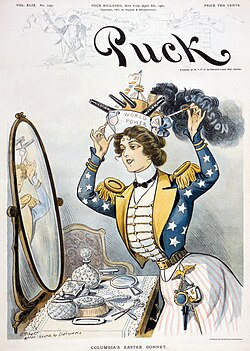
Puck
~ the obit ~
Joseph Keppler came out of Vienna as a cartoonist and landed in St. Louis, where in 1871 he started a German-language comic weekly called Puck. It lasted until August 1872. He went to work for Frank Leslie's in New York instead, met a German businessman named Adolph Schwarzmann there, and in 1876 the pair revived the title. Backers wanted it in English, so from 1877 there were two Pucks running side by side, and the German one lasted another fifteen years.
The name is from A Midsummer Night's Dream, and the cover carried Puck's line every single week: What fools these mortals be! The character got redrawn as a chubby boy in a top hat admiring himself in a hand mirror, and he sat on the masthead for the whole forty-two years.
The printing is what made the business. Puck was the first weekly anywhere to make full-color lithographed cartoons pay, and the first magazine of any kind to run illustrated advertising. A typical issue ran sixteen pages at ten by thirteen and a half inches, with a color cartoon on the front cover and another on the back. In the middle sat a double-page color centerfold, usually political. Everything else was black and white jokes and a page of editorials. Sales ran over eighty thousand copies a week by the early 1880s and at least 125,000 by 1884.
Its politics ran against Tammany Hall and the machine that owned it. They also ran against the Catholic Church, in a way nobody tries to soften now. Founded by German immigrants sympathetic to Bismarck's campaign against the Church at home, Puck went after Irish Catholic New York and Pope Leo XIII together, for twenty years, often in the same drawing.
~ the rap sheet ~
| Born | 1876 in German, New York, English edition from 1877 |
|---|---|
| Peak | over 80,000 a week in the early 1880s, 125,000 by 1884 |
| Killed | 5 September 1918 |
| Lifespan | 42 years |
| Made by | Joseph Keppler and Adolph Schwarzmann |
| Killed by | William Randolph Hearst, by removing what it was for |
~ the building on houston street ~
From 1887 the whole operation sat in its own building at Lafayette and Houston, a Romanesque Revival block designed by Albert and Herman Wagner and finished in 1885. It was built to hold the largest lithographic presswork under a single roof in the world and it generated its own electricity. The Puck Building is still there, still called that, with a gilded Puck in a top hat standing over the entrance. The real estate has now outlasted the magazine by over a hundred years.
Keppler kept drawing until 1893, when he took a smaller twelve-page version of Puck to the Chicago World's Fair grounds. He died in 1894. Henry Cuyler Bunner, who had edited the thing since 1877, carried it until his own death in 1896, and after that it was run by Harry Leon Wilson and then by Keppler's son.
~ what hearst did with it ~
Nathan Straus Jr. bought it in 1914. William Randolph Hearst's company bought it in 1916, which has a joke inside it: a Puck cartoon from 1906 had mocked Hearst's run for Congress by drawing him surrounded by his own newspapers' comic characters.
Hearst discontinued the political material and turned the magazine toward fine art and social fads. That took about two years to work through the subscriber list. Publication stopped with the issue distributed on 5 September 1918. From 1931 the word sat on the Comic Weekly section of Hearst's Sunday papers, where it stayed into the 1970s, pointing at nothing.
~ reading the archive ~
The complete run is scanned at the Internet Archive in black and white off microfilm, so the free copy of a color magazine has had its argument removed. For the chromolithographs at full resolution you go to the Library of Congress, or to one of the universities that kept bound volumes.
The jokes do not survive the trip. A centerfold from 1884 assumes you know which alderman is which and why the man with the shamrock is drawn that way, and without both you are looking at decoration. The labor is what travels. Somebody hand-separated those colors onto stone, on deadline, every week for forty-two years, and a clean proof holds up against color work done a century later.
~ leave a rose ~
an anonymous tribute. one rose per visitor per day.
@}-->-- ... roses left here
~ leave a wreath ~
a rose fades by morning. a wreath stays on this grave for good, with your name on it.
paid once through stripe. payments are handled by OÜ Lakeview, the small company that keeps rip.so running. the money pays for the hosting and the nightly digging. adopt it and the headstone reads "maintained in memory by" you. the groundskeeper plants new wreaths at the next tending, usually within a day.
» one email a week: new graves and the anniversaries of the dead. subscribe
other phenomena: This Is Why You're Fat, NetAid, YouTube Original Channel Initiative, ペタ (Peta)
also died in the pre-1980s: Wire Recording, Tefifon, New Youth
~ leave a note ~
visitors before you have left these graveside notes. anonymous welcome.