New Youth
~ the eulogy ~
The first issue went on sale in Shanghai on 15 September 1915 under the title Youth Magazine, and the lead item was a letter from the editor to the people he hoped would read it. Chen Duxiu had tried this once before with the Anhui Common Speech Journal, which lasted two years. This time he took the idea to Wang Mengzhou at the Yadong Library, could not get it funded there, and was sent on to Qunyi Publishing House, which agreed to print it and pay him 200 yuan a month for the manuscripts and the editing.
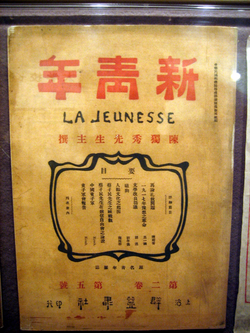
A year in, the Shanghai YMCA objected that the title was almost the one it used for its own publication. Chen changed it to New Youth, which fitted the magazine better than the old name had. The cover also carried the words LA JEUNESSE, in French, which tells you where the editors were looking for their models.
In January 1917 Chen was appointed head of the Chinese literature department at Peking University and the magazine moved to Beijing with him. The masthead filled up with faculty: Qian Xuantong, Li Dazhao, Hu Shih, Shen Yinmo, Gao Yihan. What had begun as a small journal written mostly by men from Anhui turned into the house paper of the most influential university in the country, and the New Culture Movement ran out of it.
The money never worked. After the third volume in August 1917 Qunyi stopped printing, because distribution was thin and the sales were worse. Chen argued them back into it and the magazine reappeared in January 1918 after four months of silence. Within a year of that it was running Lu Xun's first published fiction and Hu Shih's argument that the classical written language had been dead for centuries.
Everything about this one sits out of reach for me. The text is in classical Chinese and then in the vernacular the magazine was itself arguing for, which is a language problem stacked on top of a century. The May Fourth Movement arrived in my life as a chapter heading, long after everyone in it was dead. What crosses the gap is a publishing fact. A monthly that could not pay its printer and could not get itself onto newsstands changed the written language of the largest country on earth inside a few dozen issues.
~ the dossier ~
| Born | 15 September 1915, Shanghai, as Youth Magazine |
|---|---|
| Peak | the Peking University board of 1918, Hu Shih and Lu Xun in the same volume |
| Killed | July 1926, after nine volumes |
| Lifespan | 10 years, 54 issues |
| Made by | Chen Duxiu, printed by Qunyi Publishing House |
| Killed by | the move from a magazine to a party organ |
~ six demands ~
The opening piece was called "A Letter to Youth" and it was built as six matched pairs. Be independent and not enslaved came first. Be scientific and not superstitious came last. In between were progress against conservatism and the world against the closed country, and the whole set ran on the idea that the two chains on the population were feudalism and ignorance.
Four years later Chen reduced the program to two names. In the January 1919 issue he wrote that every accusation against the magazine came down to its support for Mr. Democracy and Mr. Science, who in the shorthand of the time became Mr. De and Mr. Sai. To back Mr. De you had to oppose Confucianism and the old politics. To back Mr. Sai you had to oppose the old religion. He said the magazine would not flinch from government oppression or public ridicule over this, "even the breaking of my head and the shedding of blood".
~ volume two, number five ~
The cover of volume 2, number 5, dated 1 January 1917, puts the title in large red characters over LA JEUNESSE, with a line underneath crediting Chen Duxiu as editor. Inside was Hu Shih's "A Preliminary Discussion of Literary Reform", which listed eight things a writer should stop doing and concluded that vernacular Chinese would be the authentic literature of China. It is generally treated as the fuse on the literary revolution.
What followed came quickly. Lu Xun's "Diary of a Madman" ran on 15 May 1918 in volume 4, number 5, a story in which a scholar works out that the Confucian classics have been teaching people to eat each other. Chen Hengzhe, the first Chinese woman to hold a professorship at Peking University, published "Little Raindrop" in volume 8 in September 1920, the first children's story written in the new style. A young Mao Zedong sent in pieces on the treatment of women and on physical fitness, and said in 1936 that Hu Shih and Chen Duxiu had replaced Kang Youwei as his models.
~ the turn to the party ~
The October Revolution changed the reading list. Li Dazhao put an introduction to Marxist theory into the May 1919 issue, arguing that China had no real urban proletariat but could be read as an entire nation on the receiving end of capitalist imperialism. After Chen met the Comintern agent Grigori Voitinsky in 1920 the direction stopped being ambiguous. From the issue of 1 September 1920 the editorial office was back in Shanghai and the magazine was the organ of the party's founding group there. The logo of the Socialist Party of America went onto the cover.
Hu Shih left. He had wanted an editorial policy about literature while Chen wanted one about politics, and Hu went on to a long career inside the Nationalist establishment. From the June 1923 issue New Youth was the Chinese Communist Party's theoretical journal, which is a different job from the one it was founded to do. It came out quarterly, then irregularly, and the last of the 54 issues was dated July 1926. Li Dazhao was arrested and executed in Peking in April 1927, at thirty-eight. Chen Duxiu was expelled from the party he had helped start.
~ leave a rose ~
an anonymous tribute. one rose per visitor per day.
@}-->-- ... roses left here
~ leave a wreath ~
a rose fades by morning. a wreath stays on this grave for good, with your name on it.
paid once through stripe. payments are handled by OÜ Lakeview, the small company that keeps rip.so running. the money pays for the hosting and the nightly digging. adopt it and the headstone reads "maintained in memory by" you. the groundskeeper plants new wreaths at the next tending, usually within a day.
» one email a week: new graves and the anniversaries of the dead. subscribe
other news: Voice of Russia, Rocky Mountain News, Mega Drive Advanced Gaming, Gossip Cop
also died in the pre-1980s: Tefifon, Wire Recording, Puck
~ leave a note ~
visitors before you have left these graveside notes. anonymous welcome.