Die Gartenlaube
» see diegartenlaube.de as it lived, on the wayback machine
~ the obit ~
Ernst Keil had the idea in jail. The Leipzig publisher was convicted in 1852 as a state criminal over a press offense and sent to the Hubertusburg prison, and what he worked out in there was a magazine for the whole family that could carry liberal politics without announcing them. He came out and launched it in 1853 as Die Gartenlaube, the garden arbor, named after the one behind his own house. The conviction had stripped his civil honorary rights, so he could not be the editor of his own publication: Ferdinand Stolle held the title for the first nine years while Keil was the publisher.
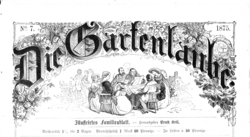
The subtitle was Illustrirtes Familienblatt, an illustrated paper for the family, and the masthead engraving showed exactly that, a grandfather reading aloud to people gathered around a table under the vines.
It was a weekly, 52 issues a year, sixteen to twenty quarto pages set in Fraktur with wood engravings worked into the text. The first print run was five thousand. Four years later it was sixty thousand. Once Keil started running novels a chapter at a time the thing became unstoppable: 160,000 by 1863, 382,000 by 1875, at a moment when a respectable German daily newspaper sold four thousand copies. Because families shared it and lending libraries and coffee houses took delivery, the number of people who actually read each issue is estimated at somewhere between two and five million. At one point it claimed the largest readership of any publication on earth, and the claim was not obviously wrong.
The content was a people's encyclopedia with a plot. Natural science next to biography, poetry next to a serial. Goethe turned up in its pages seventy-five times over the first thirty years. E. Marlitt's Goldelse ran from 1866 and made both the novelist and the magazine famous. Willy Stöwer's drawing of the Titanic going down, the one that got reprinted for the next century, was published here in 1912. Johann Strauss II wrote a waltz for its readers in 1895.
~ the rap sheet ~
| Born | 1853, Leipzig, founded by publisher Ernst Keil |
|---|---|
| Peak | 382,000 paid copies in 1875, two to five million readers |
| Killed | 1944, as Die neue Gartenlaube |
| Lifespan | 91 years |
| Made by | Ernst Keil, with Ferdinand Stolle as first editor |
| Killed by | ninety years of owners, ending at Eher Verlag |
~ what the family was reading ~
The founding politics were radical liberal. It wanted a unified democratic Germany and an educated public to go with it, and it pushed bourgeois virtue hard against aristocratic privilege. In its first two decades the paper was notably decent about Jews, running occasional pieces on Jewish family life, which was not the ordinary position for a German family weekly. After unification in 1871 that reversed. From 1874 to 1876 it published Otto Glagau's attacks on "the Jews" as the authors of the financial crash, and the antisemitism stayed in the house from then on.
Keil died in 1878 with the magazine at its height. In 1886 his widow sold it to Adolf Kröner and his son, who took the politics out and then the religion, and after that anything else that might upset a subscriber. Divorce and suicide became unmentionable. By 1900 the people's encyclopedia was an entertainment weekly.
~ sold four times ~
August Scherl bought it in 1904 and pushed it back toward politics, this time nationalist. One prewar article promised that the coming war would be "the happy, great hour of struggle", and that it was better to live forever on a plaque of heroes than to die nameless in a bed. Scherl's own business failed anyway and he sold out in 1914.
Alfred Hugenberg took the Scherl group in 1916. Over the seventeen years that followed he used his newspapers to help put Hitler in the chancellery, believing Hitler would be his instrument. It worked out the opposite way, and Hugenberg ended up with no influence in the state he had helped build. In 1938 the bulk of that empire was bought by Eher Verlag, the Nazi Party's publisher, which moved the magazine to Berlin and renamed it Die neue Gartenlaube. Circulation had been falling for decades by then. A much thinner version limped through the war and stopped in 1944.
~ in fraktur ~
The whole run is online, scanned and transcribed by volunteers at German Wikisource, which is more care than most dead magazines get. I cannot read it. Fraktur defeats me the way it defeats most people who did not grow up with it, and the German is nineteenth-century anyway. What comes across without the text is the masthead: a family around a table while one of them reads out loud. That was a format description, not decoration. Ninety-one years of a product built for a room where a single copy served the whole household.
diegartenlaube.de is a for-sale page now, German domain parking, a green button and a price on request.
~ leave a rose ~
an anonymous tribute. one rose per visitor per day.
@}-->-- ... roses left here
~ leave a wreath ~
a rose fades by morning. a wreath stays on this grave for good, with your name on it.
paid once through stripe. payments are handled by OÜ Lakeview, the small company that keeps rip.so running. the money pays for the hosting and the nightly digging. adopt it and the headstone reads "maintained in memory by" you. the groundskeeper plants new wreaths at the next tending, usually within a day.
» one email a week: new graves and the anniversaries of the dead. subscribe
other news: Exaro, SVM Mac, Boardwatch, Amiga Survivor
also died in the pre-1980s: Simplicissimus, IMSAI 8080, Comic Cuts
~ leave a note ~
visitors before you have left these graveside notes. anonymous welcome.