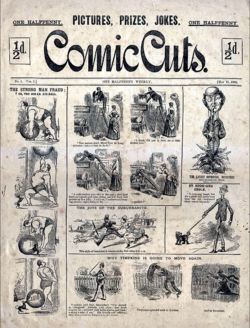
Comic Cuts
~ the obit ~
Alfred Harmsworth was twenty four years old and running Answers, a cut-and-paste weekly of letters and tips largely swiped from American magazines, when he noticed it had stalled at a circulation of 180,000. His fix was to launch something cheaper that could carry an advertisement for it. Comic Cuts came out at a halfpenny, printed in black ink on the cheapest white newsprint going, and the first issue was reportedly assembled in four days by an editor named Houghton Townley.
The title was literal. A "cut" was the trade word for a line block, and the early numbers were exactly that: gag cartoons and jokes lifted wholesale from Life and Harper's, pasted into eight pages. The first issue was cover-dated 17 May 1890, went on sale the preceding Monday, and sold 118,864 copies of a 120,000 print run. Across the top it promised PICTURES, PRIZES, JOKES, with a halfpenny box in each corner. Circulation reached 300,000 soon after, which was 120,000 more than the magazine it had been invented to advertise.
It was aimed at adults, specifically the newly literate working class who could not justify a penny newspaper. Newsagents complained about the margin a halfpenny left them and sold it anyway. Within a few issues the comic was running an announcement asking "clever artists" to send work in, partly because demand had outrun the supply of stealable material and partly because a rival publisher held the reprint rights to some of it. Victorian London was full of broke illustrators. One of the first to answer was a twenty year old named Tom Browne, paid a shilling a week and signing himself Vandyke Browne, whose drawing style became the house standard for British comics for the next forty years.
By the end of 1892 Harmsworth was telling his brother Harold privately that the comic sold 430,000 a week. Figures given to the Advertiser's Protection Society put it at half a million in the 1900s. The magazine invented a fictional editor called Clarence C. Cutts to claim a million readers, described itself as the original comic when it was nothing of the sort, and billed itself as "the poor man's Punch" until Punch's publisher sent legal notices.
~ the rap sheet ~
| Born | 17 May 1890, eight pages for a halfpenny |
|---|---|
| Peak | 430,000 a week at the end of 1892, around half a million in the 1900s |
| Killed | 12 September 1953, issue 3,006 |
| Lifespan | 63 years |
| Made by | Alfred Harmsworth, then Amalgamated Press |
| Killed by | The Dandy and The Beano, plus paper rationing that never really lifted |
~ schemo magnifico ~
Harmsworth's real move came next. Rivals were already copying him, so instead of defending the market he decided to compete with himself and keep both halves. Illustrated Chips arrived ten weeks later as a deliberate sister title, flopped as a text-heavy tabloid, relaunched after six issues as more of the same thing, and became a hit on its own terms. The pair reached combined sales of half a million a week. Harmsworth filed this trick under a private set of publishing rules he had written for himself and called the Schemo Magnifico. By 1898 the Comic Cuts masthead had stopped being coy about what it sold: ONE HUNDRED LAUGHS FOR A HALFPENNY.
In 1901 the family consolidated its holdings into Amalgamated Press. Harmsworth went on to found the Daily Mail, took the halfpenny price into newspapers with it, and died a viscount in 1922. The loss-leading advertisement he had run off cheap newsprint outlived him by thirty one years.
~ the things that ran in it ~
Comic Cuts printed its first full-page strip on 14 February 1891 and kept drifting from single-panel gags toward serialized characters. Jack B. Yeats, brother of the poet, drew a Sherlock Holmes parody called Chubblock Homes that debuted as three frames in issue 184 on 18 November 1893 and grew into a running serial. Frank Holland's burglar Chokee Bill held the front page from February 1897 until 1900. Tom Browne's Squashington Flats arrived in 1895 and was an immediate hit.
Some of what ran in it has no defense. A single-frame feature called Comic Cuts Colony started in 1894 and was revived in 1910, and several of the long-running strips of the 1920s were built on racial caricature the comic reached for whenever it wanted a cheap laugh. It sits in the archive with everything else. By the 1900s the readership had shifted to children, the adults having followed the halfpenny price into the newspapers, and contributors began leaving their work unsigned rather than be known for juvenile fiction.
~ three thousand and six ~
DC Thomson launched The Dandy in 1937 and The Beano in 1938, and the weekly comic market reorganized around them inside two years. Then came paper rationing, which Amalgamated Press handled by canceling story papers to free up its allocation. Comic Cuts survived that round. It absorbed The Jolly Comic in 1939 and Larks in 1940, then was knocked down to fortnightly publication in 1941, and it did not get back to weekly until 22 November 1952.
What kept it alive past its sales, according to the comics researcher W. O. G. Lofts, was nostalgia in the boardroom. Whenever the Amalgamated Press directors sat down to cut underperforming titles and somebody named Comic Cuts, a director who had started his own career as a junior on it would object, and the decision got postponed. The older directors eventually retired.
The last issue was dated 12 September 1953 and numbered 3,006. Illustrated Chips died the same Saturday at 2,997 issues, three short of its own round number, and The Funny Wonder went with them. All three were replaced the following week by a title called TV Fun, and the end of them made the national papers. Comic Cuts was nominally merged into Knockout, which carried over none of its features. The masthead read Knockout and Comic Cuts from 19 September 1953 until 20 March 1954, and then it just read Knockout. The issue count stood as the British record until The Dandy passed it in 1999.
~ leave a rose ~
an anonymous tribute. one rose per visitor per day.
@}-->-- ... roses left here
~ leave a wreath ~
a rose fades by morning. a wreath stays on this grave for good, with your name on it.
paid once through stripe. payments are handled by OÜ Lakeview, the small company that keeps rip.so running. the money pays for the hosting and the nightly digging. adopt it and the headstone reads "maintained in memory by" you. the groundskeeper plants new wreaths at the next tending, usually within a day.
» one email a week: new graves and the anniversaries of the dead. subscribe
other phenomena: Star Wars Kid, Mahir "I Kiss You", Most Awesomest Thing Ever, The Beast
also died in the pre-1980s: Television Electronic Disc, Argosy, Cartrivision
~ leave a note ~
visitors before you have left these graveside notes. anonymous welcome.