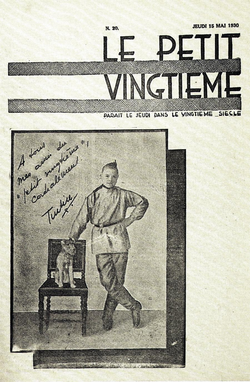
Le Petit Vingtième
~ the obituary ~
Le Vingtième Siècle was a Catholic conservative daily in Brussels, run by an abbot named Norbert Wallez. Georges Prosper Remi turned up there in 1925, aged 18, as a clerk. He left for his military service and came back to a job illustrating the main pages and some of the weekly supplements.
In 1928 Wallez decided the paper needed an eight-page youth supplement, appearing every Thursday, and called it Le Petit Vingtième. He made the 21-year-old illustrator its editor-in-chief. The first issue is dated 1 November 1928, and the comic inside it was written by the paper's sports editor and drawn by Hergé, who thought it was dusty next to what the Americans were running and next to Alain Saint-Ogan.
So he started his own. On 10 January 1929, in issue 11, Tintin in the Land of the Soviets began at two pages a week, with Hergé drawing most of the covers as well. The supplement went from eight pages to sixteen on 23 January 1930, and the extra space launched Quick & Flupke, a gag strip that ran 310 times before the paper folded.
It grew its own publishing arm, Les éditions du Petit Vingtième, which put out the first three Tintin books and the first two Quick & Flupke collections before handing the rights to Casterman in 1934, because Casterman could handle a character who was by then selling in France and Switzerland. Hergé got assistants: Eugène Van Nijverseel, who signed himself Evany, and Paul Jamin, who signed Jam.
~ the case file ~
| Born | 1 November 1928, eight pages, out every Thursday |
|---|---|
| Peak | quadrupled Le Vingtième Siècle's Thursday sales |
| Killed | 9 May 1940 |
| Lifespan | 11 years, 6 months |
| Made by | Le Vingtième Siècle, edited by Hergé |
| Killed by | the German invasion of Belgium |
~ the boy who sold the paper ~
At the end of each of the first three Tintin stories the paper staged an arrival. An actor dressed as the character would come into a Brussels railway station off a train, met by thousands of people who had read about where he had been. Zita of Bourbon-Parma, the last empress of Austria, brought her children to the first one. A deposed Habsburg stood on a Brussels platform to welcome a fictional boy reporter back from the Soviet Union.
The commercial half of this is simpler. Circulation of the parent newspaper quadrupled on Thursdays. A Catholic daily aimed at adults had discovered that the eight pages it added for children were the reason people bought it, a lesson most newspapers did not learn for another thirty years.
In Turkey the albums are completely ordinary objects. Tenten sits in every decent bookshop, hardbacked, in the order Casterman settled on, and nothing on that shelf tells you the stories first ran two pages at a time in a school-age supplement edited for an abbot, opening with a travelogue written to be anti-Bolshevik. The album is the only form that traveled. The thing that printed it first never left Belgium.
~ the final thursday ~
Land of Black Gold started on 28 September 1939 and was still running when the paper stopped. The last issue of Le Petit Vingtième is dated 9 May 1940. Germany invaded Belgium the following morning, the parent newspaper was closed under the occupation that followed, and the serial simply ends where the paper does.
Hergé's brother was taken prisoner in the invasion. He and his wife Germaine drove out of Belgium in an Opel Olympia toward France, reached Saint-Germain-Lembron on 22 May 1940, and sat out the collapse in a village in the Puy-de-Dôme at the invitation of the cartoonist Marijac. On 28 June 1940 he went home to an occupied country with no magazine to draw for.
~ what survived the supplement ~
The new director of Le Soir, by then a German-controlled daily, asked him to build a youth supplement for it. Le Soir Jeunesse appeared on 17 October 1940 built to the dead supplement's exact shape, eight folded pages of comics and features, opening with The Crab with the Golden Claws and introducing Captain Haddock. Paper shortages killed the supplement inside a year, and Tintin moved into Le Soir itself as a daily strip. The story that had been cut off in May 1940 was restarted from the beginning after the war and finished in Le Journal de Tintin, which launched in 1946 and got its own forty-two years.
One artifact of the final months is worth a line. In February 1940 the paper prepared De Bengel, a Dutch-language version of Le Petit Vingtième and the first appearance of Tintin in Dutch. It appears never to have been distributed, and exactly one copy is known to exist.
~ leave a rose ~
an anonymous tribute. one rose per visitor per day.
@}-->-- ... roses left here
~ leave a wreath ~
a rose fades by morning. a wreath stays on this grave for good, with your name on it.
paid once through stripe. payments are handled by OÜ Lakeview, the small company that keeps rip.so running. the money pays for the hosting and the nightly digging. adopt it and the headstone reads "maintained in memory by" you. the groundskeeper plants new wreaths at the next tending, usually within a day.
» one email a week: new graves and the anniversaries of the dead. subscribe
other kids: GirlSense, Playhouse Disney, VizWoz, magnet
also died in the pre-1980s: Servet-i Fünun, Motion Picture Herald, National Telephone Company
~ leave a note ~
visitors before you have left these graveside notes. anonymous welcome.