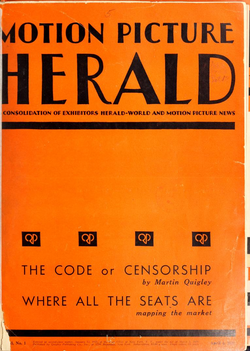
Motion Picture Herald
~ the obituary ~
This was the paper the people who owned the buildings read. Not the studios and not the fans: the exhibitors, the men and women running one screen in a town in Texas or a chain of them in Ohio, who needed to know which picture to book next month and what to charge for it. Martin J. Quigley had been serving that readership out of Chicago since 1915, when he bought into a regional sheet called Exhibitors Herald, and he spent the next sixteen years buying up the competition. Motography went in 1917 and Moving Picture World in December 1927, under a New York Times headline reading "Screen Papers Merged." Motion Picture News followed at the end of 1930.
Motion Picture Herald is what came out of that last merger, and the cover said so: under the logo ran the line "Consolidation of Exhibitors Herald-World and Motion Picture News." The title was entered as second-class matter at the New York post office on 12 January 1931, which dates the start better than the catalogs do, since the volume numbering restarted every quarter and makes the April issues look like a first issue too. Quigley Publishing Company, 1790 Broadway, New York. Weekly, three dollars a year, thirty-five cents a copy.
It ran for forty-one years and stopped with the December 1972 issue. Something called the QP Herald took its place and was gone by May 1973. Nobody involved appears to have written down a reason, and the reference work that supplies the end date supplies nothing else, so the most-cited trade paper in American exhibition history has a death with no cause of record. The family stayed in business around the hole: the International Motion Picture Almanac, the Herald's reference sibling, kept coming out until 2014.
~ the case file ~
| Born | January 1931 at 1790 Broadway, New York, out of Exhibitors Herald-World and Motion Picture News |
|---|---|
| Peak | the Top Ten Money Making Stars poll, filled in by exhibitors and carried by the wire services every Christmas |
| Killed | December 1972 |
| Lifespan | 41 years under that name, 57 counting the Exhibitors Herald it grew out of |
| Made by | Quigley Publishing Company, under Martin Quigley and then his son |
| Killed by | no stated reason; a successor called the QP Herald lasted five months |
~ the code of censorship ~
What lifts it off the trade-paper shelf is what its publisher did in 1930. Quigley was a devout Catholic layman who believed the movies needed a written morality, and he recruited a Jesuit, Father Daniel A. Lord, to draft one with him. The industry's own trade body adopted it on 31 March 1930 as the Production Code. For the next thirty-odd years every American film was cut to fit a document co-written by a man who also owned the paper the exhibitors read.
He was not quiet about it either. The front cover of the volume that opens in April 1931 advertises two pieces: "Where All the Seats Are," a mapping of the market, and "The Code of Censorship, by Martin Quigley." The Media History Digital Library, which ranks the Herald sixth among all the trade journals it has digitized, describes him as a mediator between Hollywood and the Church, and notes that some exhibitors read him instead as a servant of the studios and the big chains. He died on 4 May 1964 at St Vincent's in Manhattan, two days short of seventy-four. The Times obituary headline was "Martin Quigley, Wrote Film Code."
~ what the picture did for me ~
The best department in it was written by its readers. "What the Picture Did for Me" printed short reports from exhibitors on how a booking had actually performed, in their own words, signed with their theater and their town. A sample from 1931: See America Thirst, Universal, reported as a great two-reel comedy ruined to make a feature, too much Harry Langdon, no good for small towns, signed L. L. Levy of the Iris Theatre in Kerens, Texas. The same correspondent found The Lady Surrenders wonderful for little theater groups, who he noted do not come to the picture shows. Those same questionnaires fed the Herald's Top Ten Money Making Stars poll, which the wire services ran every Christmas. On 25 December 1943 the New York Times reported that Betty Grable had taken the Motion Picture Herald's box-office championship for the year.
The column was suspended around the 1930 merger and the readership did not take it well. A letter printed in the spring of 1931 under the heading "Urges Department's Return" begins by telling the editors that the writer's restraint has given way, and continues: I am of the woods, and woody, and I would give the Herald, and all its pleasures, and all its pomps, and all its powers for one slight glimpse of "What the Picture Did for Me." He then lists the pictures he would not have booked if the department had been running, ending with the worst of them.
Those reports are the oldest ancestor I know of for the thing I actually grew up reading. When I started buying hardware off Turkish forums in the early 2000s, the only review worth reading came from somebody who had already paid for the part and lived with it a month, posting under their own handle into a thread other buyers could argue with. Kerens, Texas in 1931 is the same document with a different distribution problem.
~ the blank line ~
Every American periodical had to print an annual statement of ownership, and the Herald's for 1931 is sworn before a notary named Julia E. Copello on 1 April by the business manager, Geo. Clifford. Item five asks for the average number of copies of each issue sold to paid subscribers, and the line is empty, with a parenthesis under it explaining that this information is required from daily publications only. So the paper that existed to count other people's receipts never had to print its own. The best figure anyone has is a comparison: the Media History Digital Library puts Motion Picture Daily at roughly 5,000 copies and about a third of the Herald's readership.
~ the last herald ~
Martin Quigley Jr, who was born in 1917 and served in the OSS during the war, ran Quigley Publishing until 2001 and died in 2011. A grandson was still running it in 2005. The name on the company outlived the weekly by around thirty years, which in trade publishing is normal: the almanacs and the reference CD-ROMs kept selling long after the thing that generated the material had stopped.
Today quigleypublishing.com answers with a page that bounces to a lander, and the lander is a domain for sale. The journalism outlasted the publisher. Volumes of the Herald sit scanned on the Internet Archive out of the Library of Congress collections, so the April 1931 cover selling Quigley's own censorship article is a few seconds away from anybody who goes looking for it.
~ leave a rose ~
an anonymous tribute. one rose per visitor per day.
@}-->-- ... roses left here
~ leave a wreath ~
a rose fades by morning. a wreath stays on this grave for good, with your name on it.
paid once through stripe. payments are handled by OÜ Lakeview, the small company that keeps rip.so running. the money pays for the hosting and the nightly digging. adopt it and the headstone reads "maintained in memory by" you. the groundskeeper plants new wreaths at the next tending, usually within a day.
» one email a week: new graves and the anniversaries of the dead. subscribe
other news: PC Joker, Webwereld, Svět počítačů, Reader's Digest Canada
also died in the pre-1980s: Kee Games, National Telephone Company, Electronic Arrays
~ leave a note ~
visitors before you have left these graveside notes. anonymous welcome.