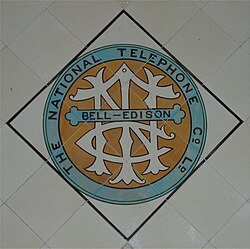
National Telephone Company
~ the last words ~
In 1880 a British court decided that a telephone was a telegraph. The Post Office had gone after the Edison Telephone Company arguing that its wires and instruments fell inside the meaning of Section 4 of the Telegraph Act of 1869, and it won, which meant a telephone conversation was legally a telegram and anyone who wanted to carry one needed a license from the Postmaster-General. The license took a share of the income and carried an option for the state to buy the whole thing out after a set period. Every private telephone company in Britain was therefore born on a timer, and the National Telephone Company was the one that ran the longest.
It was registered on 10 March 1881, based in Glasgow, as the first provincial subsidiary of the United Telephone Company, which held the Bell and Edison patents. Its territory ran from Yorkshire and Nottinghamshire up through part of Scotland, with Ulster attached, and it began by buying out the Bell and Edison operations already working in Glasgow. Within four years it was buying competitors instead, starting with the Dundee and District Telephone Company in June 1885.
By 1894, after it had absorbed its own parent and most of its sibling companies, the only serious challenger left to it was the Post Office, which barely bothered competing outside Newcastle and Cardiff. The company built like something that expected to last: 19 Newhall Street in Birmingham, red brick and terracotta and now grade I listed, opened as a central exchange in 1887, and Telephone House on Temple Avenue in London, commissioned in 1899, which still carries the NT monogram and a set of stone cherubs holding telephone handsets.
~ the record ~
| Born | 10 March 1881, registered in Glasgow |
|---|---|
| Peak | 1,565 exchanges and 561,738 subscribers at handover |
| Killed | 31 December 1911, at midnight |
| Lifespan | 30 years and 9 months |
| Made by | the United Telephone Company, as its first provincial subsidiary |
| Killed by | the purchase option inside its own operating license |
~ the amalgamation habit ~
The merger list reads like an index of British regional ambition. On 1 May 1889 the NTC absorbed the United Telephone Company that had created it, along with the Lancashire and Cheshire Telephonic Exchange Company. The rest of the family followed one at a time: the Northern District Telephone Company on 30 April 1890, then the South of England Telephone Company that October. The Western Counties and South Wales Telephone Company went in on 1 January 1892 and the Telephone Company of Ireland was wound up into it in January 1893. Each arrived with a line count attached, a few thousand at a time, and the Postmaster-General objected to the pattern and could not stop it.
What it could not buy, it fought. A committee of subscribers formed in 1891 to force the rates down. The Duke of Marlborough announced a rival in the same year with a twin-wire system meant to beat the NTC's single wire, and that company was in liquidation by 1894. A court case against Leeds Electric Tramways over interference on the lines went against the telephone company in 1892, on the grounds that the trams had been running before the wires went up.
Living under a single telephone monopoly is not an exotic condition to me. Turkey ran its lines through the PTT and then Türk Telekom, and the first internet connection in my house came down a copper pair that belonged to a company I had no alternative to. What I had never thought about is that the monopoly can be the thing that buys out the competition rather than the thing that got there first, and that the purchase can be written into the paperwork at the start.
~ midnight, and then hansard ~
The handover was fifteen years in preparation. The trunk network went first, transferred from April 1896 and finished on 6 February 1897. A November 1901 agreement stopped the two sides duplicating plant in London and connected the two London systems to each other for the first time. A further agreement in force from 1 September 1905 began the actual unification work, pointed at the expiry of the license on 31 December 1911. BT's own archive records the end in one line: the assets passed to the Post Office at midnight on 31 December 1911, and the company went into liquidation. Arbitration over what it had all been worth did not begin until June 1912.
What the state got that night was 1,565 exchanges serving 561,738 subscribers. Hull and Portsmouth kept their municipal systems, and so did Guernsey; everywhere else, the Post Office was now the only telephone company in the country. It did not go smoothly. By 22 February 1912 the Postmaster-General was standing in the Commons explaining complaints about the London service, blaming difficulties "incidental to a transaction of such magnitude as the transfer of the National Telephone Company's undertaking to the State", and specifically the 5,150 subscribers and 1,950 junction circuits moved off the old Westminster and Avenue exchanges, whose equipment "was not of a modern type" and whose leases were running out. Asked whether people had not complained just as much before the transfer, Herbert Samuel agreed that they had: the service "has always been the subject of complaint, and the complaints are by no means new".
~ leave a rose ~
an anonymous tribute. one rose per visitor per day.
@}-->-- ... roses left here
~ leave a wreath ~
a rose fades by morning. a wreath stays on this grave for good, with your name on it.
paid once through stripe. payments are handled by OÜ Lakeview, the small company that keeps rip.so running. the money pays for the hosting and the nightly digging. adopt it and the headstone reads "maintained in memory by" you. the groundskeeper plants new wreaths at the next tending, usually within a day.
» one email a week: new graves and the anniversaries of the dead. subscribe
other connectivity: J-Sky, AboveNet, Tele-Communications Inc., Netscape Online
also died in the pre-1980s: Kee Games, MITS, Studebaker
~ leave a note ~
visitors before you have left these graveside notes. anonymous welcome.