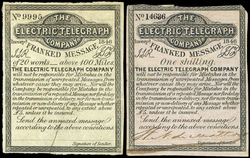
Electric Telegraph Company
~ the last words ~
The electric telegraph was already famous before anyone built a business on it. Railway companies had strung Cooke and Wheatstone's instruments along their lines to signal trains, each system the private property of the railway that paid for it, and in 1843 Cooke extended the Great Western's wire to Slough at his own expense and opened that one line to the public at a shilling a message. What did not exist was a company whose actual trade was carrying messages for strangers. The Electric Telegraph Company, registered in September 1845 and incorporated by its own Act of Parliament in 1846, was the first of those anywhere in the world.
Cooke founded it with John Lewis Ricardo, the member of parliament for Stoke-upon-Trent, and the company set up at Founders Court in Lothbury, behind the Bank of England. It was authorized at £600,000 and owned by almost nobody: eight shareholders between them held the whole paid-up stock, and the company never advertised its shares in the press. It bought every patent Cooke and Wheatstone had obtained, paying Cooke around £50,000 and Wheatstone £30,000, and took Edward Davy's electric relay for £600, which was the piece that let a signal weakened by distance be renewed and pushed onward. Charles Wheatstone was not in it. His collaboration with Cooke had collapsed into a long argument over which of them had invented the telegraph, went to arbitration in 1841 and produced no winner, and the company was formed without him.
On 1 January 1848 it opened the world's first central telegraph station at Founders Court, with 1,524 miles of line in use or under construction, a colonnaded public hall lit from a skylight and two galleries of instrument compartments, no windows anywhere in the building and gas burning day and night. Growth came off the railways: by 1848 it had wire along half the railway miles then open in Britain, and those contracts usually carried exclusive rights to the route, which is the moat that kept later entrants off the tracks and into the roads.
Ordinary public use lagged because a message cost too much. The maximum for twenty words over any distance was fixed at ten shillings in March 1850 and cut to eight and six a year later, and it kept falling as competitors arrived. By 1855 the company was working 27,711 miles of wire through 404 stations and handling 717,404 messages a year.
~ the record ~
| Born | 1846, by the Electric Telegraph Company's Act |
|---|---|
| Peak | 10,007 miles of line and 3.7m messages in 1868 |
| Killed | 5 February 1870, nationalized under the Telegraph Act 1868 |
| Lifespan | 24 years |
| Made by | William Fothergill Cooke and John Lewis Ricardo |
| Killed by | the General Post Office |
~ founders court ~
What the company proved, and then had taken off it, is that a telegraph network is a natural monopoly. It bought up rival patents as policy: when Henry Highton patented a gold-leaf instrument, the company bought it. Its one serious rival, the Magnetic, got round all that by using a system the patents did not cover and burying cable along public highways rather than fighting for railway wayleaves, and the two of them were effectively a duopoly to the end. In July 1855 their chairmen signed an unpublished agreement fixing message rates between them on a joint national tariff.
One clause in the founding act deserves attention. Parliament reserved to the government the right to take the company's resources in a national emergency, and in April 1848 it used that power against the Chartists, disrupting the movement's communications around the Kennington Common demonstration. Twenty years later the state used a different statute to take the whole thing permanently.
It also went to sea. The company merged with the International Telegraph Company in 1855 to become the Electric and International, and it ran the Monarch, bought for £6,250 and the first ship anywhere permanently fitted out as a cable layer. The Monarch put wire under the sea to the Netherlands and Ireland, later to the Channel Islands and the Isle of Man, and laid a private line across the Solent so that Queen Victoria could telegraph from Osborne House.
~ ten shillings to four ~
The office at Great Bell Alley in Moorgate, which the company moved its London operations to in 1859, was laid out over three floors and staffed by a large number of men and boys on an accelerating scale of pay. It also employed a significant number of women from a higher social class to work the Wheatstone needle instruments. They were paid less than the men and were required to leave when they married. Maria Craig, an early employee, made supervisor. The street was later renamed Telegraph Street in the company's honor, and a pub called The Telegraph stands on the site now.
The scale at the end is worth setting out, because it is larger than the company's reputation suggests. In 1868, its last full year working for itself, the Electric and International had paid-up capital of £1,177,425 with only £7,550 of that on loan, ran 10,007 miles of line carrying 50,065 miles of wire across England, Wales, Scotland and Ireland, owned 7,245 instruments, and employed 1,465 clerks alongside 759 messengers who between them moved 3,137,478 inland messages and 539,188 foreign ones. It was the largest private employer in the City of London. Net profit had climbed every year from £67,363 in 1862 to £171,843 in 1868.
~ what the post office inherited ~
The Telegraph Act 1868 received royal assent on 31 July that year, under a long title that said exactly what it meant: an Act to enable Her Majesty's Postmaster General to acquire, work, and maintain Electric Telegraphs. Section 8 named the Electric and International first of the three big companies and set the price at twenty years' purchase of the net profits for the year ending 30 June 1868. The company kept building anyway. Its last new office opened at Wick in Caithness on 25 September 1868, reached by a difficult coastal circuit running down to Golspie, eight weeks after the Act that ended it became law.
A member told the Commons in July 1869 that the Electric and International would receive £2,900,000 against a total capital and debenture debt of £1,240,000. Shares that stood at 132 in January 1867 were at 255 by July 1869. The last meeting of shareholders, on 17 August 1869, declared a dividend of 25 percent and voted £5,000 in staff bonuses. The officers held a farewell dinner on 11 January 1870, and the company carried on working until 5 February 1870, when it stopped. Around thirty firms went across. The Post Office took 1,058 telegraph offices, another 1,874 at railway stations and 60,000 miles of wire, and the central telegraph office of the new state service was the company's own building.
Two things happened on the way out that are worth recording. The directors, on handing the business over, are said to have ordered the destruction of the company's historic documents and files, which is why so much of what is known about it has had to be reassembled from outside. And the Monarch, sent out on her first cable job for the Post Office, broke down beyond repair and was demoted to a coal hulk.
The nationalization itself went badly. The Post Office had promised Parliament £600,000 a year net from the telegraphs and was earning £36,725 by 1875, with working expenses running at over 96 percent of income. By 1873 it had moved £812,000 out of Post Office Savings Bank deposits without parliamentary authority to cover the gap. When the Treasury found it the Postmaster General resigned, and Frank Scudamore, the civil servant who had driven both the takeover and the raid, left for Ottoman Turkey in 1875 to reorganize the Turkish posts. William Fothergill Cooke, paid around £50,000 for his patents in 1846 and knighted in 1868, died in 1879 leaving an estate of £16. The company's last chairman left £112,500.
The wire itself never stopped. The Post Office telegraph monopoly became Post Office Telecommunications in 1969, was separated out as British Telecom in 1981, privatized in 1984, and has traded as BT since 1991. A company that stopped working on a Saturday in February 1870 is the oldest root of the British telephone network, and the argument the Victorians had about who should own the wires is the argument everyone is still having.
~ leave a rose ~
an anonymous tribute. one rose per visitor per day.
@}-->-- ... roses left here
~ leave a wreath ~
a rose fades by morning. a wreath stays on this grave for good, with your name on it.
paid once through stripe. payments are handled by OÜ Lakeview, the small company that keeps rip.so running. the money pays for the hosting and the nightly digging. adopt it and the headstone reads "maintained in memory by" you. the groundskeeper plants new wreaths at the next tending, usually within a day.
» one email a week: new graves and the anniversaries of the dead. subscribe
other connectivity: Bredbandsbolaget, Svyazinvest, Rabbit, NYNEX
also died in the pre-1980s: Sony CV-2000, PlayTape, Penn Central
~ leave a note ~
visitors before you have left these graveside notes. anonymous welcome.