Telex
~ the obit ~
Telex was never in a house. That is the whole reason it sits outside anything I can remember: the first modem I had, in 1998, was a thing that lived in a bedroom and screamed at a phone line, and a telex machine was a thing that lived in an office with a company name on the door. Nobody got a telex number because they wanted one. You got one because you ran a business that other businesses needed to reach in writing.
It started as a German research program in 1926 and became an operational teleprinter service in 1933. The idea was to give teleprinters a dialed switching network of their own rather than a leased line nailed between two fixed machines. Every subscriber became reachable from every other subscriber, which is the trick the telephone had already pulled, applied to text instead of voice.
From there it turned into the standard way companies talked to each other across borders, and it stayed that way for about fifty years. West Germany alone had 123,298 telex connections by 1978. Shipping agents ran on it because a ship at sea was reachable through a coast station, and newsrooms ran on it because that is how the wire services delivered copy to a desk overnight.
The reason it outlived its own obituary was legal rather than technical. When you connected, the exchange pulled an answerback code off a mechanical drum inside the machine at the far end and printed it on your paper. That gave the sender proof that a named subscriber had received a specific text, with a time on it, which is exactly what a fax could not do and email would not do properly for another twenty years.
~ the rap sheet ~
| Born | 1933, as a switched teleprinter service in Germany |
|---|---|
| Peak | 123,298 telex lines in West Germany alone by 1978 |
| Killed | 31 August 2020, when the Lugano exchange was decommissioned |
| Lifespan | 87 years |
| Made by | the Deutsche Reichspost, then every national post and telegraph administration |
| Killed by | fax first, then email |
~ the machine in the corner ~
The hardware was slow on purpose. Telex ran at 50 baud on a five-bit code, which is roughly six or seven characters a second, and the character set had no lowercase in it. Everything ever sent by telex was in capitals because the alphabet only went that far. That constraint is where the clipped telegram register came from, the one that drops articles and pronouns and ends up sounding like a ransom note, since every character cost money and time.
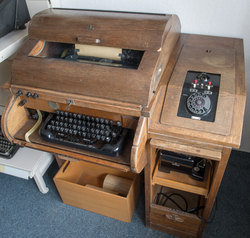
The machines themselves were built like typewriters that had been told to expect abuse, and they ran unattended. A telex arriving at three in the morning printed itself onto the roll and waited. That was the actual product being sold, not speed.
~ why it took so long to die ~
Fax arrived in the 1980s and took the informal traffic almost immediately, because a fax could carry a drawing and a signature and did not require the other office to own a specific machine on a specific network. Email took the rest in the 1990s, and SWIFT had already taken the banks. Neither fax nor email could produce the thing a telex produced, though, which is why the service survived in shipping and in the parts of government that write the rules about what counts as delivery.
So it became an expense that was easier to keep paying than to argue about. Subscribers dropped away one national network at a time. British Telecom stopped taking new telex customers in 2004 and shut its service in 2008, which is roughly when most of Europe finished the job.
~ the last exchange ~
The end of the network has an address. Hasler of Berne built a family of telex exchanges called the T200, the first of which went into service in Hong Kong on 2 February 1972. Over fifty of them ran in sixteen countries. When Swisscom wanted out, it encouraged a small private company called SwissTelex to take over the T203 exchange in Lugano, which by 2015 was still carrying subscribers in twenty countries who had nowhere else to go.
On 31 August 2020 that exchange was decommissioned, and the eighty-seven year old international telex network stopped being a thing you could dial. Its triplicated processor went to the Museum for Communication in Bern. There are telex-over-internet gateways still selling to shipping companies, and a hobbyist network keeps real machines talking to each other, but the switched public service that every country once ran is finished.
~ leave a rose ~
an anonymous tribute. one rose per visitor per day.
@}-->-- ... roses left here
~ leave a wreath ~
a rose fades by morning. a wreath stays on this grave for good, with your name on it.
from $1, paid once through stripe. it keeps the graveyard running: the hosting and the nightly digging. adopt it and the headstone reads "maintained in memory by" you. the groundskeeper plants new wreaths at the next tending, usually within a day.
» one email a week: new graves and the anniversaries of the dead. subscribe
other connectivity: Ebone, PC Card (PCMCIA), ExpressCard, Marconi
also died in the 2020s: Mediavideo, Atrium, The Subservient Chicken
~ leave a note ~
visitors before you have left these graveside notes. anonymous welcome.