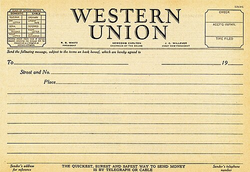
Western Union Telegram
~ the obituary ~
The telegram reached me as grammar rather than as a service. Turkish still has telgraf çekmek, to pull a telegram, and it is a live phrase that people use without any expectation of a wire being involved. That is what a technology leaves behind when it has been gone long enough: a verb with nothing under it.
Western Union was incorporated in 1851 under a longer name, took the short one in 1856, and finished the first transcontinental telegraph line in 1861. For most of the following century it was how urgent news traveled in the United States. Births, deaths, contracts, war department notifications. The physical form of it, a printed strip pasted onto a yellow sheet and handed over at a door, is one of the most recognizable objects of the twentieth century and nobody under forty has held one.
The peak was 1929, with two hundred million messages in a single year. That was the last moment when a telegram was cheaper than a long distance phone call, and the whole business rested on that one comparison. Once it stopped being true the decline ran for seventy-six years without ever quite finishing, because there was always somebody who needed a signed physical delivery or a legally provable timestamp.
~ the case file ~
| Born | 1851, as the New York and Mississippi Valley Printing Telegraph Company |
|---|---|
| Peak | 200 million telegrams carried in 1929 |
| Killed | 27 January 2006, when Telegram and Commercial Messaging services ended |
| Lifespan | a hundred and fifty-five years |
| Made by | Western Union |
| Killed by | cheap long distance calling first, then email and text messages |
~ what a word cost ~
Telegrams were priced per word, and that single fact rewrote how a generation of people wrote. Articles and conjunctions came out first. Punctuation went next, replaced by the word STOP, because a period could be lost in transmission and a word could not. The result was a compressed register that reads today like a text message with better manners.
It also produced a class of professional compression. Newspapers ran cable desks whose job was to expand wire copy back into English. Businesses bought code books that mapped whole sentences to five-letter groups so a paragraph could travel as one billed word. The economics of a channel shaping the language on it is not a new observation, but the telegram is the oldest large-scale case of it anyone can still read.
~ the last ten ~
Western Union announced on its website that Telegram and Commercial Messaging services would end effective 27 January 2006. There was no ceremony and no press release worth the name. The story broke in the first days of February, more than a week after the service had already stopped, when somebody noticed the page.
The company later described the final ten messages. Birthday wishes, condolences on a death, notification of an emergency, and several from people who had worked out what was happening and wanted to be the last. Twenty thousand telegrams had gone out across all of 2005, against two hundred million in 1929. The service had been running on sentiment and on the small number of legal situations that still wanted paper.
~ the pivot ~
The part that gets lost is that Western Union did not die. It is a large company today and it has been a money transfer business for far longer than most people assume. Moving money by wire was a side effect of having a telegraph network, and by the 1980s the side effect was the business while the messages were the legacy obligation.
The telegram itself did not fully stop either. International Telegram, trading as iTelegram, took over the American service on the same day Western Union left it and still delivers them. That is the usual shape of these endings: the product survives at a scale so small it no longer counts as a fact about the world.
~ what stayed in the language ~
What died on 27 January 2006 was not the ability to send a telegram. It was the assumption that a telegram was a thing that existed, sitting in the background of every American town with an office and a counter. That assumption had been quietly false for decades and the announcement simply made it official.
The residue is linguistic and it is durable. English kept telegraphic as an adjective for terse writing, and Turkish kept its verb for an act nobody performs. Films still use the yellow sheet as shorthand for bad news arriving from far away, which works on audiences who have never seen a real one. A hundred and fifty-five years of infrastructure ended up as a tone of voice, which is more than most services manage.
~ leave a rose ~
an anonymous tribute. one rose per visitor per day.
@}-->-- ... roses left here
~ leave a wreath ~
a rose fades by morning. a wreath stays on this grave for good, with your name on it.
from $1, paid once through stripe. it keeps the graveyard running: the hosting and the nightly digging. adopt it and the headstone reads "maintained in memory by" you. the groundskeeper plants new wreaths at the next tending, usually within a day.
» one email a week: new graves and the anniversaries of the dead. subscribe
other connectivity: Network General, ARPANET, AOL Dial-Up, Hellas Online
also died in the 2000s: Enron, Outlook Express, Fake IPL Player
~ leave a note ~
visitors before you have left these graveside notes. anonymous welcome.