ARPANET
~ the obituary ~
The network everything else grew out of was switched off on 28 February 1990. I was six years old and eight years away from hearing a modem for the first time, so this is a grave I can only read about. By the time a dial-up line in Turkey put me on the internet, ARPANET had been gone for most of a decade and nobody around me had ever heard the word.
It started on 29 October 1969 at half past ten at night, when a programmer at UCLA tried to type the word login into a machine at Stanford Research Institute and the far end crashed after two letters. The first thing ever sent across the ancestor of the internet was "lo". Two more sites came up before December, and that was the entire network: three computers in California and one in Utah.
ARPA paid for it. Bolt Beranek and Newman built the boxes that made it run, Interface Message Processors, minicomputers the size of a refrigerator that sat between each host and the leased phone line and did the packet switching. The idea under test was that a message could be broken into pieces and put back together at the far end, with every piece free to take whatever route was open at that moment. Most of the telephone industry considered this a poor way to build a network.
~ the case file ~
| Born | 29 October 1969, first host-to-host message sent from UCLA |
|---|---|
| Peak | 213 host computers by 1981, and 113 nodes before the 1984 military split |
| Killed | 28 February 1990 |
| Lifespan | twenty years and four months |
| Made by | ARPA, with the switching hardware built by Bolt Beranek and Newman |
| Killed by | NSFNET, and the internet it had already become |
~ what it actually was ~
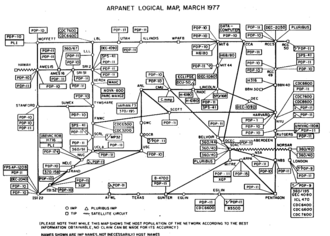
For most of its life ARPANET was small. Nine nodes by the middle of 1970 and forty by late 1973, carrying 213 host computers between them by 1981. It was a research instrument paid for by the US defense department and used by a few thousand people at universities and contractors, and the thing it existed to prove was already proven by about 1972. Everything after that was operations.
The part nobody planned was what the users did with it. Electronic mail was written in 1971 as a side project by an engineer at BBN and within two years it was most of the traffic on the network. A network built to let researchers share expensive computers turned out to be a network for talking, which is the single most reliable finding in the history of this website.
~ the handover ~
On 1 January 1983 ARPANET dropped its original Network Control Program and switched to TCP/IP in a single scheduled cutover. It is remembered as flag day, and it is the reason the internet has one protocol family instead of a museum of them. Some sites were not ready and lost service for weeks. In September 1984 the military hosts were split off into MILNET, which took the network from 113 nodes down to 45.
What was left was a research network that other research networks had outgrown. NSFNET came up in 1986 on faster links with a broader mandate, and the traffic went there. By the end of the decade ARPANET was slower than the thing it had spawned and cost real money to keep running.
~ the day it died ~
The decommissioning was administrative. Sites were migrated off through 1989, the remaining IMPs were unplugged, and on 28 February 1990 the network formally stopped existing. There was no outage anyone noticed, because every host worth reaching had already been reachable another way for years.
Vint Cerf, who co-wrote the protocols that replaced its original ones, marked it with a poem called Requiem for the ARPANET. "It was the first, and being first, was best, but now we lay it down to ever rest." A network died and the people who built it wrote verse about it, which tells you how much of the early internet was made by people who understood exactly what they had done.
~ leave a rose ~
an anonymous tribute. one rose per visitor per day.
@}-->-- ... roses left here
~ leave a wreath ~
a rose fades by morning. a wreath stays on this grave for good, with your name on it.
from $1, paid once through stripe. it keeps the graveyard running: the hosting and the nightly digging. adopt it and the headstone reads "maintained in memory by" you. the groundskeeper plants new wreaths at the next tending, usually within a day.
» one email a week: new graves and the anniversaries of the dead. subscribe
other connectivity: Network General, Western Union Telegram, Arcor, LibertySurf
also died in the 1990s: Spinnaker Software, Philips CD-i, New Century Network
~ leave a note ~
visitors before you have left these graveside notes. anonymous welcome.