Dial-up Internet
~ how it started ~
Dial-up internet, in the consumer sense, lived from about 1992 (when AOL and CompuServe and Prodigy made it mass-market) until about 2005 (when broadband DSL and cable surpassed it in most western markets). In peripheral markets and rural areas, dial-up persisted into the 2010s, though the last AOL dial-up customer was reportedly disconnected in 2024.
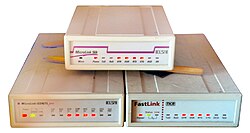
The technology itself was not glamorous: a modem on your computer dialled a phone number, the modem on the other end answered, and the two of them negotiated a connection over the same audio channel that carried voice. The maximum theoretical speed was 56 kilobits per second, which translates to roughly 7 kilobytes per second of useful download. A single mp3 took 10 minutes. A movie took a weekend.
~ the rap sheet ~
| Era | ~1992, ~2005 (consumer mainstream) |
|---|---|
| Peak speed | 56 kbps (V.90 standard) |
| Realistic download speed | ~5 KB/s |
| Time to download a 4MB MP3 | 13 minutes (when nothing went wrong) |
| Killed by | DSL, cable broadband, the cell network |
~ the handshake ~
The single most evocative sound of the early consumer internet was the dial-up handshake. About 25 seconds of escalating squeals, beeps, hisses, and white noise. It begins with a dial tone (familiar), though it dials the number (a series of fast tones). It hears the answering modem (a sustained tone). Then the two modems begin negotiating: which protocol, which speed, which compression. A high-pitched static eruption. A descending tone. A second escalation. Then, suddenly, silence. You were online.
The sound is now classified as ASMR. It is one of the most-commented audio clips on YouTube. People in their thirties and forties report it producing physiological calm, because the reason is straightforward: that sound preceded reading something on the early internet, talking to friends on AIM, downloading a song from Napster. The sound of arrival in a new world. It is associated with anticipation, freedom, and possibility, in a way that wifi static absolutely is not.
~ the phone-line wars ~
Dial-up tied up your home phone line. While you were on the internet, nobody could call your house. While someone was on the phone, you could not use the internet, which is why this produced two genres of household conflict that no longer exist:
The "GET OFF THE INTERNET" call. A parent or sibling needs to make a phone call. They pick up the receiver. They hear the modem static. They scream up the stairs. The internet user, mid-Napster download, has to disconnect, losing the half-finished file forever. The screamer makes their three-minute phone call. The internet user reconnects. The download must restart from zero, because there were no resumable downloads in 1999.
The "I'M EXPECTING A CALL" preemption. The reverse: a parent forbids internet use because they are waiting for an important phone call. The teenager is forced to wait, on the couch, in physical reality, like a person from history.
~ the pay-by-the-hour era ~
Most of the western world transitioned to "unlimited" dial-up by 2000, but in many countries, especially in eastern Europe, southern Europe, Turkey, the Middle East, and most of the global south, dial-up was billed by the minute. Phone companies treated each minute online as a metered call.
This produced a culture of frantic efficiency. You logged in, performed your tasks, check email, download the song you'd queued up on a friend's computer earlier, briefly look at one website, and logged off as fast as possible. Bills were terrifying. Many parents will remember a child's first month of unsupervised internet use producing a phone bill the size of a car payment.
~ what dial-up gave us ~
The discipline of finite use. Every minute online cost something, either money, or a phone line, or a parent's patience. You used the internet with purpose. You did not "scroll" anything. The infinite-feed model of the modern internet is partly a function of how cheap connectivity became.
The gravity of downloads. A 50MB file was an event. You started it before bed. You woke up to see if it had completed. You celebrated when it had. The current relationship with files (download with a click, forget about it) is missing this gravity.
The friend with broadband. Someone in your social circle, usually a slightly older friend or a friend with a wealthier parent, had broadband first. Their house became a portal. You went over with a stack of CDs to burn. They were generous. The early internet had a sharing infrastructure that flowed through actual physical houses.
~ the void ~
The patient relationship with bandwidth. We complain when a Netflix episode buffers for two seconds. A dial-up child waited four minutes for a single web page to render and considered it an expected experience. The modern internet has trained us into infant-level patience thresholds.
The handshake as a ritual. There was a specific sequence of sounds that meant "the rest of the world is now reachable from this room." It was a transition. Logging in was an event. Wifi has no equivalent rite of passage.
~ the eulogies ~
"my mum once unplugged the phone cable mid-download because she was 'waiting for a call from your aunt.' the aunt called. the call lasted ninety seconds. my download had been at 87%. i did not speak to my mum for four days." - e.k. 40
"i still know the dial-up number for our local ISP from 1998 by heart. i do not know my own current home phone number. the brain prioritises differently than we do."; b.ö. 44
"i played the dial-up sound at my wedding for the slideshow transition between baby photos and adult photos. half the room cried. they thought i was being clever. i was not. i miss it that much.", i.t. 42
~ leave a tribute ~
visitors before you have left these graveside notes. anonymous welcome.