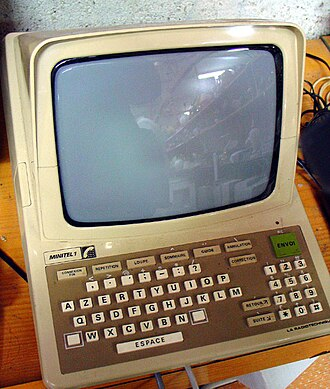
Minitel
~ the obit ~
minitel was a public online network operated by the french state telecom from 1980 to 2012. terminals were given out for free to french households starting in 1982. by the late 1980s several million homes had one sitting next to the rotary phone. by the mid-1990s peak there were about 25 million users on a network of around 9 million terminals. it was the largest pre-web online system in the world.
i never used minitel. turkey had nothing like it. when i got online in late 1998, the dial-up internet was the only "online" anyone here knew. but minitel had been giving french households online banking, train booking, news, chat, and adult services since before i was in school. it is one of the more interesting "what could have been" stories in computing history.
the system worked through small dedicated terminals (the most common one was the Minitel 1, which was essentially a small CRT screen plus a keyboard plus a built-in modem). you connected by typing a service code: 3615 plus a name. so 3615 ULLA was the famous adult chat service. 3615 SNCF was train booking. 3617 was a higher-priced premium tier. each service was a partner of france télécom that paid revenue share for traffic.
france télécom announced the shutdown years in advance. the system was retired on 30 june 2012, with a small ceremony at the france télécom site that had hosted the central servers. by then it had been a slowly fading product for over a decade. the web had been eating it since 1998. but it had been online and useful for over thirty years, which is more than most things on this site can claim.
~ the rap sheet ~
| Born | July 1980 (Vélizy trial), 1982 (national rollout) |
|---|---|
| Killed | 30 June 2012 (France Télécom official shutdown) |
| Lifespan | 32 years (formal), ~30 years as a real service |
| Made by | Direction Générale des Télécommunications (later France Télécom, now Orange) |
| Peak users | ~25 million (mid-1990s) |
| Killed by | the world wide web, low-cost internet access in france in the 2000s |
~ how it actually worked ~
the terminal was the magic. minitel 1 was a small fixed-function computer with a 9-inch monochrome screen, a tiny keyboard with a slightly weird layout (the AZERTY plus minitel-specific keys), and a 1200-bps modem built in. you plugged it into your phone line. you turned it on. you got a connection screen. that was the whole interaction model.
the service codes were the magic. you typed 3615 (or 3614, 3616, 3617 for different price tiers) and then the four-letter code for the service. 3615 SNCF for trains. 3615 LIBE for the libération newspaper. 3615 ULLA for the famous chat. each service rendered itself in the minitel's pseudo-graphics character set. menus were numbered. navigation was function keys.
the billing was the magic. minitel calls were charged by the minute, with the rate depending on which prefix you dialed (3613 was free for some basic services, 3615 was the standard tier, 3617 was premium). france télécom collected the money on the phone bill and shared revenue with the service provider. this gave service providers a reliable revenue model decades before the web figured out how to charge for anything.
~ what it offered ~
the catalog was deeper than people remember. minitel had thousands of services at peak. SNCF train booking. the white pages directory (the original killer app, replacing physical phone books). banking from BNP and crédit agricole. weather forecasts. lottery results. classified ads. dating services (the "minitel rose" or "pink minitel" was the adult side, and it was reportedly enormous).
3615 ULLA was the most famous service in the cultural memory. it was an adult chat service, you typed messages to strangers, you paid by the minute, the revenue was massive. french newspapers wrote about it constantly. the shape of the discourse around 3615 ULLA in the 1990s looks a lot like the shape of the discourse about chat platforms thirty years later. moral panic, then normalization, then irrelevance.
the SNCF train booking is what most french people actually used minitel for in the 1990s. you typed in your departure and arrival cities and the date, you got a list of trains, you booked. tickets came in the mail or you collected them at the station. this single service is what kept minitel relevant well into the late 1990s, because it was just genuinely better than calling SNCF on the phone.
~ how the web killed it (slowly) ~
the web arrived in france like everywhere else around 1995 to 1996. for a few years it competed with minitel without obviously winning. minitel had the existing user base and the established billing model. the web had html and pictures and faster connections. by the late 1990s french isps were offering low-cost monthly subscriptions, and the per-minute minitel model started looking expensive.
the SNCF train service moved to the web in 2000. that was the canary. once the killer app was on the web, the rest followed. by 2005 most minitel services had migrated to the web or had simply shut down. minitel was kept alive for the older users who had not switched, and for the small fraction of services that were still profitable enough to maintain.
france télécom announced the planned shutdown years in advance. the actual shutdown on 30 june 2012 was a quiet affair. the official press release was sentimental. french newspapers wrote retrospectives. some early-internet historians made pilgrimages to the france télécom site that day. then it was gone.
~ what it taught us ~
the public-network model worked. minitel proved that a centrally-coordinated online network with free terminals and a per-minute billing model could reach mass adoption. that model is also why minitel could not evolve once the web arrived. the central control that gave it a head start was also what kept it from doing what the web did.
the billing model worked too well. french service providers got hooked on the per-minute revenue from minitel. when the web arrived they were slow to adapt because they were used to a model where someone else (france télécom) collected payment for them. the web's "no built-in billing" was a feature for users and a frustration for service providers. minitel's billing was a feature for providers and an exit barrier for users.
the cultural memory in france is real. french people who were adults in the 1990s remember minitel the way americans remember AOL. it was where you went online. it was the first interactive computing experience for many people. it left a kind of national-level digital nostalgia that does not have an exact equivalent in any other country, because no other country had a single national online system at that scale for that long.
~ leave a rose ~
an anonymous tribute. one rose per visitor per day.
@}-->-- … roses left here
~ leave a note ~
visitors before you have left these graveside notes. anonymous welcome.