Look-in
~ the obituary ~
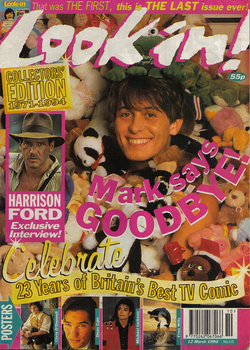
The final cover says it in a pink flash across the top: that was the FIRST, this is the LAST issue ever. Below it sits a badge reading collectors' edition, with 1971 and 1994 printed inside, next to a line about celebrating 23 years of Britain's best TV comic. The price was 55p and the date was 12 March 1994, number ten of that year, with a Harrison Ford interview flagged on the left side.
Look-in started on 9 January 1971 and called itself the Junior TVTimes, which was close to literal. It came out of the publisher behind the listings magazine and existed to tell children what was on the commercial network. Alan Fennell edited it, having written episodes for most of Gerry Anderson's series, and Angus Allan wrote most of the comic strips.
The strips were the actual product. If a show was running on ITV that season there was a drawn version of it in Look-in, starting with Timeslip and Freewheelers in 1971 and moving through On the Buses and Follyfoot as the schedule turned over. Around them went a child's whole week: Ed Stewart ran a page called Stewpot's Newsdesk until 1980, Brian Moore wrote about football and Peter Fairley handled the science, and when skateboarding and BMX arrived the magazine covered those too. Pop took the other half of the page count, in pull-out pin-ups and in invented adventure stories starring whoever was charting, Madness and Bucks Fizz included.
By the late 1980s the sales were going and the magazine kept lowering the age it was written for. ITV's publishing arm handed it to IPC in 1991, which bought it three more years of shorter articles and strips based on cartoons rather than on shows anyone was watching live.
~ the case file ~
| Born | 9 January 1971, subtitled Junior TVTimes |
|---|---|
| Peak | covers painted in acrylics by Arnaldo Putzu, who had designed Carry On posters |
| Killed | 12 March 1994 |
| Lifespan | 23 years |
| Made by | Independent Television Publications, then IPC Magazines from 1991 |
| Killed by | Fast Forward, which arrived in 1989 and outsold it |
~ the man who painted the covers ~
For the first 39 issues the covers were photographs of the stars featured inside. From issue 40 they became paintings by Arnaldo Putzu, an Italian artist working in London who had spent the 1960s designing British cinema posters, Carry On films among them. He worked in acrylics and painted the week's faces the way a poster painter does, slightly larger than life, which gave a disposable children's weekly a cover style no other magazine on that shelf had.
That ended in September 1981. Look-in redesigned, took a new logo, and went back to photographs of bands and shows. The painted Muppets gave way to stills from Knight Rider and The A-Team, and from then on the cover looked like everything else.
~ who took the readers ~
The BBC put out a rival called BEEB in 1985 that lasted briefly. The real damage came in 1989 with Fast Forward, which went on to outsell it. On one side Smash Hits and Shoot were doing music and football properly, with photographs and glossier paper, and on the other Beano and Dandy plus imported Marvel and DC titles had the comic reader. A magazine that was half of each had nowhere to stand.
This product could not have been made where I grew up. Look-in was a guide to one commercial network, written for children who could recite the Tuesday lineup, and Turkish television until 1990 was the state broadcaster and nothing else. Private channels only started reaching homes here the year I turned six.
So by the time Turkey had a television week worth building a children's magazine around, the British original was already dying. A schedule you could buy as a comic, with the shows drawn in it, is a thing I only know about secondhand. Mine was whatever channel happened to be on.
~ the goodbye issue ~
Look-in put out annuals and Summer Specials for most of its run, and Carlton Books reprinted a Best of the Seventies in 2007 and a Best of the Eighties the year after, which is how the Putzu covers got a second life in hardback. The final issue itself survives online as a fan's scan of all its pages, hosted on a free web account with an advertising banner stapled above the cover.
~ leave a rose ~
an anonymous tribute. one rose per visitor per day.
@}-->-- ... roses left here
~ leave a wreath ~
a rose fades by morning. a wreath stays on this grave for good, with your name on it.
paid once through stripe. payments are handled by OÜ Lakeview, the small company that keeps rip.so running. the money pays for the hosting and the nightly digging. adopt it and the headstone reads "maintained in memory by" you. the groundskeeper plants new wreaths at the next tending, usually within a day.
» one email a week: new graves and the anniversaries of the dead. subscribe
other kids: Toy Freaks, MatMice, Kids goo, Fisher-Price Smart Toy
also died in the 1990s: Microdeal, Claris Emailer, World Wide Web Wanderer
~ leave a note ~
visitors before you have left these graveside notes. anonymous welcome.