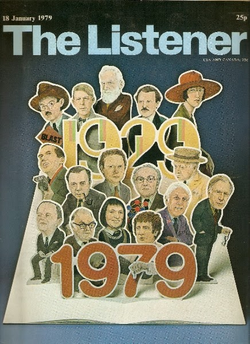
The Listener
~ the obit ~
The Listener went on sale on 16 January 1929 and described itself as a necessary auxiliary to the microphone. The problem it solved is hard to feel now. Radio in 1929 went out once and then stopped existing, so if you missed the talk, or heard it and wanted to think about it, there was nothing to go back to. The BBC's answer was to print the week's talks and sell them for a few pence, with John Reith's idea of a cultural mission sitting underneath the whole enterprise.
Newspaper owners were furious before the first issue appeared. The Newspaper Proprietors' Association called the launch an illegitimate stretching of official activity, their argument being that a state broadcaster living on license money had no business running a magazine against them. Reith negotiated with the Prime Minister and gave ground. The Listener was capped at ten percent original material unrelated to broadcasting and limited in the advertising it could carry. No other magazine in Britain was built to that shape, and it kept the shape for sixty-two years.
Inside the cap it published E. M. Forster and T. S. Eliot. George Orwell wrote for it, and so did Virginia Woolf. Auden, Larkin, Plath and Isherwood all had early work in its pages. People put it next to the Spectator and the New Statesman as the third of the serious weeklies, with the difference that it was tied to no political party and its rivals resented its subsidized position. Circulation peaked around 151,000 in 1949, which sounds healthy until you notice the Radio Times was selling 7.7 million in the same year off the same corporation.
~ the rap sheet ~
| Born | 16 January 1929, edited by Richard S. Lambert for the BBC |
|---|---|
| Peak | about 151,000 copies an issue in 1949 |
| Killed | 3 January 1991 |
| Lifespan | 62 years, most of them at a loss |
| Made by | the BBC, then a BBC and ITV joint venture from 1987 |
| Killed by | ITV walking away in 1990 and a subsidy nobody wanted to carry |
~ the peacock years ~
After the Peacock Committee reported in 1986 the BBC moved its commercial activities into BBC Enterprises, and managers started answering for the magazine's margin rather than its contributors. In 1987 it was spun out into a company jointly owned with ITV, which hired Alan Coren away from Punch to make it funnier and more focused. Subscribers who had liked the eclecticism left instead. Coren was replaced in 1989. ITV walked away the following year, and the BBC declined to carry a magazine selling 17,000 copies on its own. Copies dated 3 January 1991 were the end of it.
~ the talking mongoose ~
Richard S. Lambert edited The Listener for its first ten years and left in 1939 over a mongoose. He had taken an interest in Gef, a creature on the Isle of Man that a farming family insisted was a talking mongoose living in their walls, and a senior figure at the London County Council named Sir Cecil Levita told people that a man credulous enough to believe such a thing was unfit to edit a BBC publication. Lambert sued him for slander and won. Then he left the job anyway, which is roughly what happens when you win that kind of case.
~ the ten percent rule ~
The cap on original material is what makes The Listener strange as an object. It was not allowed to be a general magazine, so it became a printed index of what the country had been listening to, week by week, for six decades. That turns out to be an archive nobody set out to build. The whole run was digitized in 2011 and now sits behind a paywall at Gale, where the entry price for an institutional subscription stood at 760 pounds a year in 2022.
The first modem in our house turned up in 1998, seven years after this closed, and by then the premise was already unexplainable to anyone my age. A weekly paper record of what had been said on the radio only makes sense in a world where sound does not persist. The Listener was built against that problem and spent its last twenty years in a country that had stopped having it.
~ the crossword kept its numbering ~
The Listener crossword started in 1930 and has a reputation as the hardest cryptic in Britain. When the magazine closed, The Times took the puzzle and still runs it every Saturday, and the numbering never restarted. In 1991, the year the magazine died, the series was at 3089. The 2026 run is numbered 4901 to 4952.
That means roughly 1,800 Listener crosswords have appeared since there was a Listener, and most solvers filling one in on a Saturday have no particular reason to know there was ever a magazine. A handful of people complete all 52 in a year. The best of them gets a silver salver.
~ leave a rose ~
an anonymous tribute. one rose per visitor per day.
@}-->-- ... roses left here
~ leave a wreath ~
a rose fades by morning. a wreath stays on this grave for good, with your name on it.
paid once through stripe. payments are handled by OÜ Lakeview, the small company that keeps rip.so running. the money pays for the hosting and the nightly digging. adopt it and the headstone reads "maintained in memory by" you. the groundskeeper plants new wreaths at the next tending, usually within a day.
» one email a week: new graves and the anniversaries of the dead. subscribe
other news: Amstrad Action, Dianzi Youxi Ruanjian (电子游戏软件), MacMinute, The Punch
also died in the 1990s: Simtex, Bi-Bop, Amstrad Action
~ leave a note ~
visitors before you have left these graveside notes. anonymous welcome.