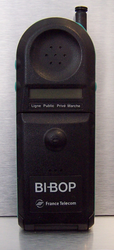
Bi-Bop
~ the goodbye ~
The mobile phone arrived in Turkey as GSM. There had been an analog system before it that almost nobody carried, so in practice the first mobile phone a Turkish household ever saw was a digital one that rang wherever you happened to be standing. Countries that get a technology late tend to skip its dead ends, and the whole middle generation of half-mobile European products is therefore something I know only as history. Bi-Bop is the one worth reading, because its limitation was so exact.
France Telecom built it on CT2, a digital cordless standard that gave excellent audio at 32 kbit/s using the same coding your cordless handset at home used. The trial started in Strasbourg on 1 October 1991 and the commercial launch followed on 26 April 1993 in Paris and Lille, spreading later to business districts and to holiday towns like Le Touquet.
The numbers were the pitch. A handset cost 1,890 francs with a subscription of 54.50 francs a month. A minute of talking came to 0.83 francs, about four times less than GSM was charging for the same minute in 1993, and if you accepted the constraint you got a mobile phone at a price a normal salary could carry.
~ the chronicle ~
| Born | 1 october 1991, trial service in Strasbourg |
|---|---|
| Peak | around 46,000 subscribers against a target of 500,000 |
| Killed | end of 1997 |
| Lifespan | six years, four of them on sale |
| Made by | France Telecom |
| Killed by | GSM getting cheap while Bi-Bop stayed stationary |
~ how it worked ~
The constraint was the base station. Each one covered roughly three hundred meters and they were marked with a flat sign in blue and green stuck to a lamp post or a wall, which meant the network was something you found by looking up. Arriving in a call zone, you registered the handset with the station in front of you, the same manipulation as pairing a cordless phone to its own base at home.
Everything difficult followed from there. There was no handover between stations, so walking out of the zone ended the call rather than moving it. There was no signal strength indicator, so you could not tell you were about to lose it. And an incoming call could only find you if the network still believed you were parked at a particular station, which is why in practice Bi-Bop was a phone for calling out.
~ the funny part ~
France Telecom sold the limitation as a feature and it half worked. In Paris in 1993 a Bi-Bop was visibly a portable telephone, and being seen holding one in a café read the same way as being seen with a GSM handset costing four times as much. The target was 500,000 subscribers by the end of 1995. It got revised down to 300,000 while the network was still being built, which is the moment somebody inside the company understood what they had sold.
The real number at the end was around 46,000. Marketing stopped in 1996 and the network was switched off at the end of 1997, with subscribers pushed toward Itineris, France Telecom's own GSM service, on preferential terms. Six years, and the company that killed it was the company that built it.
~ the next chapter ~
CT2 did not disappear, it moved indoors. The standard's descendants became DECT, and DECT is in essentially every cordless phone sold since, which means the radio underneath Bi-Bop won completely inside the house and lost completely outside it. That is a fair summary of the whole idea: short-range digital voice is excellent when you are not going anywhere.
The shape keeps coming back in better clothes. Wifi calling and femtocells are the same bargain, cheap voice through a short-range box that somebody else already installed, and they only survive because a full cellular network is sitting underneath ready to catch the call when you walk away. Bi-Bop had nothing underneath it. When you walked away, you were holding a plastic object with a dial tone that had stopped existing.
~ leave a rose ~
an anonymous tribute. one rose per visitor per day.
@}-->-- ... roses left here
~ leave a wreath ~
a rose fades by morning. a wreath stays on this grave for good, with your name on it.
from $1, paid once through stripe. it keeps the graveyard running: the hosting and the nightly digging. adopt it and the headstone reads "maintained in memory by" you. the groundskeeper plants new wreaths at the next tending, usually within a day.
» one email a week: new graves and the anniversaries of the dead. subscribe
other connectivity: Demon Internet, Personal Digital Cellular, Global Crossing, NSFNET
also died in the 1990s: Level 9 Computing, Simtex, 7th Level
~ leave a note ~
visitors before you have left these graveside notes. anonymous welcome.