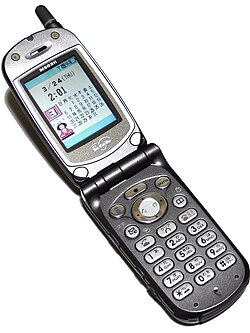
Personal Digital Cellular
~ the goodbye ~
The reason Japanese phones looked like that is written into the radio spec. PDC ran a 25 kHz carrier with a weaker broadcast than GSM, which let manufacturers build handsets smaller and lighter than anything on the European standard. The bill arrived as substandard voice quality and calls that quit inside an elevator. It is an engineering trade you could hold in your hand, and Japan took it deliberately.
Turkey went GSM in the mid nineties and never had anything else, so PDC reached me the way it reached most of the world, as photographs of phones nobody could buy. Japanese handsets in the late nineties looked like they had been sent back from a few years ahead. Some of that was true. The rest was the standard underneath, which made those phones possible and simultaneously made them unsellable anywhere off the archipelago.
The specification was written by the RCR, later renamed ARIB, in april 1991, and NTT DoCoMo launched Digital mova on it in march 1993. It used TDMA the way GSM did, running on the 800 MHz and 1.5 GHz bands. NEC and Ericsson were among the companies building the network gear. Data ran at 9.6 kbit/s circuit-switched, and up to 28.8 kbit/s on the packet side, which was called PDC-P.
~ the chronicle ~
| Born | march 1993, NTT DoCoMo's Digital mova service |
|---|---|
| Peak | nearly 80 million subscribers |
| Killed | 31 march 2012, the last mova switch-off |
| Lifespan | nineteen years, one country |
| Made by | the RCR, which later became ARIB |
| Killed by | W-CDMA, and having no market outside Japan |
~ what it carried ~
PDC-P is where i-mode lived. From february 1999 Japanese subscribers had a phone-shaped internet with paid subscription content and real email addresses, while the rest of us were poking at WAP over GSM and getting almost nothing back. For about five years Japan was straightforwardly ahead on mobile data and everybody knew it.
The catch was structural. That mobile internet ran on packet infrastructure only one country had, so the handsets could not be sold abroad and the service could not be lifted out and installed somewhere else. When DoCoMo tried to export i-mode it had to rebuild it on other people's networks, and most of those attempts died. The advantage and the isolation were the same fact.
~ the long tail ~
The shutdown ran carrier by carrier over nine years. KDDI turned off au's PDC network on 31 march 2003 and its TU-KA brand five years after that, on 31 march 2008, with SoftBank Mobile ending its own on 31 march 2010. DoCoMo announced the end of mova and its DoPa data service back in january 2009, giving people three years to move, then switched it off on 31 march 2012 as the clock went past midnight.
The subscriber curve tells it faster than any of that. Nearly eighty million at the peak, then forty six million by december 2005. What was left when the network finally went off was roughly two hundred thousand people who had never seen a reason to replace a phone that worked.
~ leave a rose ~
an anonymous tribute. one rose per visitor per day.
@}-->-- ... roses left here
~ leave a wreath ~
a rose fades by morning. a wreath stays on this grave for good, with your name on it.
from $1, paid once through stripe. it keeps the graveyard running: the hosting and the nightly digging. adopt it and the headstone reads "maintained in memory by" you. the groundskeeper plants new wreaths at the next tending, usually within a day.
» one email a week: new graves and the anniversaries of the dead. subscribe
other connectivity: Global Crossing, Demon Internet, Bi-Bop, NSFNET
also died in 2010-2014: Amplicate, Global Crossing, Kodak Gallery
~ leave a note ~
visitors before you have left these graveside notes. anonymous welcome.