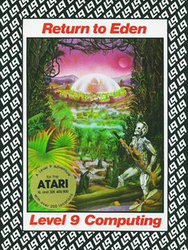
Level 9 Computing
~ the obituary ~
Level 9 began in 1981 with three brothers duplicating cassettes at home and posting them out against classified advertisements in Computing Today. The first product was an extension to Nascom BASIC. The first game, Fantasy, ran on the same machine and had no graphics whatsoever.
Colossal Adventure arrived in early 1982, a conversion of the Crowther and Woods original with seventy extra locations bolted onto the endgame so that the advertised claim of over two hundred rooms would be true when somebody counted. Two sequels followed within the year. When Rainbird reissued all three in 1986 the set was renamed Jewels of Darkness and the Tolkien references were quietly taken out, so Minas Tirith became Valaii.
Snowball opened the Silicon Dreams sequence in 1983, and the company kept producing at a rate that made no sense for its size. Knight Orc in 1987 ran on a replacement system called KAOS that gave the other characters something like independent behavior, and cast the player as the pest rather than the hero. In 1989 they announced they were leaving text adventures altogether. Scapeghost was the goodbye, and Pete Austin's line on it was that people had been declaring the adventure market dead for years, so an appropriate final release was overdue.
Then came two years of trying to be a graphics house. Mike Austin put the new engine at 165,000 lines and ten man-years of work. Champion of the Raj shipped in 1991 along with a DOS port of Cinemaware's It Came from the Desert, and in June 1991 the company closed. All three brothers went off and did something else with their lives. The distance on this one has nothing to do with dates: a text adventure is the single form that cannot cross a language border without being rewritten, and nobody rewrote these. Whatever was happening in Turkish bedrooms with copied cassettes in 1985, it was not two hundred rooms of English prose.
~ the case file ~
| Born | 1981, High Wycombe, Buckinghamshire |
|---|---|
| Peak | the Jewels of Darkness and Silicon Dreams reissues, 1986 |
| Killed | June 1991 |
| Lifespan | 10 years |
| Made by | the Austin brothers |
| Killed by | the collapse of the text adventure market |
~ a-code ~
A-code was an interpreted language the brothers devised around 1979, before there was a company to put it in. The point of it was compression. Text came down to roughly half its size, and the game data was identical on every machine, so a port meant pairing one data file with a small interpreter written for the target. Andrew Deeley, who worked on software development there, said the system let them turn out hundreds of cross-platform versions of the whole catalog inside eighteen months.
The comparison everyone reaches for is Infocom's Z-machine, and it flatters Level 9 in one specific way. Infocom shipped on disks, so a game could be paged in from storage while it ran. British machines took cassettes, which meant the entire program loaded in one go and then had to stay in memory. A-code exists because of that constraint.
~ the silver grail ~
Lancelot went out through Mandarin Software in 1988 with a competition attached to it. The first person to solve the puzzle inside won a replica of the Holy Grail in solid silver, set with amethysts and garnets, plated on the inside with 22-carat gold. It is a promotional stunt from a period when a British software house could still justify commissioning metalwork to sell a game made of words.
~ what closed with it ~
The ending was undramatic. Text adventures had been dying commercially for half a decade by then. The eight-bit machines that Level 9's entire production method was built around were finished by 1991, and what replaced them wanted pictures, which cost more than three brothers could raise.
What survives is the archive. Mike Austin maintains a source and documentation collection for the company's work, and modern interpreters will run the games on anything with a screen. Level 9 released its last text adventure in 1989 and every one of them is still readable today, which is more than most British software houses of that decade can claim.
~ leave a rose ~
an anonymous tribute. one rose per visitor per day.
@}-->-- ... roses left here
~ leave a wreath ~
a rose fades by morning. a wreath stays on this grave for good, with your name on it.
from $1, paid once through stripe. it keeps the graveyard running: the hosting and the nightly digging. adopt it and the headstone reads "maintained in memory by" you. the groundskeeper plants new wreaths at the next tending, usually within a day.
» one email a week: new graves and the anniversaries of the dead. subscribe
other gaming: FrontierVille, Tabula Rasa, Shiny Entertainment, Desura
~ leave a note ~
visitors before you have left these graveside notes. anonymous welcome.