Amstrad Action
~ the obit ~
Future Publishing's story usually gets told from the far end, where it is a large British house with a catalog running from guitar monthlies to science titles, and where its founder Chris Anderson is better known for the thing he did afterward with TED. The near end is much smaller. In 1985 Anderson, who had edited Personal Computer Games and Zzap!64, set up a company and printed one magazine about one home computer. Issue 1 of Amstrad Action is dated October 1985, reached the shelves that September, cost a pound and ran a hundred pages, which the cover worked out as a penny a page.
There were four people on it. Peter Connor edited and Trevor Gilham ran the art, while Bob Wade reviewed almost everything under the title of Software Editor. A 116-page Christmas issue with a tape stuck to the front found the readers the first few issues had not, and by October 1986 the thing had budded twice, into 8000 Plus for the PCW and PC Plus for the Amstrad machines that ran DOS.
None of this was anywhere near me. The last issue reached British newsagents in the summer I turned eleven. I would not own a modem until 1998, and the magazine rack I actually stood in front of was in Turkish. Amstrad Action belongs to a specific British arrangement I only ever read about, where one machine got one monthly and you bought it from a newsagent.
~ the rap sheet ~
| Born | October 1985, issue 1, one pound for one hundred pages |
|---|---|
| Peak | 38,457 copies audited across the second half of 1988 |
| Killed | June 1995, issue 117 |
| Lifespan | 9 years, 8 months |
| Made by | Future Publishing, founded by Chris Anderson |
| Killed by | a readership that had finished with the CPC |
~ how it scored things ~
The review apparatus was the magazine's furniture. A game got a main write-up, a second opinion in a box, a good news and bad news column, then percentages for Graphics, Sonics, Grab Factor and Staying Power before the overall AA Rating. Eighty percent or better earned an AA Rave. The best game in any given month was a Mastergame, which was the award a CPC owner would quote at you years later.
The rest of the page count went to things a reader sent in. Type-In printed program listings that you keyed into the machine yourself, line by line, which meant the magazine was partly written by its own audience. Problem Attic answered hardware questions until it grew into Forum. The Pilgrim covered text adventures, then handed over to Balrog and later The Examiner, and ran a letters column of its own for people who only cared about that one thing.
~ the thinning ~
The audited circulation peaked at 38,457 across the second half of 1988 and never got back there, though April 1992 came close at 37,120. Amstrad had already moved on. The CPC line stopped and the GX4000 console arrived and failed, after which the software houses that had kept the review pages full went to the Amiga and then to the PC. Amstrad Action kept going anyway, printing a monthly about a discontinued machine for years after it was discontinued, because the people who owned one were still there.
What a shrinking readership looks like in print is page count. July 1994's issue 106 dropped from sixty pages to thirty-six. Issue 107 was the first one produced by a single member of staff. By issue 111 there was no credits list at all, and the new editor, Karen Levell, introduced herself by answering the letters.
~ the last headline ~
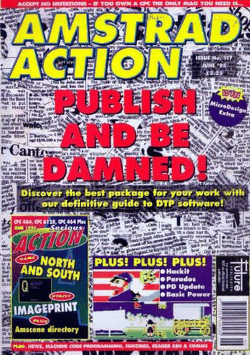
Issue 117 is dated June 1995 and costs £3.25, against the pound that issue 1 asked for. The banner across the top still says ACCEPT NO IMITATIONS, IF YOU OWN A CPC THIS IS THE ONLY MAG YOU NEED, and the cover tape carries North and South and a printing utility. The main cover line, in red capitals over the whole page, reads PUBLISH AND BE DAMNED. It is about desktop publishing software.
Inside, the box that tells you what is coming next month advertises issue 118. Nothing about the issue admits that it is the last one, and the closure was reported a couple of months later in Commodore Format, one of the sibling magazines down the corridor. A publication that spent nine years telling people exactly how good things were, down to the percentage point, did not manage to tell them it was stopping.
~ leave a rose ~
an anonymous tribute. one rose per visitor per day.
@}-->-- ... roses left here
~ leave a wreath ~
a rose fades by morning. a wreath stays on this grave for good, with your name on it.
paid once through stripe. payments are handled by OÜ Lakeview, the small company that keeps rip.so running. the money pays for the hosting and the nightly digging. adopt it and the headstone reads "maintained in memory by" you. the groundskeeper plants new wreaths at the next tending, usually within a day.
» one email a week: new graves and the anniversaries of the dead. subscribe
~ leave a note ~
visitors before you have left these graveside notes. anonymous welcome.