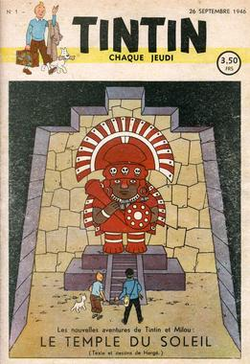
Le Journal de Tintin
~ the obituary ~
The idea belonged to André Sinave, who wanted to build a weekly on the back of a character Hergé had been drawing since 1929. Raymond Leblanc and Georges Lallemand founded Le Lombard in Brussels to publish it. The first issue is dated 26 September 1946, twelve pages, and a Dutch edition called Kuifje came out the same day. The French edition, published by Dargaud, followed on 28 October 1948.
That first issue is a stacked deck. Hergé opened Le Temple du Soleil in it. Edgar P. Jacobs opened Le Secret de l'Espadon, which is the first Blake and Mortimer story. Paul Cuvelier had Corentin and Jacques Laudy had La Légende des quatre fils Aymon. By issue thirteen, on 19 December 1946, the page count was sixteen, and in September 1948 it went to twenty.
The selling mechanism is what people forget. The magazine printed a page or two each week from albums that were not finished, so a reader who could not wait for the book bought the weekly instead. Several stories ran at once, which gave space to artists nobody had heard of, and some strips never became albums at all, which was another reason to keep subscribing. Jacques Martin brought Alix in 1948. Later came Michel Vaillant, Ric Hochet, Thorgal, Hugo Pratt's Corto Maltese and a translated run of Will Eisner's The Spirit.
~ the case file ~
| Born | 26 September 1946, twelve pages, Brussels |
|---|---|
| Peak | the whole Franco-Belgian realist school published weekly |
| Killed | 29 November 1988, issue 690 |
| Lifespan | 42 years |
| Made by | Raymond Leblanc and Le Lombard, with Hergé |
| Killed by | a licensing contract that ran out |
~ the loyalty stamp ~
Every copy carried a chèque Tintin, a point you could collect and redeem for gifts that were not sold in any shop. Food brands joined in and printed them on packets of flour and soup. There was a Tintin soda and there were Tintin shoes. The SNCF went along with it too, and would trade eight hundred chèques for a hundred kilometers of rail travel.
The subtitle on the cover read "Le journal des jeunes de 7 à 77 ans," the magazine for young people from seven to seventy-seven, later inflated to "super-jeunes." That sales line ended up describing the whole Franco-Belgian comics industry, which never did settle the question of whether it was making children's books.
~ the duel with Spirou ~
Tintin and Spirou spent forty years circling each other, and the two publishers had a gentlemen's agreement not to poach artists. The famous breach was André Franquin, who fell out with Dupuis in 1955, signed a five-year deal with Tintin and created Modeste et Pompon there while still drawing for Spirou. The dispute was patched up almost immediately but the contract was not, so he worked both sides until it expired.
The house styles were genuinely different. Spirou drew loose and funny out of Charleroi, Tintin drew clean and realistic out of Brussels, and the editorial rooms matched: Spirou's artists worked from home as free agents, Tintin's kept office hours. Greg ran the magazine as editor in chief from 1965 to 1974, and it was named publication of the year in 1972, two years before he quit.
~ three endings ~
The 1980s went badly. Teenagers who still read comics had moved to À Suivre, and younger children were buying albums instead of weeklies. At the end of 1980 the Belgian edition was canceled, leaving the French one alone. The French title was even renamed Tintin Hebdo between 30 October 1981 and 2 April 1982, a rebrand that ran five months and changed nothing. By 1988 circulation was down to 100,000.
The actual kill came from the contract. When the deal between Hergé's heirs and Raymond Leblanc expired, the estate decided to launch its own magazine without Le Lombard, and took the name with it. The last issue of Le Journal de Tintin is number 690, dated 29 November 1988. Tintin Reporter picked it up on 9 December under a different publisher, lasted nine months and died with number 34 on 28 July 1989. Le Lombard then built Hello Bédé from 26 September 1989, which reached number 197 on 29 June 1993 and stopped, carrying the Dutch Kuifje with it. Le Lombard's own official history of the magazine is a 777-page book subtitled 1946-1988, so the publisher agrees with the first of those three dates.
Hergé's albums were translated into Turkish and sold in Turkish bookshops for decades, and that is the only form any of this took where I grew up. The weekly itself, along with its forty-year argument with Spirou, happened in a language and a distribution network that stopped well short of Ankara. In January 2023 Le Lombard announced a one-off special issue for its own seventy-seventh year, published 8 September that year. One issue, thirty-five years after the last real one.
~ leave a rose ~
an anonymous tribute. one rose per visitor per day.
@}-->-- ... roses left here
~ leave a wreath ~
a rose fades by morning. a wreath stays on this grave for good, with your name on it.
paid once through stripe. payments are handled by OÜ Lakeview, the small company that keeps rip.so running. the money pays for the hosting and the nightly digging. adopt it and the headstone reads "maintained in memory by" you. the groundskeeper plants new wreaths at the next tending, usually within a day.
» one email a week: new graves and the anniversaries of the dead. subscribe
other kids: BBC Mixital, NabiscoWorld, Ty Girlz, Pilote
also died in the 1980s: DeLorean Motor Company, Video 2000, Spectravideo
~ leave a note ~
visitors before you have left these graveside notes. anonymous welcome.