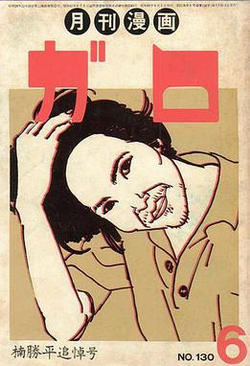
Garo
» see garo.co.jp as it lived, on the wayback machine
~ the obituary ~
Katsuichi Nagai launched Garo on 24 July 1964 with a print run of 8,000 copies, and the date is now observed in Japan as Gekiga Day. The rental book market that had supported the gritty, adult end of Japanese comics was collapsing, and the artists working in it had nowhere left to publish. Nagai's answer was a monthly that offered no money and total freedom. The name came from a ninja character in a Sanpei Shirato strip, and the point of the whole exercise was to give Shirato a home for Kamui Den, a long serial about class struggle built around an outcast ninja boy with an Ainu name.
Nagai said later that a magazine was not taken seriously unless it had at least seven contributors, so the first issues padded the masthead with pen names belonging to Shirato and Shigeru Mizuki. He had aimed it at schoolchildren, with essays against the Vietnam War and against the rising price of school lunches printed next to the comics. It landed instead with university students, and through the late sixties it was read inside the student left as something close to a house organ.
The form went strange fast. From 1967 the magazine filled up with work that had no commercial shape at all, and the critic Ryan Holmberg has traced its sources back to paper theater, prewar illustrated fiction, Buddhist parables and ghost stories. Yoshiharu Tsuge's Screw Style ran here. So did Mizuki's Kitaro stories. Seiichi Hayashi, Suehiro Maruo, Nekojiru and Kazuichi Hanawa all came through here too, along with a long line of artists who would not have been printed anywhere else. The English Wikipedia puts the circulation peak above eighty thousand in 1971; the Japanese article is more careful, dating the 80,000 to 1966 and recording that the real number sold was 48,000.
~ the case file ~
| Born | 24 July 1964 in Tokyo, a print run of 8,000 |
|---|---|
| Peak | 80,000 claimed in 1966, 48,000 actually sold |
| Killed | October 2002, issue 426, the autumn number |
| Lifespan | 38 years |
| Made by | Katsuichi Nagai and Sanpei Shirato, at Seirindo |
| Killed by | a mass resignation in 1997 and the bankruptcy behind it |
~ no page rate ~
Kamui Den ended in 1971 and sales started the long descent. By the 1980s Garo was selling around three thousand copies and renting the second floor of a timber merchant's warehouse in Kanda-Jinbocho for an office. Staff could not really live on what came in. Page rates had formally stopped years earlier, replaced by Nagai's standing promise that artists would be paid when there was profit, a line printed in the submissions column so that nobody could say they had not been told. Artists who genuinely could not eat were sometimes given about five hundred yen a page.
The magazine survived on book sales. Editors spent their days between editing and shifting stock in the warehouse, hunting for artists whose collected volumes might cover the losses the monthly was running. Big publishers kept offering to buy it and Nagai kept refusing. Meanwhile a hundred or two hundred people would apply whenever a single job opened, and the submission pile never stopped arriving.
~ the fax ~
In September 1990 Nagai handed the company to Jun Yamanaka, who ran a PC software firm called Zeit, and stayed on as chairman. The new era worked for a while. Collected volumes sold and films got made, and artists started seeing something that resembled money. Nagai stepped down as editor with the January 1992 issue and died in 1996 at seventy four.
Then Zeit missed the move from MS-DOS to Windows, and the magazine's attempt to get ahead of the internet made it worse. Digital Garo launched in February 1997 as a comics and internet hybrid, which was genuinely early, and Yamanaka pushed the shipped print run to a hundred thousand copies against real sales of fifteen to eighteen thousand. On 7 July 1997 the entire editorial staff resigned by fax, led by the deputy editor Noriko Tezuka, taking the artists' original artwork with them and telling the trade press that Seirindo was finished as a publisher. Zeit went bankrupt. The staff who walked out founded Seirin Kogeisha and launched AX, which is still running, and the litigation between the two houses was settled quietly enough that Garo could report it in its own February 2002 issue.
~ issue 427 ~
What followed was four years of a magazine trying to restart itself. Publication resumed in January 1998 under a new editor and stopped again with the September 1998 number. A new owner, Mikihiko Kanie of Daiwado, brought it back for January 2000. Monthly until June 2001, then bimonthly from that August. It went quarterly in the summer of 2002 and switched to print on demand sold over the web, which produced exactly one issue: Manga Garo, autumn number, issue 426, out in October 2002. The English Wikipedia files the end as December, which is the other date in circulation, and the difference between them is about when that single on demand number actually shipped.
Issue 427 was listed as forthcoming and never appeared. Seirindo never said the title had ended. A magazine that had spent thirty eight years not paying anybody simply stopped sending them anything to not be paid for. In 2010 the owner put out an iPad app called Garo Ver2.0, unrelated anthology work for a young audience, which lasted two issues.
Seirindo still owns garo.co.jp. Point a browser at it now and you get a live Japanese publishing house with a current catalog of conservative politics and spiritual titles, including a manga edition of the Kojiki. Nothing on the front page acknowledges that the address belonged for decades to the most important alternative comics magazine Japan ever had. Whatever reached me in Turkey from Japanese comics in the nineties came through dubbed television, which is the opposite end of the medium from a magazine that printed Tsuge for free.
~ leave a rose ~
an anonymous tribute. one rose per visitor per day.
@}-->-- ... roses left here
~ leave a wreath ~
a rose fades by morning. a wreath stays on this grave for good, with your name on it.
paid once through stripe. payments are handled by OÜ Lakeview, the small company that keeps rip.so running. the money pays for the hosting and the nightly digging. adopt it and the headstone reads "maintained in memory by" you. the groundskeeper plants new wreaths at the next tending, usually within a day.
» one email a week: new graves and the anniversaries of the dead. subscribe
other personal publishing: Diary-X, CIAYO Comics, Posterous, Moonfruit
also died in the 2000s: S! Town (S!タウン), Circuit City, MSN Music
~ leave a note ~
visitors before you have left these graveside notes. anonymous welcome.