Pilote
~ the last words ~
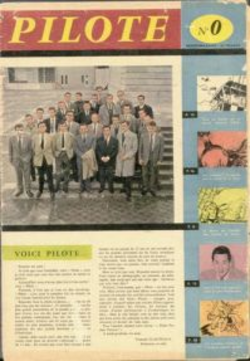
Pilote launched on 29 October 1959 at a large format of 36.5 by 26.5 centimeters, subtitled the big illustrated magazine for young people. Issue zero had gone out in June as a dummy for advertisers. The editor in chief, Francois Clauteaux, had spent the autumn on Radio Luxembourg telling listeners it was coming, and by the evening of publication day all 300,000 copies were sold. Inside were pieces on space exploration and the climbing of Everest, plus puzzles run by Pierre Bellemare and football tips from Raymond Kopa. It also carried the first episode of Asterix, by Rene Goscinny and Albert Uderzo, alongside the pirate strip by Jean-Michel Charlier and Victor Hubinon that became Barbe-Rouge.
The magazine nearly died at eighteen months old. Dargaud bought it out of trouble in 1960 and kept it alive long enough for the comics to take over the page count. By the end of the 1960s they were more than eighty percent of it. Goscinny and Charlier were made editors in 1963 with a mandate to fix a failing title, and from issue 300 in July 1965 the cover simply said it was the journal of Asterix and Obelix, because by then that was the only description anybody needed.
What came out of this one weekly is close to absurd. Blueberry, Valerian and Laureline, Achille Talon, Lucky Luke after it moved over from Spirou, Philemon, Le Genie des alpages, Rubrique-a-Brac. Twenty one of its regular contributors went on to win the grand prize at Angouleme. It also found room for outsiders, including Hugo Pratt and, improbably for a French youth weekly, Robert Crumb.
~ the record ~
| Born | 29 October 1959 in Paris, number 1 sold out the same day |
|---|---|
| Peak | subtitled Le Journal d'Asterix et Obelix from issue 300, July 1965 |
| Killed | October 1989, issue 41 of the final series |
| Lifespan | 30 years |
| Made by | Francois Clauteaux's team, bought by Dargaud in 1960 |
| Killed by | the adult comics magazines its own artists started |
~ the brasserie ~
In May 1968 the strikes stopped the presses for three weeks and the authors got nervous. On 21 May a meeting was organized by Jean Giraud and Jean-Claude Mezieres in a brasserie on the rue des Pyramides, about twenty cartoonists, some from Pilote and some from the press cartoonists' union. Goscinny had been running the magazine since 1967 and had just published an Asterix album that printed a million copies, which made him an obvious target in a room full of younger men.
The meeting turned into what Charlier later called a people's tribunal. Goscinny was accused of being a stooge of the bosses by colleagues he had personally put into the profession. He left the co-editor's job in July and was replaced by Gerard Pradal.
~ the children who left ~
The 1970s attempt to age the magazine up came too late for the people who wanted it. Philippe Druillet and Giraud found that Pilote could not carry what they were trying to do, so they left and started Metal Hurlant, which is where Heavy Metal came from. The founders of L'Echo des savanes and Fluide Glacial also came off this masthead. Dargaud cut the schedule from weekly to monthly in 1974 and replaced Goscinny as editor in chief, and a younger line of cartoonists moved in to fill the pages with work aimed at adults.
Sales recovered briefly and then leaked away through the 1980s. For most of the French comics boom I was a small child in Turkey, where Asterix arrived the way it arrived almost everywhere outside France, as albums in translation, with no trace of the weekly those pages had been cut out of. Magazines that produce classics tend to get that deal. The classics travel and the container stays home.
~ the last editorial ~
In March 1986 Dargaud merged Pilote with Charlie Mensuel to make Pilote et Charlie, which ran 27 issues under Philippe Mellot. In 1988 it went back to being Pilote. The last issue, number 41, came out in October 1989, just as the magazine turned thirty, and Mellot opened his final editorial on exactly that: the day after its thirtieth year, Pilote was playing its last performance in the sets its readers knew. The magazine that started adult comics, he wrote, had lived, and the one that had hatched the greatest works of the ninth art and taught several generations to read was going out that day with a reputation that reached Tokyo and San Francisco.
Dargaud still owns the title and has used it since 2003 for one off specials: a summer number in June 2003 under the slogan about the paper that enjoys coming back, a Christmas number in 2004, a May 68 anniversary issue in 2008, a Gotlib tribute with Fluide Glacial in 2014, a Valerian issue in 2017 when the film came out. They arrive years apart and then stop again. The last one was nine years ago.
~ leave a rose ~
an anonymous tribute. one rose per visitor per day.
@}-->-- ... roses left here
~ leave a wreath ~
a rose fades by morning. a wreath stays on this grave for good, with your name on it.
paid once through stripe. payments are handled by OÜ Lakeview, the small company that keeps rip.so running. the money pays for the hosting and the nightly digging. adopt it and the headstone reads "maintained in memory by" you. the groundskeeper plants new wreaths at the next tending, usually within a day.
» one email a week: new graves and the anniversaries of the dead. subscribe
other kids: JuniorNet, Bonus.com, Purple Moon, Kamen Rider Megaton Smash
also died in the 1980s: Mark V. Shaney, Dragon 32/64, Telecomsoft
~ leave a note ~
visitors before you have left these graveside notes. anonymous welcome.