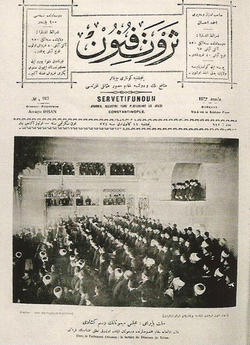
Servet-i Fünun
~ the obituary ~
Ahmed İhsan Tokgöz could not get a license to publish. The Hamidian press regime handed those out sparingly, so he went to Nikolaidis, who owned a science-minded newspaper called Servet, and arranged to bring his magazine out as a supplement to it. The first Servet-i Fünun, the wealth of the sciences, appeared on 27 March 1891. By the next year it stood on its own.
It was a technical achievement before it was a literary one. Abdülhamid II put money into it, and Ahmed İhsan used that to bring a plate maker over from Europe, which is why the printing beat everything else on the stands in Istanbul. The masthead carried a line in French, Journal illustré turc paraissant le jeudi, a Turkish illustrated journal appearing on Thursdays. It started daily and settled into a weekly, twelve pages for the first half year and fourteen after that.
The turn came in 1896. Recaizade Mahmud Ekrem had been conducting a public argument about whether rhyme belonged to the eye or the ear, and he installed his student Tevfik Fikret at the magazine's literary desk. From issue 256, dated 7 February 1896, Servet-i Fünun was a literary magazine, and the writers who gathered around it became the Edebiyat-ı Cedide, the New Literature. Halit Ziya Uşaklıgil, Mehmed Rauf, Cenab Şahabeddin and Hüseyin Cahit all published there. Their slogan was art for art's sake and their models were French.
The magazine outlived all of that by more than forty years. It came through the end of the empire, a long interruption during the First World War while Ahmed İhsan was in Switzerland for treatment, a relaunch in 1924 and a change of alphabet in 1928. The final issue, number 2461, came out on 25 May 1944.
~ the case file ~
| Born | 27 March 1891, Istanbul, as a supplement to the newspaper Servet |
|---|---|
| Peak | 1896 to 1901, the Edebiyat-ı Cedide years under Tevfik Fikret |
| Killed | 25 May 1944, issue 2461 |
| Lifespan | 53 years |
| Made by | Ahmed İhsan Tokgöz |
| Killed by | outliving its founder and its moment |
~ issue 256 ~
Fikret ran about thirty pieces under the heading Musâhabe-i Edebiyye between issue 258 and issue 512, and that is where most of the movement's arguments were actually made. The opposition was loud. Ahmed Midhat Efendi attacked the group in Sabah as "Dekadanlar", the decadents, and Cenab Şahabeddin answered with essays asking what decadence was and what symbolism was. Ahmed Midhat eventually printed a retraction under the title Teslîm-i Hakîkat, surrendering to the truth.
It came apart from the inside first. Ali Ekrem's "Şiirimiz" ran across four issues in late 1900 and caused the first real split, after which two contributors left for the rival magazine Ma'lûmât. Fikret himself walked out in 1901 over an administrative quarrel with Ahmed İhsan, not over poetry or politics.
~ a month and a half ~
Later in 1901 Hüseyin Cahit, by then running the literary side, published a translation from the French titled "Edebiyat ve Hukuk", literature and law. Mehmed Tâhir at Ma'lûmât reported it to the authorities and the magazine was shut.
It reopened six weeks later as something else. The contributors drifted away one by one, and Ahmed İhsan took it back to what it had been before 1895: a heavily illustrated weekly about science and new machinery. That is the version in the photograph on this page, issue 917 from December 1908, with a full page given to the Ottoman parliament sitting again after thirty years.
~ new letters ~
In November 1928 Turkey replaced the Arabic script with the Latin alphabet, and every publication in the country had to decide what to do about a readership that had just been made illiterate. Servet-i Fünun changed its name. It became Servet-i Fünûn-Uyanış, the new word meaning awakening, and Halit Fahri Ozansoy was brought in to run it. The Ottoman name stayed on the masthead beside the new one, which is a fair picture of what the whole country was doing that year.
It kept going for another sixteen years and it kept finding writers. Cahit Sıtkı Tarancı, Ziya Osman Saba, Sabahattin Kudret Aksal and Cahit Külebi all came up through its pages in the 1930s. Ahmed İhsan died on 29 December 1942, having published the magazine for fifty-one years. His friends and the young writers on the staff kept it alive for another seventeen months.
~ the last one ~
Issue 2461 is dated 25 May 1944. The sources give no reason for stopping. Ahmed İhsan had been dead for a year and a half and the magazine had been his since 1891.
Here is where I have to admit a specific kind of ignorance. I went through the Turkish school system, and Edebiyat-ı Cedide was a unit in lise edebiyat with a list of names to memorize and a date range, 1896 to 1901, to put on the exam. Nobody mentioned that the movement was a magazine, or that the magazine carried on for another forty-three years after the movement ended, printing photographs of parliaments and engines. What I was handed was the literary term. The object behind it came out on Thursdays for fifty-three years, and its founder had to borrow somebody else's license to start it.
~ leave a rose ~
an anonymous tribute. one rose per visitor per day.
@}-->-- ... roses left here
~ leave a wreath ~
a rose fades by morning. a wreath stays on this grave for good, with your name on it.
paid once through stripe. payments are handled by OÜ Lakeview, the small company that keeps rip.so running. the money pays for the hosting and the nightly digging. adopt it and the headstone reads "maintained in memory by" you. the groundskeeper plants new wreaths at the next tending, usually within a day.
» one email a week: new graves and the anniversaries of the dead. subscribe
other news: The Bulletin, Reader's Digest Canada, Gettingit.com, Tele 24
also died in the pre-1980s: Motion Picture Herald, Le Petit Vingtième, Kee Games
~ leave a note ~
visitors before you have left these graveside notes. anonymous welcome.