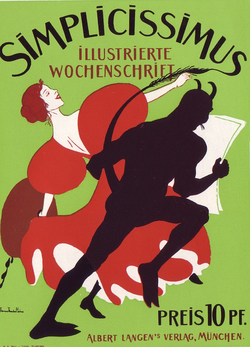
Simplicissimus
~ the obituary ~
Every issue from 1896 to 1944 has been scanned by a German research library and put online for nothing, and the certificate on that archive expired on 1 September 2026, so an encrypted connection to it now fails outright and you have to ask for the site over plain HTTP like it is 1998. That is how I read the first issue: ten Pfennig, dated 4 April 1896, Munich, subtitled simply as an illustrated weekly, with a quarterly subscription at one mark fifty delivered to the house.
Albert Langen was twenty-six and a publisher, and what he had in mind was not primarily a satire sheet but an illustrated literary review on the French model. The name came from Grimmelshausen's novel of 1668. Thomas Theodor Heine was the only artist in issue one and drew for it for the next thirty-seven years. On page two of that issue sits a poem in the magazine's own voice which ends on the line that the bitter fools are the good fools, and the lead story is by Frank Wedekind.
The names in the early volumes are the reason the thing is remembered at all. Thomas Mann's first appearance is in issue 21, dated 22 August 1896; Rilke turns up in issue 23 two weeks later. Hermann Hesse, Heinrich Mann, Jakob Wassermann, Arthur Schnitzler, Robert Walser, Erich Kästner, Joachim Ringelnatz and a Kurt Tucholsky pen name all pass through. By 1906 the core artists had enough leverage to force Langen to spin the magazine into a separate company and hand them shares in it.
Circulation claims are all the publisher's own and should be read that way. Langen's sales catalog gives 15,000 in April 1897 and 85,000 by April 1904. The archive's editor puts it near 100,000 around 1906, and adds that nobody can count the copies read in cafes and reading circles on top of that. The launch was announced at 300,000 free copies, which was advertising.
~ the case file ~
| Born | 4 April 1896 in Munich, ten Pfennig an issue |
|---|---|
| Peak | approaching 100,000 copies around 1906, with Thomas Mann and Rilke in its first volume |
| Killed | 3 June 1967 |
| Lifespan | 71 years across two runs |
| Made by | Albert Langen, with Thomas Theodor Heine drawing from issue one |
| Killed by | six-figure printing debts, and pardon magazine taking the readers |
~ the red bulldog ~
Heine drew it first in issue 8, dated 23 May 1896, as a small figure in the margin: a dog that has snapped its own chain. The authorities had been calling the magazine socialist and indecent, and Heine turned the accusation into a trademark. From the fourth volume it was stamped in color on the binding and printed blood red on black as a poster. The lithographic stone is in a Munich print collection.
The bulldog cost them in 1898. Issue 31, dated 29 October, covered Wilhelm II's journey to Palestine, and the piece that did the damage was a poem by Wedekind under a pseudonym, thanking the Kaiser for lifting from the Holy Land the disgrace of not yet having been visited by him. Because the magazine was printed in Leipzig, Saxon prosecutors had it. Heine got six months and Wedekind got six, both served in a fortress at Königstein rather than a prison. Langen left the country and stayed away until 1903, when he paid thirty thousand marks to come home. The next issue was seized before it reached the shops and never sold at all.
~ what they signed in march 1933 ~
On the night of 10 March 1933 the SA came through the editorial offices and wrecked them. On the 23rd the shareholders signed an undertaking that the magazine would from now on be managed and conducted in a strictly national spirit, with every mockery and caricature of the movement avoided. On 1 April readers were told the temporary ban had been lifted because loyal conduct toward the government had been promised in binding form. One account has Julius Streicher chairing the meeting with the staff at a Munich hotel with a dog whip on the table.
Heine was Jewish. Within days the Gauleiter of Munich made him surrender his editorial chair and his shares under threat of a camp, and he left the city on a dead relative's passport, going to Prague, then Brno, then Norway, then Sweden, where he died in 1948. The cover line crediting him as co-founder, which he had added himself after Langen's death, was deleted. In 1935 the company was folded into a Munich publisher inside the Nazi party's own press group. Klaus Mann wrote in 1937 that of everything printed in the Third Reich the satirical weekly Simplicissimus was among the most repellent, and the sentence that follows is just: only Th. Th. Heine is missing.
It survived because it was useful abroad. A rival party humor paper was closed in 1938 and this one was not, because a foreign reader could be shown it. The last wartime issue is number 37 of volume 49, dated 13 September 1944, shut down by the Propaganda Ministry in the general press closures. Its final drawing, by Otto Nückel, is a battlefield of ghosts in a ruin with a skeleton waving a pirate flag, which somebody got past the censor in the confusion.
~ nennen sie uns schlicht simpl ~
A Danish cartoonist named Olaf Iversen restarted it on 9 October 1954, keeping the old Tuesday publication day and using the printing house that had worked for the party. He never completed the purchase of the title from the Bavarian state, and a government memo of 1959 says so in those terms: strictly speaking, Iversen is using the name without the right to it. Olaf Gulbransson, who had drawn for the original, called him a cheeky piece of work for announcing him without asking, then contributed anyway from 1955. It printed fifty thousand copies and sold about thirty. In August 1966 the editor replaced the art nouveau wordmark that had been on the cover since 1896 with blocky modern type and told his readers to call the magazine plain Simpl from now on. Nine months later the printing debts reached six figures and it stopped, on 3 June 1967, sixteen pages thin and a mark dear, offering what Der Spiegel said the magazine reader of 1967 did not want, which was the chance to laugh at himself.
~ leave a rose ~
an anonymous tribute. one rose per visitor per day.
@}-->-- ... roses left here
~ leave a wreath ~
a rose fades by morning. a wreath stays on this grave for good, with your name on it.
paid once through stripe. payments are handled by OÜ Lakeview, the small company that keeps rip.so running. the money pays for the hosting and the nightly digging. adopt it and the headstone reads "maintained in memory by" you. the groundskeeper plants new wreaths at the next tending, usually within a day.
» one email a week: new graves and the anniversaries of the dead. subscribe
other phenomena: Nickelodeon Studios, Otoko no Ko Bokujou, Forum signatures, Doctor Fun
also died in the pre-1980s: IMSAI 8080, Television Electronic Disc, Cartrivision
~ leave a note ~
visitors before you have left these graveside notes. anonymous welcome.