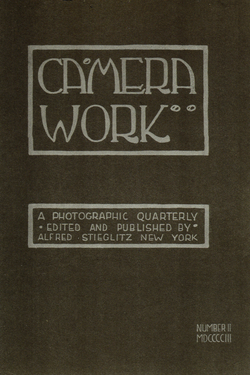
Camera Work
~ the last words ~
Alfred Stieglitz had spent five years editing Camera Notes, the house journal of the Camera Club of New York, arguing in it that photography was a fine art rather than a technical hobby. In 1902 the club threw him out and he gave up the editorship. That August he put out a two-page prospectus for something of his own, which would be self-published and would owe allegiance, as he wrote, only to the interests of photography.
Number 1 of Camera Work was cover-dated January 1903. Six hundred and twenty seven people had already paid. A year cost four dollars and a single copy cost two, in a decade when McClure's was selling to the whole country for a dime. Stieglitz insisted on printing a thousand copies of every number no matter how many were actually spoken for. He took no salary, his associate editors took none either, and no photographer was ever paid for appearing in it.
The timing was deliberate. Kodak had put a camera in anyone's hands with the promise that you press the button and we do the rest, and the pictorialists Stieglitz gathered around him were trying to put the rest back in. Soft focus, visible handwork, the photographer's decisions left sitting on the surface of the print. Camera Work called itself the mouthpiece of the Photo-Secession, the invitation-only circle he founded the same year the club expelled him, and from 1905 it had a room to match at 291 Fifth Avenue.
In January 1910 he broke his own rule. Number 29 carried four caricatures by Marius de Zayas, the first things in the magazine that were not photographs, and after that it ran painting and aesthetics alongside the gravures. The double number 34-35 in 1911 gave itself to Rodin's drawings with a note on Cézanne and a piece on Picasso beside them. The special number of August 1912 put seven Matisse plates and seven Picasso plates next to Gertrude Stein's word portraits of both, which was the first time Stein had been published in her own country. The photographers on the subscription list did not all follow him there.
~ the record ~
| Born | number 1, cover-dated January 1903 |
|---|---|
| Peak | 627 subscribers at launch, 1,000 copies printed per issue |
| Killed | numbers 49 and 50, June 1917 |
| Lifespan | 14 years, 50 numbers |
| Made by | Alfred Stieglitz |
| Killed by | the war economy, plus his own change of taste |
~ how a copy was made ~
Edward Steichen designed the cover, a flat gray-green panel with the title set in an Art Nouveau face, and Stieglitz liked it enough to make Kodak take the back page in the same style. The gravures came off the photographers' original negatives wherever a negative could be had, and when one could, the caption said so, because that made the page an original print rather than a reproduction of one. They were run by trade houses in New York, by Annan in Glasgow for the British work and by Bruckmann in Munich for the European, then often printed on Japanese tissue and mounted onto colored stock. Stieglitz tipped every single one into every single copy himself, retouching dust spots and scratches as he went, and would not let anyone else near the job. A set of prints once failed to arrive for a Photo-Secession show in Brussels, so they hung pages out of the magazine instead. Most of the visitors could not tell.
I spend my working days at the other end of this. In computer vision an image is a tensor that gets generated and discarded by the thousand, and the entire economic case rests on nobody ever having to touch one. Camera Work was built on the opposite bet, and the argument was not really in the essays. It was in the glue.
~ down to thirty six ~
The list shrank every year after the magazine stopped being only about photographs. Stieglitz responded by destroying unsold copies to make the back numbers scarce, which did raise their price and did not bring anybody back. By the end the print run had been cut from a thousand to under five hundred, the war had made good paper expensive and then hard to get at all, and thirty six people were still paying.
Number 47 is the one that gives the game away. Some years before it Stieglitz had asked his friends what the gallery at 291 meant to them. He got sixty eight replies and printed every one unedited, including Steichen's, which described the exercise as a project in self-adulation. Four of the sixty eight came from photographers. It remains the only issue of Camera Work published without a single picture in it.
~ numbers forty nine and fifty ~
Number 48 did not appear until October 1916, roughly sixteen months after the one before it. What it introduced was Paul Strand, who had dropped the soft focus entirely and was photographing kitchen bowls and strangers on the street in hard clean light. Stieglitz printed him knowing exactly what it meant, and wrote that the work was brutally direct, devoid of all flim-flam and of any ism.
The final issue was a double, numbers 49 and 50, June 1917, fifty six pages, eleven Strand plates. Those eleven were printed straight onto the heavy journal page instead of being tipped in on Japanese tissue, so the last thing the magazine did was give up its own signature gesture. It carried an announcement that the next number would be Georgia O'Keeffe. There was no next number and no farewell notice. Stieglitz closed 291 within weeks and was left holding several thousand unsold copies of Camera Work plus more than eight thousand of a second journal he had been running. He sold the lot to a ragman by weight. Nearly every copy in existence today came off a subscriber's shelf.
A gallery in Berlin has traded under the name CAMERA WORK since 1997, selling Avedon and Man Ray prints. Its own about page calls the name historically coined and leaves it at that, which is the honest version. Nobody has tried to claim the thing itself.
~ leave a rose ~
an anonymous tribute. one rose per visitor per day.
@}-->-- ... roses left here
~ leave a wreath ~
a rose fades by morning. a wreath stays on this grave for good, with your name on it.
paid once through stripe. payments are handled by OÜ Lakeview, the small company that keeps rip.so running. the money pays for the hosting and the nightly digging. adopt it and the headstone reads "maintained in memory by" you. the groundskeeper plants new wreaths at the next tending, usually within a day.
» one email a week: new graves and the anniversaries of the dead. subscribe
other phenomena: Judge, PsychoExGirlfriend.com, HQ Words, Elder Pastitsios
also died in the pre-1980s: Oz, Judge, Electronic Video Recording
~ leave a note ~
visitors before you have left these graveside notes. anonymous welcome.