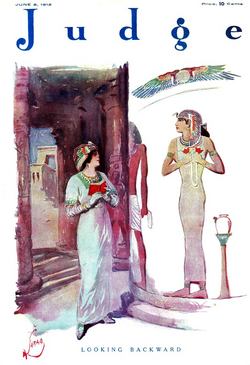
Judge
~ the goodbye ~
James Albert Wales drew for Puck until he quarreled with Joseph Keppler, and then he left. Every account of the split says only that there was a quarrel, which is all anybody wrote down. He took the cartoonist Livingston Hopkins with him and found backing from Frank Tousey, who published dime novels, and George H. Jessop, who wrote. The first number of The Judge came out on 29 October 1881, sixteen quarto pages, into the middle of the Long Depression.
It did well enough at first and then ran straight into the problem that it was a copy of Puck being sold against Puck. Wales got out in 1885, went back to the magazine he had walked away from, and died the following December at thirty four. He had spent a good part of his career on antisemitic caricature and wrote a line in Judge in 1882 about Jews already ruling Europe and it being only a question of time before they ruled America too. That is in the bound volumes with everything else. The definite article went as well, dropped from the title in 1886 and put back in 1938, a change that survives now only in serial records.
What saved it was politics. Puck was a Democratic paper and it was taking the Republican candidate James G. Blaine apart week by week through the 1884 campaign, so the Republicans went looking for a weapon of their own and found a failing humor weekly for sale. On 27 September 1884 Judge ran Frank Beard's answer, a cover putting Grover Cleveland's illegitimate child on a newsstand in front of the whole country, and the chant that came out of it followed Cleveland for the rest of his life: Ma, Ma, where's my Pa?
~ the chronicle ~
| Born | 29 October 1881, sixteen quarto pages |
|---|---|
| Peak | 100,000 copies by 1912, past Puck at last |
| Killed | 1947, with no last issue anybody wrote down |
| Lifespan | 66 years |
| Made by | James Albert Wales, then William J. Arkell |
| Killed by | The New Yorker, with the Depression helping |
~ bought by a party ~
William J. Arkell bought Judge in 1885 and spent whatever it took. He pulled Bernhard Gillam and Eugene Zimmerman off Puck's staff and made Gillam his director-in-chief in 1886, with the whole operation pointed at the Cleveland administration. Isaac Gregory edited it from 1886 to 1901 and tied it to the Republican Party tighter still, running William McKinley's campaign through Grant Hamilton's covers and Victor Gillam's centerfolds. Circulation went from about 50,000 in the early 1890s to around 85,000, and reached 100,000 by 1912, by which point it had finally passed the magazine it was invented to attack. Gillam himself did not see much of it. He caught typhoid and died on 19 January 1896, at Arkell's home town in upstate New York.
Plenty of people came through. James Montgomery Flagg invented a tramp called Nervy Nat for Judge in 1903, his first comic strip, years before he drew the Uncle Sam recruiting poster. Art Young and R. F. Outcault turned up in its pages. Norman Rockwell's first Judge cover ran on 7 July 1917, a soldier escorting a woman, captioned Excuse Me!
~ four months in 1924 ~
The 1920s were the best years it ever had. Norman Anthony worked his way up to the editorship and aimed the magazine squarely at college students and the alumni drinking in cities, reprinting campus humor magazines and running a column called High Hat about speakeasies and what you could make in your own bathroom. A young Theodor Geisel got hired on the strength of a cartoon whose punchline used a brand of bug spray called Flit, which turned into seventeen years of advertising work and the line Quick, Henry, the Flit. Behind the boom the business was already shaky: the parent company went into receivership in 1921, and Frank Leslie's Illustrated Newspaper was folded into Judge in 1922.
Harold Ross was an editor of Judge from 5 April to 2 August 1924. Four months. He took what he learned about what a humor weekly should not be, and in February 1925 he started The New Yorker. Anthony was poached by Life in 1928, the Depression arrived the year after, and Judge dropped its price to a dime and went monthly in 1932.
~ where the record stops ~
It skipped October and November of 1938 and came back. Then something odd happens to the paper trail. The serial records at HathiTrust and Princeton both end their holdings at volume 116, number 2720, January 1939, and both put a question mark after it while guessing that the magazine ceased there. That is where the microfilm reel ends, eight years short of the obituary.
The Internet Archive has covers from 1941 and 1943, plus one from February 1945, all of them monthly. Syd Hoff was still drawing for it at the end. The last issue anyone can actually produce is number 2802, dated June 1947, and the one before it is number 2801 from April, which means that by then it was not even monthly anymore. Every source agrees the magazine ended in 1947 and not one of them names the issue it ended on. Nobody wrote down the last day of a paper that had spent sixty six years telling America what to laugh at.
No copyright renewals were ever filed on any issue or any contribution, so the entire run is public domain and free to read. The domain judge.com belongs to a staffing and IT consultancy in Pennsylvania, which has never mentioned the magazine and has no reason to.
~ leave a rose ~
an anonymous tribute. one rose per visitor per day.
@}-->-- ... roses left here
~ leave a wreath ~
a rose fades by morning. a wreath stays on this grave for good, with your name on it.
paid once through stripe. payments are handled by OÜ Lakeview, the small company that keeps rip.so running. the money pays for the hosting and the nightly digging. adopt it and the headstone reads "maintained in memory by" you. the groundskeeper plants new wreaths at the next tending, usually within a day.
» one email a week: new graves and the anniversaries of the dead. subscribe
other phenomena: Camera Work, HQ Words, PsychoExGirlfriend.com, Entertainment Weekly (print)
also died in the pre-1980s: Oz, Camera Work, Electronic Video Recording
~ leave a note ~
visitors before you have left these graveside notes. anonymous welcome.