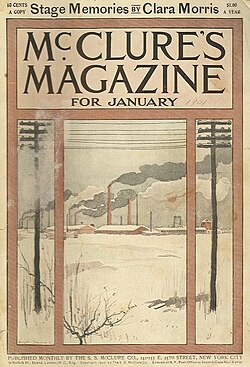
McClure's
~ the goodbye ~
S. S. McClure and John Sanborn Phillips had been classmates at Knox College in Illinois. McClure went into the syndication business, selling the same story to many newspapers at once, and by 1893 he wanted a magazine of his own. Phillips found the 7,300 dollars it took to start one. The first issue is dated June 1893.
The price was the opening move. McClure's sold for ten cents a copy and a dollar a year, printed right on the cover, at a time when a respectable American monthly asked twenty-five or thirty-five cents. The arithmetic only works if advertising pays for the magazine and the reader pays for almost nothing, which is the arrangement the whole twentieth century then ran on.
What a dime bought was good. Robert Louis Stevenson and Rudyard Kipling appeared in it, novels came a chapter at a time, and Willa Cather later worked on the staff. By June 1898 circulation had gone past 400,000 and the magazine was carrying more advertising than anyone it competed with.
~ the chronicle ~
| Born | June 1893, New York, on $7,300 from John Sanborn Phillips |
|---|---|
| Peak | over 400,000 copies by June 1898 |
| Killed | March 1929 |
| Lifespan | 35 years, 9 months |
| Made by | S. S. McClure and John Sanborn Phillips |
| Killed by | a takeover by The Smart Set, after eighteen years of drift |
~ january 1903 ~
Ida Tarbell had started her history of the Standard Oil Company in November 1902. It ran nineteen installments, built out of court records and company documents, and John D. Rockefeller's trust was eventually broken up because of it. Nobody had put that much reporting labor into a single business before.
In the January 1903 issue the third Tarbell installment sat beside Lincoln Steffens on municipal corruption, under the title The Shame of Minneapolis. Ray Stannard Baker was in there too, on the United Mine Workers. McClure noticed what he had assembled and wrote an editorial in that same issue pointing out that every one of those pieces described Americans deciding the law did not apply to them. Magazine historians treat the issue as the start of the muckraking era. Oddly, the circulation barely moved because of it. The 1898 average had been 349,623 and in 1905, three years into the reporting that made the magazine's name, it stood at 375,000.
From January 1907 to June 1908 it ran a fourteen-part investigation into Christian Science and Mary Baker Eddy, which is the same method pointed at a church. By then the reporters who had built the reputation were gone, having walked out in 1906 to buy The American Magazine, and that story belongs to the magazine they bought.
~ the long way down ~
The money went first. The company started building its own printing plant on a 105,000 dollar estimate and spent over three times that, advertising revenue slipped, and by 1911 S. S. McClure no longer controlled the magazine that carried his name and had to sell it to creditors. He lived until 1949 and watched the rest from outside.
What followed took eighteen years and has no clean shape to it. The company went into film briefly as McClure Pictures. The magazine published a car yearbook in 1916 with the specifications of a hundred manufacturers. Then it was relaunched as a women's title and stopped publishing three separate times without quite dying, the longest gap running from September 1924 to April 1925. In July 1928 it came back as New McClure's Magazine. The last issue is March 1929, after which The Smart Set took the title and there was no McClure's left on any newsstand.
Project Gutenberg and the Modernist Journals Project both carry it free now, cover to cover, advertising included. The ads age worst and explain most. They are what made a dime cover price survivable, and once they went elsewhere there was no magazine underneath.
~ leave a rose ~
an anonymous tribute. one rose per visitor per day.
@}-->-- ... roses left here
~ leave a wreath ~
a rose fades by morning. a wreath stays on this grave for good, with your name on it.
paid once through stripe. payments are handled by OÜ Lakeview, the small company that keeps rip.so running. the money pays for the hosting and the nightly digging. adopt it and the headstone reads "maintained in memory by" you. the groundskeeper plants new wreaths at the next tending, usually within a day.
» one email a week: new graves and the anniversaries of the dead. subscribe
other news: KernelTrap, The Superficial, CNN iReport, NewsTilt
also died in the pre-1980s: Magnavox Odyssey, Penn Central, Sony CV-2000
~ leave a note ~
visitors before you have left these graveside notes. anonymous welcome.