The Century Magazine
~ the eulogy ~
In 1881 Roswell Smith bought The Century Company of New York and renamed it after the Century Association, the club he belonged to. The magazine that came with the deal was Scribner's Monthly, by then in its eleventh year, and from November 1881 it appeared under the new name. Josiah Holland, who had been Scribner's editor and part owner, was supposed to edit it. He died before the first issue under the new masthead came out. The job went to Richard Watson Gilder, the managing editor, who held it for twenty eight years.
What Gilder put out every month was fiction and history, under engravings of a quality nobody else was paying for. Mark Twain's Adventures of Huckleberry Finn ran as excerpts across 1884 and 1885. Henry James serialized The Bostonians in it. Jack London wrote for it. Theodore Roosevelt contributed across three decades, including one piece filed while he was sitting president, and Antonín Dvořák wrote a tribute to Schubert for the 1894 volume while he was teaching in New York. Nikola Tesla filed a long article for the June 1900 number on the problem of increasing human energy. A writer in the New York Times said the thing had moved the capital of English-language illustrated magazines from London to New York, and for a decade or so that was true.
Its politics moved more than its readers did. Under Holland it had been an Evangelical paper, hostile to Catholicism and to anybody who doubted the divinity of Christ. Mormon polygamy was a standing target. By an April 1879 editorial it had decided that all seekers of truth were allies whether they believed or not. In 1875 it had argued there was not enough evidence for Darwinism; when Darwin died in 1883 it printed a tribute written by Alfred Wallace. By 1923 it was attacking what it called the poisonous dogmatism of William Jennings Bryan and publishing W. E. B. Du Bois.
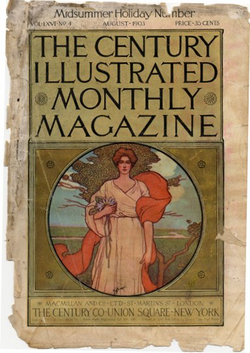
The decline started in the 1890s and the magazine understood it precisely. By 1900 the list had fallen to roughly a hundred and twenty five thousand names, half the 1880s figure, lost to cheaper monthlies its editors considered vulgar. The August 1903 cover shows you the problem without needing a word of explanation. The masthead runs across four lines, THE CENTURY ILLUSTRATED MONTHLY MAGAZINE, with Macmillan of St Martin's Street, London underneath the New York imprint, and the price printed up in the corner is thirty five cents. McClure's was selling for ten. An 1898 editorial complained about the profusion in literary and pictorial output that was fogging the intellect and lowering taste. A few months later it said fast trains and cheap print had replaced the age of reflection with the age of agitation. A 1902 editorial decided divorce was a threat to civilization. The diagnosis was not wrong about what was happening to it. Gilder simply would not act on it, and went on holding the standard up while the subscribers walked.
~ the dossier ~
| Born | November 1881, after Roswell Smith bought the company and renamed it |
|---|---|
| Peak | 250,000 subscribers in the 1880s, on the Civil War series |
| Killed | Spring 1930, volume 120 number 2, at 20,000 subscribers |
| Lifespan | 48 years under that title, 60 counting Scribner's Monthly |
| Made by | The Century Company, New York |
| Killed by | cheaper competition, then a buyout by The Forum |
~ grant one day and beauregard the next ~
The idea came from an assistant editor, Clarence Buel: write to the men who had commanded in the Civil War and ask them to put down what they remembered. It was scheduled for twelve months. It ran three years and became a four-volume book afterward. Grant wrote for it, after holding out until his own finances collapsed. Sherman and Sheridan filed, so did McClellan, and from the Confederate side Longstreet and Beauregard agreed to appear in the same pages as the men who had beaten them. In the end two hundred and thirty participants of every rank contributed.
Readers who had fought started mailing in their own recollections along with furious corrections of what the generals had claimed, in such volume that from 1885 the magazine gave them a standing section called Memoranda on the Civil War. The editors went on tours of the battlefields with commanders to explain the ground and artists to draw it. Gilder wrote to his wife about the traffic through the office: Grant one day and Beauregard the next.
Subscriptions went to two hundred and fifty thousand, a figure no magazine of that kind had previously reached. Edward Weeks wrote that even by 1950 no quality magazine had matched it, against a reading public three times the size. Before the series, Sherman was the only major figure of the war who had written a first-person account; afterwards three more of them turned their installments into books of their own.
~ the last magazine to allow a photograph ~
In 1889, after years of holding out, The Century became the last major American periodical to print photographic illustration. Gilder had explained the resistance in his own pages. He objected to what he called the minute and literal representation of the visible world, and preferred painting, which recorded only what deserved recording. He thought cheap printing was going to do the same flattening thing to prose. He was arguing against halftone reproduction in a magazine whose entire reputation rested on the engravings, so the position was at least consistent, and it was also the single technology that every competitor used to undercut him.
~ spring 1930, volume 120 ~
Gilder died in 1909 and Robert Underwood Johnson took over until he resigned in 1913. The 1910s were financially bad, though the fiction stayed good: H. G. Wells ran The World Set Free across the first three numbers of 1914. Glenn Frank edited from 1921 to 1925 and pointed it at current affairs, cutting the illustrations back; he left to become president of the University of Wisconsin at Madison, and after he was gone the illustrations went entirely. Hewitt Howland had it from 1925 to the end.
In 1929 the monthly became a quarterly, a decision to survive instead of competing. In 1930 the proprietors of The Forum purchased the title and ran the two together as Forum and Century. The Online Books Page dates the final number Spring 1930, volume 120, number 2. Twenty thousand subscribers were left, which is beneath a tenth of the figure the Civil War series had delivered forty five years earlier.
The Century Company's other two famous products are still in use. The Century Dictionary is a standard reference. And in 1894 Linn Boyd Benton cut a typeface at American Type Founders at the request of Theodore Low De Vinne, the magazine's printer, who wanted something more legible for the page without losing characters per line: Century Roman, first used in 1895. Benton's son developed it into Century Schoolbook, which went into American textbooks and stayed there. Anybody who learned to read off those pages learned off a face descended from the one this magazine had cut for its own columns.
~ leave a rose ~
an anonymous tribute. one rose per visitor per day.
@}-->-- ... roses left here
~ leave a wreath ~
a rose fades by morning. a wreath stays on this grave for good, with your name on it.
paid once through stripe. payments are handled by OÜ Lakeview, the small company that keeps rip.so running. the money pays for the hosting and the nightly digging. adopt it and the headstone reads "maintained in memory by" you. the groundskeeper plants new wreaths at the next tending, usually within a day.
» one email a week: new graves and the anniversaries of the dead. subscribe
other news: The Ladder, Mega Power, Medyakronik, Kotaku UK
also died in the pre-1980s: The Ladder, LEF, VideoBrain Family Computer
~ leave a note ~
visitors before you have left these graveside notes. anonymous welcome.