Scribner's Magazine
~ the goodbye ~
This was the second magazine the house of Scribner published. The first, Scribner's Monthly, ran from 1870 to 1881 and then left the firm and became The Century. Six years later the publisher came back with a new monthly carrying the family name on the cover, and put over half a million dollars into launching it, because the competition was Harper's Monthly and The Atlantic Monthly, neither of which was going to leave room out of politeness.
What you got for twenty five cents was a general monthly in the full nineteenth century sense, carrying fiction and reporting under engravings by the best illustrators the firm could buy. The firm claimed it was the first magazine anywhere to run color illustration, and whether or not the claim holds up, the look of the object was the selling point. Theodore Roosevelt wrote for it. So, later, did Edith Wharton and Ernest Hemingway.
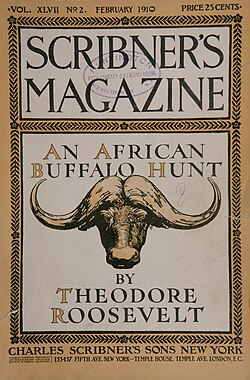
The February 1910 cover is the business model in one object. Volume XLVII, number 2, price twenty five cents, and across the middle in capitals: AN AFRICAN BUFFALO HUNT BY THEODORE ROOSEVELT. The ex-president had gone on safari after leaving the White House and was filing the trip to Scribner's as he went. Circulation went past two hundred thousand on the back of it.
Then the First World War ended and the readers started leaving. By 1930 the magazine was selling about seventy thousand copies, against a hundred and twenty thousand for Harper's and a hundred and thirty thousand for The Atlantic. It kept the quality and lost the arithmetic.
~ the chronicle ~
| Born | January 1887, after the firm spent over $500,000 setting it up |
|---|---|
| Peak | over 200,000 copies while Roosevelt was writing for it |
| Killed | May 1939, volume 105, number 5 |
| Lifespan | 52 years |
| Made by | Charles Scribner's Sons, New York |
| Killed by | circulation, then a merger that took only the name |
~ banned in boston ~
In 1929 Scribner's serialized A Farewell to Arms across six installments from May to October, and paid Hemingway sixteen thousand dollars for it, the most the magazine had ever paid for a serial. On 20 June the Boston police chief, Michael H. Crowley, banned the June issue from the stands for being salacious. The New York Times had the story the next morning.
The publisher's answer was that judging a few passages without the story around them was not criticism but censorship. The novel came out in book form that September and sold well. Set the sequence out plainly. A magazine with ten years left paid a record fee for a novel and had the issue pulled off the stands by the Boston police, and its circulation still would not hold against two competitors who did neither.
~ the commentator years ~
Charles Scribner's Sons sold the magazine in 1938 to Harlan Logan Associates. The last issue under the old masthead is May 1939, volume 105, number 5. In November it was merged with a small monthly called The Commentator and the combined thing was published out of Philadelphia as Scribner's Commentator.
The afterlife is the ugly part.
Scribner's Commentator was a pocket-sized isolationist monthly, backed by Charles Shipman Payson and edited by George T. Eggleston, and through 1940 and 1941 it argued hard and publicly against American entry into the war. Its last issue is dated January 1942, a month after Pearl Harbor. The same masthead had carried Roosevelt's safari dispatches thirty years earlier.
~ the one that kept trading ~
Scribner the book publisher is still here, as an imprint inside Simon and Schuster, and scribner.com will sell you a novel this afternoon. A backlist keeps earning for decades. A monthly issue stops earning at the end of its month, and that difference decided which half of the firm kept the name.
The magazine itself is public domain now and scanned, volume by volume, in the online catalogs. I went to one of those scans to check what the thing cost, and the answer is sitting in the top corner of the February 1910 cover, next to the volume number: twenty five cents.
~ leave a rose ~
an anonymous tribute. one rose per visitor per day.
@}-->-- ... roses left here
~ leave a wreath ~
a rose fades by morning. a wreath stays on this grave for good, with your name on it.
paid once through stripe. payments are handled by OÜ Lakeview, the small company that keeps rip.so running. the money pays for the hosting and the nightly digging. adopt it and the headstone reads "maintained in memory by" you. the groundskeeper plants new wreaths at the next tending, usually within a day.
» one email a week: new graves and the anniversaries of the dead. subscribe
other news: Russiangate, ORACLE, Infowars, Personal Computer Games
also died in the pre-1980s: Electrologica, Blast, Harper's Weekly
~ leave a note ~
visitors before you have left these graveside notes. anonymous welcome.