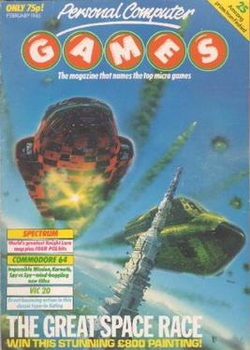
Personal Computer Games
~ the eulogy ~
VNU was a Dutch publishing group with a London office and a list built on business titles. In July 1983 it launched a magazine about games for home micros, which at that point nobody had proved was a business. The second issue came out on 28 October, and from February 1984 the thing was monthly.
Coverage was deliberately multi-format. Spectrum and Commodore 64 at the front because that is where the readers were, with the BBC Micro and the Electron and the VIC-20 and the new Amstrad CPC behind them. By the end the cover price was seventy five pence and the strapline promised the magazine that names the top micro games.
The last issue is February 1985. Nineteen months on sale.
~ the dossier ~
| Born | July 1983, second issue 28 October, monthly from February 1984 |
|---|---|
| Peak | monthly coverage of the Spectrum and the Commodore 64 at the top of the boom |
| Killed | February 1985, 75p |
| Lifespan | nineteen months |
| Made by | VNU, from London |
| Killed by | a 1985 shelf with too many games magazines on it |
~ the panel ~
Reviews ran in a section called Screen Test, and no single person wrote them. A game got an explanation of how it played, then boxouts at the end carrying separate verdicts from the PCG Panel, which was the staff plus readers brought in specifically to disagree with the staff. Scores were out of ten for graphics, sound, originality and lasting interest, with an overall mark sitting on top of those.
Putting the reader inside the review is an idea the British magazines kept circling for another decade. It answers the problem every games magazine has, which is that one person's taste is being sold to thousands of people as a verdict. The compromise PCG settled on was a page where the staff and the readers argued in print.
~ what the advertisers did ~
Imagine Software, the Liverpool house that spent like a record label, bought pages here and then stopped paying for them. VNU's business arm went to court on 28 June 1984 over ten thousand pounds of unpaid advertising, and Imagine was wound up eleven days later. That was the year the British software boom ran out of money, and the magazines sat directly downstream of it, losing ad pages first and titles afterward.
~ where everyone went ~
Chris Anderson edited it and Bob Wade wrote for it, and when it folded the pair turned up at Newsfield launching Zzap!64. Anderson then started a company of his own and printed Amstrad Action in October 1985. That company was Future Publishing, which spent the following thirty years owning most of the British games press and now points the domains of its dead titles at its surviving websites.
Reading the run from Turkey forty years on, what dates it is not the machines. It is the back half of every issue: mail order firms in towns I have never heard of, and coupons to cut out and post with a cheque. The magazine lasted nineteen months. The people in it lasted considerably longer.
~ leave a rose ~
an anonymous tribute. one rose per visitor per day.
@}-->-- ... roses left here
~ leave a wreath ~
a rose fades by morning. a wreath stays on this grave for good, with your name on it.
paid once through stripe. payments are handled by OÜ Lakeview, the small company that keeps rip.so running. the money pays for the hosting and the nightly digging. adopt it and the headstone reads "maintained in memory by" you. the groundskeeper plants new wreaths at the next tending, usually within a day.
» one email a week: new graves and the anniversaries of the dead. subscribe
other news: CNN Philippines, Infowars, Russiangate, ORACLE
also died in the 1980s: Morrow Designs, Whitechapel Computer Works, Trilogy Systems
~ leave a note ~
visitors before you have left these graveside notes. anonymous welcome.