Blast
~ the goodbye ~
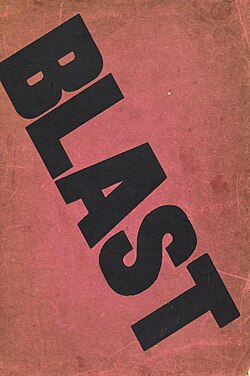
The thing was nine inches by twelve and the cover was pink. Not a tasteful pink either: Ezra Pound called it the great MAGENTA cover'd opusculus, and the New York Times, reporting on the new cult of rebel artists that August, settled on cerise. The word BLAST ran across it diagonally in black capitals, set at a size meant to be legible across a shop. Inside were 168 pages of manifesto and drawings, priced at two shillings sixpence.
It had a reason to be angry and the reason had a name. Filippo Marinetti had been coming to London since 1910 to recruit for Italian Futurism, and in June 1914 The Observer published an English Futurist manifesto that he had written with C. R. W. Nevinson. Wyndham Lewis found his own name printed at the bottom as a signatory, which nobody had asked him about. On 12 June, while Marinetti performed his poem about the siege of Adrianople with Nevinson accompanying on a drum, Lewis and nine others shouted the recital down. Jacob Epstein and Henri Gaudier-Brzeska were in the group.
Blast was the reply, assembled by Lewis from what he called a determined band of miscellaneous anti-futurists. Pound coined Vorticism for it and acted as the group's publicist, writing to James Joyce that Lewis was starting a new quarterly and that it was mostly a painters' magazine with him to do the poems. John Lane published it at the Bodley Head in London, with John Lane Company carrying it in New York and Bell and Cockburn in Toronto. The cover is dated 20 June 1914 and it actually reached the shops on 2 July.
The English press was not impressed. Reviewers found the writing dull and the typography a secondhand Futurist trick, and Marinetti wrote to Harold Monroe that he took the bad reviews as a victory for his side, while regretting that the English had not simply joined him against the common enemy of attachment to the past.
~ the chronicle ~
| Born | 2 July 1914, cover-dated 20 June, 168 pages at two shillings sixpence |
|---|---|
| Peak | a 20-page manifesto signed by eight artists, July 1914 |
| Killed | July 1915, the second and final number, 112 pages |
| Lifespan | two issues over twelve months |
| Made by | Wyndham Lewis, published by John Lane at the Bodley Head |
| Killed by | the First World War, which took its artists one at a time |
~ blasted and blessed ~
The first twenty pages are a manifesto in the form of two lists. Things were to be BLASTED or BLESSED, in type set at a scale nobody used for prose, and the choices were personal rather than programmatic. England went first, out of politeness, cursed for a climate that can manufacture no snow and can only drop the sea on us in a drizzle like a poem by Mr Robert Bridges. France got blasted for pig plagiarism and bad music. Putney was named a purgatory, because that is where Swinburne had gone to be respectable.
The blessings are stranger than the curses. Seafarers were blessed for exchanging one element for another, and hairdressers for attacking Mother Nature for a small fee and trimming aimless and retrograde growths. Henry Tonks, who taught at the Slade, managed to appear on both lists. Eight people signed at the end, Lewis and Pound among them, with Helen Saunders and Jessica Dismorr the two women on the list. Epstein declined to sign and let his work run anyway.
~ thirty three days ~
Britain declared war on Germany on 4 August 1914, five weeks after Blast 1 reached the shops. A magazine built on machinery and on violence promised to the Victorians had its subject taken away from it and handed to the Western Front.
The second number came out in July 1915 and is known as the War Number. It ran to 112 pages, carried a short play by Pound and two poems by a young T. S. Eliot, Preludes and Rhapsody on a Windy Night, and printed an essay by Gaudier-Brzeska called Vortex, written from the trenches. He was killed at the front a few weeks after writing it. Nothing followed it.
~ reading the scan ~
I came to Blast the way most people do now, as a scanned PDF on a university server, which is a flat way to meet an object whose entire argument is physical. The Modernist Journals Project has both numbers page by page, and what survives the scanning is the typography: the sheer size of the letters, the refusal to sit in columns. The pink does not survive the process at all.
~ blast 3, november 1919 ~
Lewis was mobilized in 1916 and served as an artillery officer in France before becoming a war artist for the Canadian government. Hulme was killed. David Bomberg came back having lost his faith in the whole modernist project. Lewis told a friend he intended to publish a third Blast in November 1919. He ran a Group X exhibition at Heal's Gallery in the spring of 1920 and started another magazine, The Tyro, which managed two issues. Richard Cork's summary is that by 1920 even Lewis had to admit the movement was dead.
Black Sparrow Press reprinted both numbers in the early eighties, bound with a Blast 3 that was a festschrift for Lewis rather than a magazine, and Thames and Hudson did a facsimile in 2009. Original copies sit in the V and A and the Tate, plus a long list of American university libraries. A quarterly that appeared twice is now among the most reproduced objects in English modernism, reprinted far more often than it was ever published.
~ leave a rose ~
an anonymous tribute. one rose per visitor per day.
@}-->-- ... roses left here
~ leave a wreath ~
a rose fades by morning. a wreath stays on this grave for good, with your name on it.
paid once through stripe. payments are handled by OÜ Lakeview, the small company that keeps rip.so running. the money pays for the hosting and the nightly digging. adopt it and the headstone reads "maintained in memory by" you. the groundskeeper plants new wreaths at the next tending, usually within a day.
» one email a week: new graves and the anniversaries of the dead. subscribe
other phenomena: WWE ThunderDome, Dunkindonuts.org, Wai-Que, Modern Humorist
also died in the pre-1980s: Harper's Weekly, Kallol, Tales from the Crypt
~ leave a note ~
visitors before you have left these graveside notes. anonymous welcome.