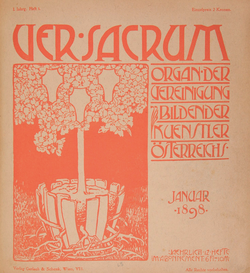
Ver Sacrum
~ the last words ~
In 1897 a group of Viennese artists walked out of the Künstlerhaus, where the city's official art establishment lived, and formed a breakaway association. They had no building. They had no exhibition. One of the first things they resolved to do was publish a magazine, which tells you what they thought the argument was actually about. Their own account, written six years later, puts it as the year they decided to break the spell lying over art life in Vienna.
The first number came out in January 1898 under the name Ver Sacrum, Latin for sacred spring. Underneath it is an old Italic rite in which a people facing crisis vowed the coming spring's offspring to the gods, and the children, once grown, were sent out of the territory to found something of their own. The critic Ludwig Hevesi thought the Secession had actually picked the phrase up from a Ludwig Uhland poem of that title, where a band of consecrated youth is called the seed corn of a new world. For artists who had just quit the only institution that could show their work, neither reading was subtle, and neither was meant to be.
Alfred Roller drew the cover and ran the editorial side. On that first cover a young tree stands in a square wooden tub and its roots have grown through the staves and split them apart, and three blank shields hang in the branches for the arts the association meant to cover. The plate is signed with the year 1897. Across the top, in red lettering built out of straight strokes, the title. Along the side, the thing it was: Organ der Vereinigung bildender Künstler Österreichs, the journal of the Association of Austrian Artists. At the bottom, the terms, hand-lettered in the same face as the art: twelve issues a year, six florin by subscription, ten marks if you lived in Germany.
~ the record ~
| Born | January 1898, two kronen an issue in Vienna |
|---|---|
| Peak | 12 kronen a year, with foreign subscribers always the majority |
| Killed | December 1903, Heft 24 of volume six |
| Lifespan | six years, 120 numbered issues |
| Made by | the Vereinigung bildender Künstler Österreichs |
| Killed by | its own committee, which declared the job finished |
~ a square page ~
Almost every magazine ever printed is taller than it is wide, because that is how paper gets cut and how a page turns. Ver Sacrum came out nearly square, 30.8 by 29.2 centimeters by the Leopold Museum's measurement of a surviving copy, which wasted stock and annoyed printers and made the thing impossible to shelve beside anything else. That was the argument. A square page does not favor a tall picture over a wide one, and the people laying it out were the same people hanging the exhibitions.
A single copy cost two kronen and a year cost twelve. The cover quotes the subscription in florin instead, because Austria was midway through a currency changeover that had introduced the krone in 1892 and would not finish withdrawing the gulden until 1900, so the front of the magazine carries two currencies at once without remarking on it. Gerlach and Schenk in Vienna published the first volume; E. A. Seemann in Leipzig took it over from 1899.
~ what the members put into it ~
The committee counted the output itself when it closed the magazine down. Across six volumes the members had supplied 471 drawings made specially for Ver Sacrum and 216 original woodcuts, plus 55 original lithographs and etchings. Each of those was made for the page rather than copied off a canvas hanging somewhere else. Koloman Moser and Josef Hoffmann worked on it directly, Joseph Maria Olbrich and Gustav Klimt turn up through the early volumes, and the advertising pages were designed by Secession members too, so even the glassware and paint-company ads are part of the object.
The text side was not an afterthought. Rainer Maria Rilke appeared in it, along with Hugo von Hofmannsthal, Maurice Maeterlinck, Knut Hamsun, Richard Dehmel and Arno Holz. The first issue carried pieces by Hermann Bahr and Max Burckhard. Heidelberg's art library, which holds the digitized run, rates Ver Sacrum as doing for Austria what Pan did for Germany, and says the graphic design of it set the pattern for Austrian book art afterward.
~ heft twenty four ~
Most accounts of the ending say the money ran out. The magazine printed its own version on pages 399 to 401 of the 1903 volume, signed by the Ver Sacrum Committee, and it reads differently. With the 24th issue of this volume, it says, Ver Sacrum enters a new stage of its development: in place of the regularly appearing issues there will be an occasional series of publications. Then the reason. The magazine has fulfilled its purpose. Ending the regular schedule frees artistic manpower inside the association for the larger tasks it has set itself.
The same notice is honest about the economics without blaming them. Ver Sacrum could never by its nature win a large readership, the committee writes, and then flags one thing about that: foreigners from every part of the world always made up the majority of the subscriber lists. And apart from the second volume, all member work for Ver Sacrum was done unpaid. So the thing had no real audience at home and no payroll, and the people who made it decided that abroad knew who they were and the Viennese public had long since taken a side, so the discussion was general and the organ was redundant.
There was a drift before that. From 1900 it went twice monthly with a smaller print run and turned inward, until it was largely an information sheet for Secession members about Secession business. The subtitle tracks it exactly. It starts as the Organ of the association in 1898, becomes the Zeitschrift of the association in 1899, and from 1900 reads Mitteilungen, meaning notices. A magazine that renames itself notices has already told you what it has become.
~ the 1969 one ~
Sixty six years later somebody brought the name back. Ver Sacrum, Neue Hefte für Kunst und Literatur ran in Vienna from 1969 to 1974, edited by Otto Breicha with Hilde Spiel and Georg Eisler, who was then president of the Vienna Secession. It was published by Verlag Jugend und Volk, which Breicha described as the legal successor of the house that had handled the old Ver Sacrum, and it was printed at 27.2 by 30.2 centimeters, only slightly smaller than the original. Breicha was clear that this one was not a house organ of the Secession.
Five issues appeared in five years, and the print runs shrank the whole way down, from 1,500 copies for the second to 999 for the fifth. Each number came with a luxury edition of exactly 99 copies carrying signed original prints. The fifth took two years to arrive and ran to 182 pages. Then it stopped. The Austrian National Library's account of the revival draws the contrast plainly: the original was wound up because its owners judged the job done, while the 1969 version went under because it sold badly.
~ leave a rose ~
an anonymous tribute. one rose per visitor per day.
@}-->-- ... roses left here
~ leave a wreath ~
a rose fades by morning. a wreath stays on this grave for good, with your name on it.
paid once through stripe. payments are handled by OÜ Lakeview, the small company that keeps rip.so running. the money pays for the hosting and the nightly digging. adopt it and the headstone reads "maintained in memory by" you. the groundskeeper plants new wreaths at the next tending, usually within a day.
» one email a week: new graves and the anniversaries of the dead. subscribe
other phenomena: Pobieraczek.pl, Não Salvo, Peanut Butter Jelly Time, InStyle (print)
also died in the pre-1980s: The Delineator, Clairtone, Nutting Associates
~ leave a note ~
visitors before you have left these graveside notes. anonymous welcome.