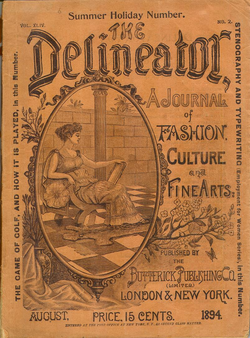
The Delineator
~ the obituary ~
Ebenezer Butterick's business was the graded paper sewing pattern, which let a woman in Ohio cut out a dress that had been designed in New York. The patterns sold, but a pattern on its own is a sheet of tissue in an envelope. It needed context: a season, and a reason to want this neckline this year. So the company started a magazine in 1869 under the name The Metropolitan Monthly, and renamed it The Delineator in 1875.
The magazine stayed downstream of the pattern catalog for sixty eight years. It printed the Butterick designs with the fashion reporting that made sense of them, along with embroidery charts and pieces on decorating the house the dress was going to be worn in. The business model was selling the plan rather than the product, and it took the rest of publishing about a century to find a name for that.
Charles Dwyer, editor from 1894 to 1906, pushed it past clothes into editorials and fiction about the expanding public life of American women. His successor as managing editor was Theodore Dreiser, who wrote about women as consumers and opened the magazine to readers writing in about social problems. Honoré Willsie Morrow edited it from 1914 to 1919. L. Frank Baum published short stories in it while Oz was making him famous.
In November 1926, under Mrs. William Brown Meloney, The Delineator absorbed The Designer, a rival founded in 1887 and published by the Standard Fashion Company, which happened to be a Butterick subsidiary. That was one pattern company's magazine eating another's, with the same owners on both sides of the deal.
~ the case file ~
| Born | 1869 in New York as The Metropolitan Monthly, renamed 1875 |
|---|---|
| Peak | the Child-Rescue Campaign placed over 2,000 children, 1907 to 1911 |
| Killed | April 1937, volume 130 number 4 |
| Lifespan | 68 years |
| Made by | the Butterick Publishing Company |
| Killed by | a merger into Pictorial Review that killed both titles inside two years |
~ the campaigns ~
From May 1894 it ran a monthly series on women's colleges, starting with Vassar, written by graduates of the schools in question and covering what the place cost as well as what it taught. After the first year the focus moved to women's experience at co-educational schools, beginning with Cornell and spreading through the land-grant universities. For a reader in a small town deciding whether this was even possible, that series was a practical document.
The Child-Rescue Campaign ran from 1907 to 1911 and is the strangest thing the magazine ever did. Each issue serialized the photograph and story of an institutionalized child, and readers wrote in to adopt them. Over two thousand children, mostly from white working-class and immigrant families, were placed in private homes this way. It fed directly into the 1909 White House Conference on the Care of Dependent Children that Theodore Roosevelt hosted.
In 1921 the editor Marie Mattingly Maloney started Better Homes in America, to promote home ownership and modernization. By 1923 it was a national campaign with Calvin Coolidge and his Commerce Secretary Herbert Hoover behind it.
~ the parts nobody reprints ~
The same magazine published articles on eugenics, which was presented at the time as a science and is racial pseudoscience. It sat in the reform pages next to the child placements and the housing campaign, because in American progressive publishing of that period it frequently did. Any honest account of The Delineator's reform work has to include it.
~ april 1937 ~
The last issue of The Delineator is volume 130, number 4, dated April 1937. The last issue of Pictorial Review as its own magazine is volume 38, number 7, also April 1937. Both titles stop in the same month because they were rolled into one thing called Pictorial Review-Delineator, after the Pictorial Review's owner acquired the sixty-eight-year-old Butterick title.
Pictorial Review had been the largest women's monthly in the country, past three million copies. The merged magazine lasted until March 1939 and then that stopped too. Two large circulations went in and the combined title survived under two years.
What remains is paper. Cornell has 143 issues scanned and the Internet Archive has thirty nine. Bound volumes sit in the costume collections at the Met and at Winterthur, kept for the plates rather than the writing. Helen Dryden's covers from the late 1920s get pulled out and sold as prints. The dresses in them were only ever advertisements for an envelope of tissue paper, and they outlasted every campaign the magazine was proud of.
~ leave a rose ~
an anonymous tribute. one rose per visitor per day.
@}-->-- ... roses left here
~ leave a wreath ~
a rose fades by morning. a wreath stays on this grave for good, with your name on it.
paid once through stripe. payments are handled by OÜ Lakeview, the small company that keeps rip.so running. the money pays for the hosting and the nightly digging. adopt it and the headstone reads "maintained in memory by" you. the groundskeeper plants new wreaths at the next tending, usually within a day.
» one email a week: new graves and the anniversaries of the dead. subscribe
other news: PC Media, BGamer, SmartPlanet, Wiadomości24.pl
also died in the pre-1980s: Ver Sacrum, Clairtone, Nutting Associates
~ leave a note ~
visitors before you have left these graveside notes. anonymous welcome.