Liberty
» see libertymagazine.com as it lived, on the wayback machine
~ the obituary ~
Robert R. McCormick ran the Chicago Tribune. His cousin Joseph Medill Patterson ran the Daily News in New York. In 1924 the two of them decided the country needed a national weekly as well. They did not have a name for it, so they ran a contest with a twenty thousand dollar prize, which is around 380,000 in today's money for one word. Charles L. Well sent in Liberty, with the line "A Weekly for Everybody" attached.
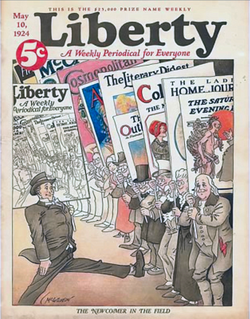
The first issue is dated 10 May 1924 and cost five cents. The cover cartoon is called The Newcomer in the Field, and it shows a crowd of vendors at a newsstand holding up the competition, Collier's and The Saturday Evening Post among them, while a small figure at the front waves the new one. A banner across the top reads THIS IS THE $20,000 PRIZE NAME WEEKLY. The magazine was telling you what it intended to do before it had done anything.
It mostly did it. Liberty got to enormous circulation and was described as the second greatest magazine in America, which is a strange compliment that means everyone knew who was first. It also lost money continuously. Over seven years the two cousins are believed to have dropped as much as twelve million dollars on it, and in 1931 they sold the whole thing to Bernarr Macfadden, the physical-culture publisher.
What went in the pages was everything. F. Scott Fitzgerald and P. G. Wodehouse wrote for it. So did Dashiell Hammett and Agatha Christie. Conan Doyle sold it the last six Sherlock Holmes stories in 1926 and 1927, including The Adventure of Shoscombe Old Place, which is the sixtieth and final one. James M. Cain serialized Double Indemnity across eight issues before it became the film. Between the fiction sat signed pieces by Albert Einstein and by Al Capone, because the editors would print anybody whose name moved copies.
~ the case file ~
| Born | 10 May 1924, five cents, A Weekly Periodical for Everyone |
|---|---|
| Peak | second in circulation only to The Saturday Evening Post |
| Killed | July 1950 |
| Lifespan | 26 years, 2 months |
| Made by | Robert R. McCormick and Joseph Medill Patterson |
| Killed by | a cover price rise, then advertising that never came back |
~ four minutes and forty seconds ~
Here is the thing Liberty is actually remembered for. At the head of every article it printed how long the article would take to read, down to the second. A review of Citizen Kane: four minutes and forty seconds. Mae West on being in jail: fourteen minutes.
The method was a man with a watch. A staff member read the piece and timed himself, then the figure was doubled on the theory that the reader was slower than the staff. It sat under the byline, so you could decide whether you had time for this one before the train arrived.
Every blogging platform I use now does this and calls it a feature. Medium turned it on by default in 2014 and the WordPress plugins followed, all of them dividing a word count by an assumed rate. Liberty did it with a stopwatch, ninety years earlier.
~ macfadden's decade ~
Macfadden ran Liberty from 1931 to 1941 and it was the strongest decade the magazine had. He was loudly for Franklin Roosevelt, and an article asserting that Roosevelt was physically fit to hold office may have moved real votes at a moment when the country was asking whether a man who had had polio could do the job.
It ended badly. In 1941 it came out that Macfadden had been overstating circulation by as many as twenty thousand copies to charge more for advertising. John Cuneo and the Kimberly-Clark paper company took over, corrected the figures, and found that the advertisers did not come back. Paul Hunter got it in 1944. In 1942 Liberty had followed the Saturday Evening Post from five cents to ten, and circulation fell to 1.4 million. It went monthly in 1947 and stopped with the July 1950 issue. A Canadian edition kept going into the mid-1960s under a string of owners, one of them Jack Kent Cooke.
~ seventeen thousand stories ~
Liberty did something unusual for its era: it bought all publishing and distribution rights to the work it printed, where the rest of the industry bought first serial rights only. In 1968 Dr. Seuss sued over cartoons he had sold the magazine in 1932, and lost. That ruling is why the Liberty Library Corporation today holds clear title to roughly seventeen thousand stories and fifteen thousand cartoons by people whose names are still worth money.
libertymagazine.com is live, calls itself America's Storyteller, and licenses that archive. Nothing new is published. The dead title is a rights portfolio now. A weekly that could not sell an advertisement in 1950 still sends invoices.
~ leave a rose ~
an anonymous tribute. one rose per visitor per day.
@}-->-- ... roses left here
~ leave a wreath ~
a rose fades by morning. a wreath stays on this grave for good, with your name on it.
paid once through stripe. payments are handled by OÜ Lakeview, the small company that keeps rip.so running. the money pays for the hosting and the nightly digging. adopt it and the headstone reads "maintained in memory by" you. the groundskeeper plants new wreaths at the next tending, usually within a day.
» one email a week: new graves and the anniversaries of the dead. subscribe
other news: Asiaweek, Linux Voice, Central Asia Online, MTV News
also died in the pre-1980s: Four Color, Polavision, Eckert-Mauchly Computer Corporation
~ leave a note ~
visitors before you have left these graveside notes. anonymous welcome.