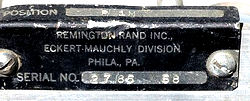
Eckert-Mauchly Computer Corporation
~ the last words ~
In March 1946, J. Presper Eckert and John Mauchly resigned from the Moore School of Electrical Engineering at the University of Pennsylvania rather than accept a new policy that would have required them to assign their patents to the university. Much of the senior engineering staff went out with them. They took an office at 1215 Walnut Street in Philadelphia and called the new outfit the Electronic Control Company, which was incorporated on 22 December 1947 as the Eckert-Mauchly Computer Corporation.
The two of them had built ENIAC, which is why anyone remembers either name. What they had not done was deliver a working machine on a schedule to a customer who was paying for it, and the company spent four years learning how different that job is. Their own estimates of delivery dates and costs proved optimistic. Every contract they signed was priced against a machine that did not exist yet.
Harry Straus of the American Totalisator Company put $500,000 into the company and kept it alive. Straus was killed in an airplane crash in October 1949 and American Totalisator's directors withdrew their support. In the same period the company lost its clearance for government work during an investigation into supposed communist infiltration. By early 1950 it was openly for sale, with National Cash Register and Remington Rand both circling. Remington Rand made the first offer and bought it on 15 February 1950.
I met this company as a footnote. ENIAC gets a chapter in every computer engineering course and UNIVAC gets the census photograph, but the four years in between, where two men tried to sell the thing and could not make the arithmetic come out, is the part nobody assigns.
~ the record ~
| Born | March 1946, as the Electronic Control Company, Philadelphia |
|---|---|
| Peak | BINAC delivered to Northrop in 1949, UNIVAC under contract |
| Killed | 15 February 1950 |
| Lifespan | Just under 4 years |
| Made by | J. Presper Eckert and John Mauchly |
| Killed by | Cost overruns, and the death of its investor Harry Straus |
~ the machine that came first ~
Before UNIVAC there was BINAC, a small machine built for the Northrop corporation and eventually delivered in 1949. It is remembered mostly as an argument. BINAC had worked fine in acceptance tests at the company's own shop, and was then taken apart for shipping to California, where Northrop refused to allow any Eckert-Mauchly employees onto the site to reassemble it.
Northrop's verdict was that the machine never worked well for them. Both accounts of why can be true together. What is clear is that the company delivered its first computer and got a dissatisfied customer out of it, at the moment it most needed a reference.
~ what remington bought ~
The UNIVAC that Remington Rand got for its money was not a product yet. Construction was completed by December 1950. The Census Bureau accepted the first one on 31 March 1951 and it was dedicated that 14 June, although the machine itself was not shipped until the following December. It had originally been priced at $159,000. By the end of the run a UNIVAC cost between $1.25 million and $1.5 million.
~ the name on the division ~
The founders' names came off the letterhead one layer at a time. The business went in under its own name, a subsidiary of Remington Rand, and was shortly relabeled the Eckert-Mauchly Division instead. After that it was simply the UNIVAC division, which is the name that survived the Sperry merger and lasted until 1975, when the division was renamed Sperry UNIVAC.
Counting from the incorporation, the corporation that carried both founders' names existed for two years and two months. The patents they had walked out of a university to keep ended up the property of a company that also made typewriters and electric shavers, and the ownership line from there runs through Sperry to Unisys, which is still trading.
~ leave a rose ~
an anonymous tribute. one rose per visitor per day.
@}-->-- ... roses left here
~ leave a wreath ~
a rose fades by morning. a wreath stays on this grave for good, with your name on it.
paid once through stripe. payments are handled by OÜ Lakeview, the small company that keeps rip.so running. the money pays for the hosting and the nightly digging. adopt it and the headstone reads "maintained in memory by" you. the groundskeeper plants new wreaths at the next tending, usually within a day.
» one email a week: new graves and the anniversaries of the dead. subscribe
other gadgets: Automatic, Sequent Computer Systems, Sony LocationFree, Hercules Computer Technology
also died in the pre-1980s: Polavision, Electronic Video Recording, Electric Telegraph Company
~ leave a note ~
visitors before you have left these graveside notes. anonymous welcome.