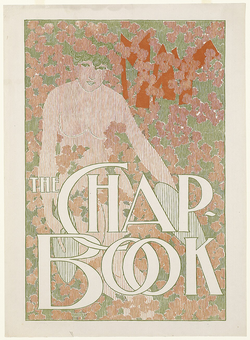
The Chap-Book
~ the obituary ~
It cost five cents and it fit in a coat pocket, which was the whole proposition. The Chap-Book came out of Cambridge, Massachusetts on 15 May 1894, put together by two Harvard men who had started a publishing firm the year before by selling a guidebook to the Chicago World's Fair. The name was borrowed from the cheap pamphlets peddlers used to carry around rural England, and the magazine was designed to look like one on purpose.
The firm moved to Chicago in August 1894 and the magazine went with it. It appeared on the first and fifteenth of every month without fail for four years. It printed Verlaine in July 1894, Mallarmé the following January, Stephen Crane's "Verses" in March 1896, and work by Henry James, Max Beerbohm, H. G. Wells, Robert Louis Stevenson, Kenneth Grahame, Yeats and Hardy, in a format that at the start was barely bigger than a postcard.
The print run is recorded inside the magazine itself. It states 10,000 copies for the number of 1 December 1894, then 12,500 for the issues that followed through February 1895. That is a real audience for a pamphlet of poems and book notices, and it was enough to turn the magazine into something worth copying across the entire country within a year of launch.
~ the case file ~
| Born | 15 May 1894, Cambridge, Massachusetts, five cents a copy |
|---|---|
| Peak | 12,500 copies an issue over the winter of 1894 into 1895 |
| Killed | 1 July 1898, volume IX number 4 |
| Lifespan | 4 years, 100 numbers |
| Made by | Herbert Stuart Stone and Hannibal Ingalls Kimball |
| Killed by | its own editors, who preferred the book side |
~ bradley's posters ~
Will Bradley made seven posters to advertise it between 1894 and 1895, and they outlived everything printed inside. "The Twins" came in August 1894, "The Blue Lady" later that year, "The Poet and His Lady" in January 1895, then "May", "The Pipes", "Pegasus" and a Thanksgiving number. The May poster is a woman's head rising out of a field of orange and green stippling, the word MAY cut into the top corner in orange, the title set in enormous hand-drawn letters across the lower half, and BRADLEY signed small at the foot.
These hang in museums now. Frank Hazenplug and Claude Fayette Bragdon drew for it too, and Bragdon did the decorations for the Notes department. The posters have become a standard reference point for American graphic design of the 1890s.
~ the imitators ~
The last issue contains the magazine's own summary of what it had set off: there was scarcely a village or town which did not have its little individualistic pamphlet frankly imitating the form and tone of The Chap-Book. Counts of these things vary, and nobody has a firm one, but roughly three hundred of them appeared in the United States between 1894 and about 1903. The trade called them ephemerals or bibelots, and most lasted a handful of issues.
The Chap-Book itself did not stay small. On 15 January 1897 it dropped the pocket format for quarto and added a book-review department, and in February 1898 it moved to smooth paper with illustrations. The cover price doubled to ten cents around the same time Herbert Stone bought the magazine out of the partnership and put his own imprint on it, in May 1896. By the end the thing imitating a peddler's pamphlet was a conventional literary review.
~ the sale ~
The notice in the number of 1 July 1898 is a model of how to close a magazine. Instead of the July 15th issue of The Chap-Book, it says, subscribers will receive the issue of The Dial for the same date. The Dial had bought the subscription list and the goodwill along with it, and The Chap-Book called the buyer the best purely critical journal in America on the way out. The stated reason for stopping was that the editors' time was better spent on the books.
Herbert Stone kept publishing in Chicago until 7 May 1915, when he went down with the Lusitania at about forty three. The firm's other half, Kimball, had gone to New York years earlier. chapbook.org today is a Namecheap parking page carrying a domain auction pitch.
~ a hundred numbers later ~
The sentence about every village having its own pamphlet is the part I recognize. By 1999 I had a modem and the habit of reading other people's homepages, and any well-built one would generate dozens of worse copies within a couple of months: same layout logic, same fonts, nothing worth reading. The Chicago version cost a nickel and mine cost whatever the phone call cost, and the impulse behind both is that making the object is most of the pleasure.
What the 1890s had and the late 1990s did not was a sale price at the end. Stone and Kimball could hand a subscription list to a competitor and walk away with money. Every personal site from my era that stopped updating simply stopped, and then the hosting lapsed. Nothing bought the goodwill. The Chap-Book got a hundred numbers and an obituary it wrote for itself. The posters are still on walls a hundred and thirty years later.
~ leave a rose ~
an anonymous tribute. one rose per visitor per day.
@}-->-- ... roses left here
~ leave a wreath ~
a rose fades by morning. a wreath stays on this grave for good, with your name on it.
paid once through stripe. payments are handled by OÜ Lakeview, the small company that keeps rip.so running. the money pays for the hosting and the nightly digging. adopt it and the headstone reads "maintained in memory by" you. the groundskeeper plants new wreaths at the next tending, usually within a day.
» one email a week: new graves and the anniversaries of the dead. subscribe
other news: London Daily News, St. Nicholas, Stand News, TUNeZINE
also died in the pre-1980s: St. Nicholas, Camera Work, Judge
~ leave a note ~
visitors before you have left these graveside notes. anonymous welcome.