The Knickerbocker
~ the goodbye ~
The earliest recorded version of "why did the chicken cross the road" appeared in this magazine. So did "Mocha Dick, or The White Whale of the Pacific", Jeremiah Reynolds's account of a white sperm whale repeatedly sighted near the island of Mocha off Chile, which is where Melville's whale came from. So did Francis Parkman's The Oregon Trail, in twenty one installments. For about twenty years a disproportionate amount of what American readers thought of as American literature came out of one monthly office in New York.
It was founded in January 1833 by Charles Fenno Hoffman, who edited three issues and handed it on. The second owner, Timothy Flint, changed the spelling from Knickerbacker to Knickerbocker and then sold it in April 1834 to Lewis Gaylord Clark, who ran it for the next twenty seven years. Clark's own columns, the "Editor's Table" and "Gossip with Readers and Correspondents", were what most subscribers actually opened it for.
Washington Irving joined the staff in 1839 at $2,000 a year, and hated it. He disliked monthly deadlines and he disliked having a word count, and he said so in his first piece, explaining that he was tired of writing volumes with all their preparation and parade and had decided to secure himself a snug corner in some periodical where he could loll at his ease in an elbow chair. He stayed two years. The magazine's name was his anyway: Diedrich Knickerbocker was the invented Dutch historian Irving had used in 1809 to sell A History of New-York, promoted by planting missing-person notices about him in the city's newspapers.
~ the chronicle ~
| Born | January 1833, founded by Charles Fenno Hoffman, who lasted three issues |
|---|---|
| Peak | by 1840 the most influential literary magazine in the United States |
| Killed | October 1865, after four title changes in three years |
| Lifespan | 32 years, two bound volumes a year for most of them |
| Made by | Lewis Gaylord Clark, editor and publisher from April 1834 |
| Killed by | the war, its editor's departure and plain lack of money |
~ what the cover was doing ~
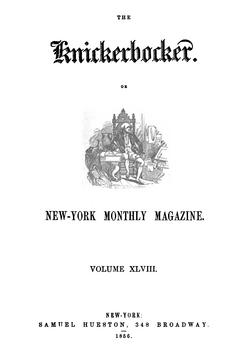
A surviving title page from 1856 reads The Knickerbocker, or New-York Monthly Magazine, Volume XLVIII, published by Samuel Hueston at 348 Broadway. Two volumes a year from 1833 puts volume 48 in the second half of 1856, so the numbering checks out against the founding date without needing a source. The vignette in the middle is Diedrich Knickerbocker himself, in buckled shoes, sitting in a carved chair surrounded by heaps of paper.
Being named after a joke character who had been used to hoax the New York press was the magazine's founding position, and it never really dropped it. "Knickerbocker" also meant the city's old Dutch-descended gentry, which was close enough to the readership for the title to work as a promise.
That word reached me, and reached most of the world, as a basketball team. Turkish sports television in the 2000s said Knicks several hundred times a season and Knickerbocker approximately never, and the magazine that made the name worth borrowing had been shut for 140 years by then. Irving invented a Dutch historian to sell a book in 1809, and what still circulates daily is a clipped form of that name on a franchise at Madison Square Garden.
~ how the war took it ~
Clark stepped down late in 1861 and in March 1862 launched a competitor called Clark's Knickerbocker, which he wanted kept clear of what he described as the spirit of abolition that had got into the original. His old magazine passed through Kinahan Cornwallis, then J. Holmes Agnew, then A. J. H. Duganne, and renamed itself on the way: The Knickerbocker Monthly from 1863 to February 1864, The American Monthly Knickerbocker from March to December 1864, The American Monthly for the first half of 1865, and finally The Fœderal American Monthly from July. The last number came out in October 1865.
The renamings read like a title trying to shed an association it could no longer afford. The Knickerbocker name had been worth money for thirty years because it meant a particular kind of genteel New York literary world, and by 1863 that world was on both sides of a war. The old encyclopedias give a blunter cause, which is that the money ran out.
~ what survived ~
Clark came out of it better than the magazine did. When it folded, former contributors raised the money to buy him a house at Piermont on the Hudson, partly by publishing a volume of their own work called The Knickerbocker Gallery and handing him the proceeds. He spent his remaining years writing for the Evening Post and the Home Journal, and died in 1873. He had also spent a good part of his career trading insults in print with Edgar Allan Poe, a feud both men kept going in their own pages for years.
The full run is scanned and free at the Internet Archive and HathiTrust, and without that nobody would read a line of it. The chicken joke sits in the March 1847 number on page 283, and it is not the version anybody tells. The answer printed there was that a chicken crossing the road would be a fowl proceeding. A hundred and seventy nine years of retelling filed the pun off and kept the deadpan, and almost nothing else printed in these pages lasted that well.
~ leave a rose ~
an anonymous tribute. one rose per visitor per day.
@}-->-- ... roses left here
~ leave a wreath ~
a rose fades by morning. a wreath stays on this grave for good, with your name on it.
paid once through stripe. payments are handled by OÜ Lakeview, the small company that keeps rip.so running. the money pays for the hosting and the nightly digging. adopt it and the headstone reads "maintained in memory by" you. the groundskeeper plants new wreaths at the next tending, usually within a day.
» one email a week: new graves and the anniversaries of the dead. subscribe
other news: Knight Ridder, Al Hawza, SoftSide, 8000 Plus
also died in the pre-1980s: Television Electronic Disc, BBC Third Programme, The Dearborn Independent
~ leave a note ~
visitors before you have left these graveside notes. anonymous welcome.