Graham's Magazine
~ the last words ~
In December 1840 George Rex Graham bought Burton's Gentleman's Magazine for $3,500, which worked out to a dollar for each of its 3,500 subscribers, and merged it with Atkinson's Casket, which he already owned. That gave him a list of 5,000 names and a magazine whose first number is dated January 1841. He was 27, admitted to the Pennsylvania bar the year before and an apprentice cabinet-maker before that. The new monthly did not start at volume one, either: Graham kept the Casket's running count, so it opened at Volume XVIII.
His one real idea was the rate. Graham paid five dollars a page at a time when American magazines paid a dollar, and the figure became a unit of measurement among writers, who called it a Graham page. It worked immediately. William Cullen Bryant, Nathaniel Hawthorne, James Russell Lowell and Henry Wadsworth Longfellow all appeared. James Fenimore Cooper was the best paid of them, taking $1,600 for a serial and another $1,000 for a run of naval biographies. Graham liked to say that some issues cost him $1,500 in authorship alone, and the Saturday Evening Post reported that the engravings in the August 1841 number had cost $1,300 on their own.
He hired Edgar Allan Poe as critic and editor in February 1841 at $800 a year, and introduced him to readers in a sentence that manages to sound like a shrug: "Mr. POE is too well known in the literary world to require a word of commendation." Two months later Graham's printed "The Murders in the Rue Morgue", which is where detective fiction starts. Poe got his assistant editor to handle the correspondence, which left him time to write, and he spent the rest of it building the reputation for savagery that followed him around. Lowell said Poe sometimes mistook his bottle of prussic acid for his inkstand.
Poe left in April 1842 and later did the arithmetic out loud, setting his $800 against the $25,000 he believed Graham was clearing. Rufus Wilmot Griswold, who disliked him and would go on to write the obituary that poisoned his name for a century, took the chair at $1,000, two hundred more than Poe had been paid. Late in 1844 Poe offered Graham first publication of "The Raven" and Graham turned it down, though some accounts have him handing over fifteen dollars anyway as a kindness. He made it up later by printing "The Philosophy of Composition", the essay in which Poe explains how he wrote the poem Graham had passed on.
~ the record ~
| Born | January 1841 in Philadelphia, out of Burton's Gentleman's Magazine merged with Atkinson's Casket |
|---|---|
| Peak | 40,000 copies a month by March 1842, paying five dollars a page when the going rate was one |
| Killed | December 1858, with volume LIII |
| Lifespan | 18 years and 36 volumes, numbered XVIII to LIII |
| Made by | George Rex Graham, 134 Chestnut Street, Philadelphia |
| Killed by | Harper's New Monthly Magazine, against a magazine with no international copyright to defend it |
~ forty thousand a month ~
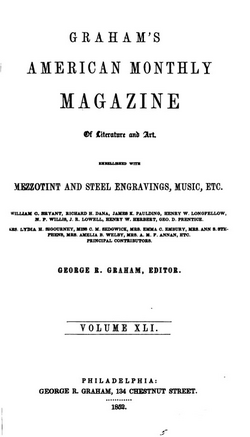
The 5,000 names Graham started with were 25,000 by the end of the first year and 40,000 copies a month by March 1842. John Sartain, who cut the engravings, thought the pictures were doing the work rather than the prose, and the magazine's own advertising agreed with him: the 1852 title page bills the thing as "EMBELLISHED WITH MEZZOTINT AND STEEL ENGRAVINGS, MUSIC, ETC." before it gets to the writers. Part of why that mattered is that most monthlies of the period were printing worn plates bought in from other magazines, and Graham was commissioning new ones. What the engravings showed was bridges and contented domestic scenes, calibrated to a readership he wanted to include rather than impress.
The generosity had limits, and they were printed. A notice in the May 1841 number warned contributors that anyone sending in an article "must state distinctly at the time of sending them, whether they expect pay", because no compensation would be allowed without a special contract agreed before publication. The notice closed by promising that the rule would hereafter be rigidly enforced. At the magazine famous for five dollars a page, silence from the author meant free.
~ volume forty-one ~
The 1852 title page is the cleanest artifact the magazine left. It reads GRAHAM'S AMERICAN MONTHLY MAGAZINE of Literature and Art, lists its principal contributors in small caps with Ann S. Stephens and Emma C. Embury among them, gives the editor as George R. Graham and the address as 134 Chestnut Street, and prints VOLUME XLI under the lot.
That number settles the death date, because the volumes ran two to a year. Volume XVIII opened in January 1841, which puts the first volume of 1852 at XL and the second at XLI, exactly what the page says. Push the same count forward and 1858 carries volumes LII and LIII, with LIII covering July to December. The Edgar Allan Poe Society's bibliography lists the run as volumes XVIII to LIII, January 1841 to December 1858, while its own prose on the same page says the magazine "finally closed in 1857". The volume count is the harder evidence and it closes on December 1858.
~ the cheaper rival ~
Graham lost the magazine the way people lost things in that decade, through the market. Bad copper investments forced him to sell his controlling interest in 1848 to Samuel Dewee Patterson, though he kept the editor's title. Sartain left the next year to start a magazine of his own. Friends helped Graham recover enough money to buy his way back in around March 1850, and he walked back into a different competition: Harper's New Monthly Magazine had launched that same year, and it was cheaper because it reprinted British writing it did not have to pay for. There was no international copyright to stop it. Graham's entire model had been paying American authors more than anyone else, and he was now competing with a rival whose authors cost nothing at all.
Charles Godfrey Leland took the editorship when Graham left for good in 1853 or 1854, and the title kept changing as the magazine chased a market that had moved on, ending as Graham's Illustrated Magazine of Literature, Romance, Art, and Fashion. The last volume ran out in December 1858.
Before that happened Graham used the magazine for one piece of unfinished business. Poe died in 1849 and Griswold, the editor Graham had hired to replace him, spent the years afterward building the portrait of a drunk and a degenerate that stuck to Poe's name for most of a century. Graham ran "Defense of Poe" in March 1850 and came back to it in February 1854 with "The Genius and Characteristics of the Late Edgar Allan Poe". He went blind at seventy, had part of his sight restored by an operation, and was living on help from the publisher George William Childs when he died in a hospital in Orange, New Jersey on 13 July 1894, thirty-six years after his magazine.
~ leave a rose ~
an anonymous tribute. one rose per visitor per day.
@}-->-- ... roses left here
~ leave a wreath ~
a rose fades by morning. a wreath stays on this grave for good, with your name on it.
paid once through stripe. payments are handled by OÜ Lakeview, the small company that keeps rip.so running. the money pays for the hosting and the nightly digging. adopt it and the headstone reads "maintained in memory by" you. the groundskeeper plants new wreaths at the next tending, usually within a day.
» one email a week: new graves and the anniversaries of the dead. subscribe
other news: Games-X, Mega, BYTE Magazine, Pegasus News
also died in the pre-1980s: Woman's Home Companion, Simulmatics Corporation, The Morning Post (London)
~ leave a note ~
visitors before you have left these graveside notes. anonymous welcome.