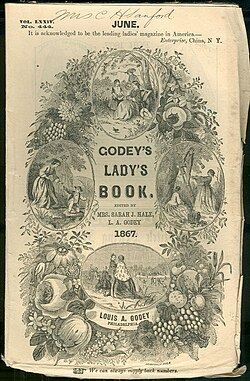
Godey's Lady's Book
~ the goodbye ~
Louis A. Godey started The Lady's Book in Philadelphia in 1830, patterned on English women's magazines and in large part lifted straight out of them, which was ordinary practice at the time. By 1836 he could claim with fair accuracy that his magazine had a much larger circulation than any other monthly in the country, and that same year he announced he would pay the highest rates in America for original contributions. In 1837 he merged with the Boston Ladies' Magazine and hired its editor, Sarah Josepha Hale, who stayed in the chair for forty years.
What subscribers got for $3 a year, against $2 for the Saturday Evening Post, was a hand-tinted fashion plate at the front of each number and a sheet of piano music carrying the latest waltz or polka. From 1853 nearly every issue also came with a pattern and measurements, so a garment could be made at home. Godey said in 1859 that producing the Lady's Book cost him $105,200 that year, $8,000 of it on coloring the plates alone. Circulation reached 63,000 by 1851, about twice its nearest rival, and 150,000 by 1860. In 1845 he had begun copyrighting each issue, a first in American publishing; the editors of the Baltimore Saturday Visiter called it a narrowly selfish course and said he would rue it bitterly.
Hale used the circulation for things Godey had not asked for. She started an "Employment for Women" department in 1852 and helped raise money for Vassar. In 1858 she petitioned President Buchanan to make Thanksgiving a national holiday, running the roast turkey and pumpkin pie articles that set what the table was supposed to look like. Godey sold the magazine in 1877 to John Hill Seyes Haulenbeek and Hale retired the same year. He died on 29 November 1878 with a fortune estimated at a million dollars.
Thanksgiving is not on any calendar I have lived by, and it had never occurred to me that the campaign to invent it ran for years inside a fashion monthly before any president agreed to it. The reach of the thing was strange. A publisher in Philadelphia was telling a country what to wear and what to play on the piano after dinner, and then also when to eat.
~ the chronicle ~
| Born | 1830, Philadelphia, as The Lady's Book, much of it reprinted from English magazines |
|---|---|
| Peak | 150,000 subscribers by 1860, at $3 a year |
| Killed | August 1898, absorbed by The Puritan |
| Lifespan | 68 years, 137 volumes |
| Made by | Louis A. Godey, with Sarah Josepha Hale editing from 1837 |
| Killed by | outliving its founder by twenty years under owners nobody can name |
~ the plate at the front ~
A surviving cover from June 1867 is volume 74, number 6, and it tells you how the magazine sold itself. Above the title there is a one-line endorsement lifted from a small New York paper: "It is acknowledged to be the leading ladies' magazine in America." Under the title, both names, Mrs. Sarah J. Hale and L. A. Godey, printed as joint editors. At the foot of the wrapper, in small type, a promise that back numbers can always be supplied.
That last line is a business model in six words. A magazine with bound annual volumes and a standing back-catalog is selling a library, which is why complete runs of Godey's still sit in good condition on library shelves while the newspapers of the same decade survive as microfilm.
~ the war it would not print ~
Godey kept politics out of the magazine on principle and enforced it. In the 1850s he dismissed his assistant editor Sara Jane Lippincott, who wrote as Grace Greenwood, for denouncing slavery in the National Era, then recanted after she said so publicly. When the Civil War came he forbade the magazine from taking any position at all, and it went further than that: it made no acknowledgment of the war whatsoever.
Readers went elsewhere for the news, as readers do, and Godey's lost roughly a third of its subscribers. The magazine survived that and never again reached the 1860 number.
~ three death dates ~
English Wikipedia's prose says the magazine ceased in 1896. Its own category files it under magazines disestablished in 1878, which is not when it stopped, it is when Louis Godey died. The Online Books Page, which lists the surviving scanned run, says it ceased in 1898 and was absorbed by a magazine called The Puritan, and the volume count agrees: the last one is number 137, dated August 1898.
So the real end is twenty years after the founder's, under the shorter title Godey's Magazine, in New York, with several owners in between whose names only turn up in family histories. The record keeps sliding back to 1878 because that is the last year anyone was paying attention.
~ leave a rose ~
an anonymous tribute. one rose per visitor per day.
@}-->-- ... roses left here
~ leave a wreath ~
a rose fades by morning. a wreath stays on this grave for good, with your name on it.
paid once through stripe. payments are handled by OÜ Lakeview, the small company that keeps rip.so running. the money pays for the hosting and the nightly digging. adopt it and the headstone reads "maintained in memory by" you. the groundskeeper plants new wreaths at the next tending, usually within a day.
» one email a week: new graves and the anniversaries of the dead. subscribe
other news: Superjuegos, McCall's, CBS News Radio, SVM Mac
also died in the pre-1980s: Simplicissimus, Die Gartenlaube, IMSAI 8080
~ leave a note ~
visitors before you have left these graveside notes. anonymous welcome.