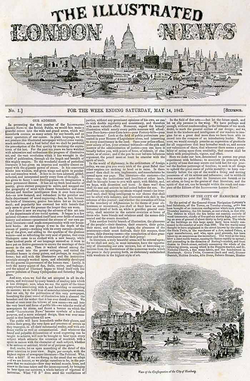
The Illustrated London News
~ the obituary ~
Herbert Ingram sold newspapers in Nottingham and noticed that the ones with pictures in them sold better. That was the whole insight. He moved to London and rented an office, hiring artists alongside reporters. On Saturday 14 May 1842 he put out a sixteen-page weekly carrying thirty-two wood engravings, timed so the lead piece could cover Queen Victoria's first masquerade ball. The rest of that opening issue covered the war in Afghanistan, the Versailles rail crash, the candidates in the American presidential election, crime reports and theater reviews. It cost sixpence and sold 26,000 copies.
The second issue did badly, and the third worse, so Ingram mailed a free copy of the Archbishop of Canterbury's installation number to every clergyman in the country and converted a large number of them into subscribers. Circulation went to 40,000, and twelve months in it was 60,000. In 1851 the paper printed Joseph Paxton's designs for the Crystal Palace before Prince Albert had seen them and sales reached 130,000. The Duke of Wellington's funeral took it to 150,000 in 1852. In 1855 it reproduced some of Roger Fenton's photographs from the Crimea, the newspaper stamp tax came off in the same year, and it was selling 200,000 a week. By 1863 it was over 300,000, a figure no other British paper was near.
Ingram himself drowned on 8 September 1860 when a paddle steamer went down on Lake Michigan, eighteen years into the thing he had started. His grandson Bruce Ingram took the editor's chair in 1900 at the age of twenty-three and kept it until he died in 1963, sixty-three years later, which made him the longest-serving editor of his day. By then the end was already visible. Television was emptying out the illustrated weeklies one title at a time, and in 1961 the company was sold to Roy Thomson's International Thomson, which closed the sister papers off one by one.
~ the case file ~
| Born | 14 May 1842, London, sixpence for sixteen pages |
|---|---|
| Peak | over 300,000 copies a week by 1863 |
| Killed | 2003, one issue after a relaunch |
| Lifespan | 161 years |
| Made by | Herbert Ingram, a Nottingham newsagent |
| Killed by | a century of falling frequency |
~ what a picture was worth ~
It is hard to hold onto now, but for about fifty years this paper was one of the only ways to see a thing you had not been present for. An artist in the field sent back a sketch and an engraver cut it into a block by hand. A week or two later a reader in London could look at the Crimea. Rivals appeared almost immediately. Ingram bought several of them and folded them in, which was cheaper than competing, and his family went on doing that for decades.
My own economy of pictures ran the opposite way. In 2003, the year this magazine finally gave up, a photograph of almost anything cost me nothing except the wait, and the wait was short enough that I stopped counting it. The ILN had been built on the reverse proposition, that a picture of an event is scarce and worth sixpence. That proposition had been dead for most of a century before the magazine stopped acting on it.
~ four a year, then two ~
Most dead publications stop. This one tapered. Weekly publication held until 1971, when it went monthly with longer pieces and a narrower selection of events. In the late 1980s it dropped to four issues a year. In 1994 it went to two, and the publishing company's attention moved to a magazine it produced for Orient Express. The last Christmas number came out in 2001.
Then in 2003 somebody tried again. Mark Palmer edited a relaunch issue. It came out, nothing followed it, and 161 years of publication stopped there. One number, no second number.
~ the archive is the business now ~
Illustrated London News Ltd still exists in London as a content and digital agency, and what it actually owns is the paper trail: the publication archive of the ILN and of the seven sister titles that went before it. Gale digitized the complete 1842 to 2003 run in 2010. iln.org.uk today answers with something called the Illustrated London News Archive Digital Museum, which sells subscriptions to the back catalog. The magazine has not published in twenty-three years. The engravings are a licensing business now, and in 2014 the company put the complete 1914 to 1918 run of all eight titles online for nothing to mark the war's centenary.
~ leave a rose ~
an anonymous tribute. one rose per visitor per day.
@}-->-- ... roses left here
~ leave a wreath ~
a rose fades by morning. a wreath stays on this grave for good, with your name on it.
paid once through stripe. payments are handled by OÜ Lakeview, the small company that keeps rip.so running. the money pays for the hosting and the nightly digging. adopt it and the headstone reads "maintained in memory by" you. the groundskeeper plants new wreaths at the next tending, usually within a day.
» one email a week: new graves and the anniversaries of the dead. subscribe
other news: HuffPost Québec, Bravo Screenfun, PublicPost, TNN 滔新聞
also died in the 2000s: easyInternetCafé, Oingo, Nullsoft
~ leave a note ~
visitors before you have left these graveside notes. anonymous welcome.