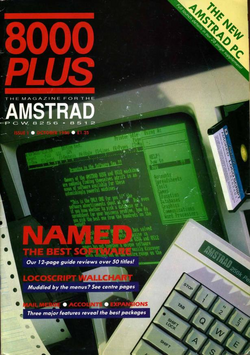
8000 Plus
~ the eulogy ~
This was a magazine for novelists and for people running a small business out of a spare bedroom, which is not a readership I have ever belonged to. The Amstrad PCW was barely a home computer. Alan Sugar had noticed that most people buying computers in Britain were using them to type, so he sold them a complete machine with the printer already in the box, for £399. It worked. Millions of PCWs went out over thirteen years, largely into households that would not have described themselves as computer people at all.
Future Publishing had one magazine when this started. In October 1986 it split off two more, and 8000 Plus went to the PCW, named for the 8256 and 8512 model numbers printed across the top of its own cover. Issue 1 cost £1.25 and was run out of Somerton in Somerset by Chris Anderson, who had founded the company the year before and would later spend two decades running TED.
The contents list from that first issue is the readership in miniature: mail merging, touch typing, disc handling, a LocoScript wallchart, a six-page guide to accounts packages. Games appear once, hedged in the blurb as titles which might tempt you away from an evening's word processing. The audited circulation sat around 30,000 at the end of the eighties, against an installed base the magazine itself put at 550,000 machines.
~ the dossier ~
| Born | October 1986, issue 1 at £1.25, edited by Future's founder Chris Anderson |
|---|---|
| Peak | about 30,000 copies in 1989, for a machine with 550,000 British users |
| Killed | December 1996, at issue 124, under the title PCW Plus |
| Lifespan | ten years and three months, 124 issues under two names |
| Made by | Future Publishing, from Somerton in Somerset and later Bath |
| Killed by | Future, with roughly a week's notice to its own editorial staff |
~ typeset on the machine it was about ~
Issue 1 explained how the magazine was made, and the answer was: on PCWs. Every word was written and edited on the machines being covered, and the typesetters in Street took the Amstrad discs directly without rekeying anything. So a magazine about a word processor was produced start to finish on that word processor, and the staff met the same limits as the readers in the same week.
The longest-serving name in it was David Langford, who had a column from the early issues to the last one and whose brief, in his own account, was to talk about being a writer, talk about writing on the PCW, make some jokes, and never say an unkind word about Alan Sugar. When the columns were collected into a book in 2009 he described them as being about the horrors of freelance life, with occasional duty mentions of the computers which were the magazines' focus. Duty mentions. That is the readership in two words: people who had bought a machine to produce pages with, and who wanted company more than they wanted benchmarks.
~ the cartoon in issue one ~
Somewhere in that first October 1986 issue sits a cartoon with the caption "NO, I DON'T THINK IT'S A GOOD IDEA TO CALL THE NEW MAGAZINE 'PCW'". Five years and two months later, Sophie Lankenau used her Christmas editorial to announce that from the January issue the magazine would be called PCW Plus.
She was careful about what kind of event it was. "This is not the launch of a new magazine, or a re-launch of 8000 Plus. It is just a simple but significant change of name." The reason was that the title had been built out of two model numbers and Amstrad had since shipped three more machines, so the back page promised a name that would embrace owners of all five PCWs in the range. Issue 63, December 1991, was the last to carry the old masthead. Issue 64 carried the new one, with the numbering and the staff unchanged.
~ 2 November 1996 ~
The end arrived on a newsgroup. Langford dates it precisely: the news that Future had axed the magazine reached the PCW world on comp.sys.amstrad.8bit on 2 November 1996, and the editorial staff had been told roughly a week before the final issue went to press. His own last column was a routine piece about bad prose in science fiction, with no goodbye in it, because nobody had told him either. Future never sent him a copy of the issue it appeared in.
What replaced it was not a Future product. PCW Today was a subscription-only magazine run out of a house in Middlesbrough, eight pounds a year, cheques and postal orders only, and it hired the people Future had just let go. It claimed around 3,500 readers, which is roughly a tenth of what 8000 Plus had been selling in 1989 and was apparently enough. Langford's column resumed there in 1997 and ran until February 2002, outliving by five years the magazine that commissioned it.
~ leave a rose ~
an anonymous tribute. one rose per visitor per day.
@}-->-- ... roses left here
~ leave a wreath ~
a rose fades by morning. a wreath stays on this grave for good, with your name on it.
paid once through stripe. payments are handled by OÜ Lakeview, the small company that keeps rip.so running. the money pays for the hosting and the nightly digging. adopt it and the headstone reads "maintained in memory by" you. the groundskeeper plants new wreaths at the next tending, usually within a day.
» one email a week: new graves and the anniversaries of the dead. subscribe
other news: OS/2 e-Zine, SoftSide, Knight Ridder, The 405
also died in the 1990s: Pyramid Technology, Softlanding Linux System, Votrax
~ leave a note ~
visitors before you have left these graveside notes. anonymous welcome.